
The Fifth of November
Chapter VI — The Decision
← Liam Barrantine / The Fifth of November
The rain had stopped by midnight. Rooke sat alone in the kitchen, the phone on the table before him. He had written a short message explaining that he possessed information about a possible planned attack. He had included his name and asked for a secure way to speak to an officer. He had not sent it. Every time he looked at the screen, he found another reason to wait.
He wanted to know whether Shaw would contact the authorities. He wanted to know who had sent the anonymous warning. He wanted to know whether the plan could be abandoned without drawing attention to everyone involved. Above all, he wanted to believe that there was still a way to separate himself from what had happened. The difficulty was that he could no longer identify the point at which that separation might have occurred.
He had attended the meetings. He had listened to the discussions. He had helped the others think through their decisions. He had watched the plan become more serious while telling himself that his involvement gave him some control over it. Now he understood that he had mistaken access for authority. He could influence the others, perhaps. He could argue with Mercer and persuade Vale to reconsider. But he could not undo the choices they had already made, and he could not guarantee that the men would listen to him when the moment arrived.
At half past midnight, he sent the message. It was only a few lines. He stated that he believed a group of men was preparing a serious act of violence in early November. He identified the house in Alwoodley where they had been meeting and explained that he was willing to provide further information. Then he put the phone down.
Nothing happened. No sirens sounded outside. No one knocked at the door. The house remained dark and quiet, and the city beyond it slept. For several minutes, Rooke felt almost foolish. He had expected the act of sending the message to change something immediately, to mark a boundary between his former life and whatever came next. Instead, the room looked exactly as it had before. The same chairs stood around the table. The same documents lay on the desk. The same brass clock displayed the same unmoving hands.
He made himself a cup of tea.
At one twelve, his phone rang. He answered.
"Mr Rooke?"
"Yes."
"My name is Detective Inspector Helen Ward. I'm calling in response to the message you sent."
Rooke gripped the edge of the table.
"Yes."
"I need to ask you some questions about the information you've provided."
"Of course."
"Are you somewhere safe to speak?"
He looked towards the dark hallway.
"I believe so."
"Are you currently at the address you mentioned?"
Rooke hesitated.
"Yes."
There was a pause at the other end.
"Is anyone else there with you?"
"No."
"Has anyone threatened you?"
"Not directly."
"Mr Rooke, I need you to be precise. If you believe that a serious offence is being planned, we need to understand what you know and how you know it. We also need to establish whether there is any immediate danger."
Rooke closed his eyes. He began at the beginning. He explained how he had met Mercer, how the early discussions had developed and how the group had gradually moved from political grievances towards a plan intended to cause widespread alarm. He described the meetings, the arguments and the growing unease among the men. He was careful not to pretend that he knew everything. There were decisions Mercer had kept to himself, conversations Rooke had not attended and details he could not verify. Ward listened without interrupting. When he had finished, she asked him to repeat the date.
"Five November," he said.
"And you're certain that is the date they have discussed?"
"Yes."
"Have they discussed a specific target?"
Rooke told her what he knew. The silence that followed was different from the earlier pauses. He could almost hear the detective rearranging the information in her mind, separating what had been reported from what remained uncertain.
"Mr Rooke, I want you to understand that we will need to establish the facts independently. We cannot assume that every part of what you've told us is accurate."
"I understand."
"We will also need to speak to you in person."
"Of course."
"Do not contact the other people involved to warn them that you have spoken to us. Do not attempt to investigate this yourself. If you receive any further messages or become aware of an immediate threat, contact the police straight away."
Rooke looked towards the window.
"Are you going to the house?"
"I can't discuss operational decisions with you over the phone."
He understood what that meant.
"Will you stop them?"
"We will assess the information and act as appropriate."
The call ended.
Rooke remained at the table, listening to the silence. He had expected fear. He had expected regret. What he felt instead was a curious mixture of relief and dread, as though he had handed over something too heavy to carry and discovered that its weight had not disappeared merely because someone else had agreed to take it.
At two thirty, he heard a car pass slowly along the road. He stood and looked through the curtain. The street was empty. He checked the front door, then the back door, and went upstairs. He did not sleep.
At six fifteen, he drove away from the house. The sky was beginning to lighten over Leeds. He passed the familiar streets of Alwoodley, the houses and gardens, the shops preparing to open for the day. At the junction, a bus pulled out in front of him. He followed it for several minutes before turning towards the city centre. He had no clear destination. He only knew that he could not remain in the house and continue pretending that the events unfolding there were separate from his own life.
Near the station, he parked and called Lawson.
"I've spoken to the police," he said.
Lawson did not answer immediately.
"Good."
"That's all?"
"What else do you want me to say?"
"I don't know."
"You did what you should have done."
Rooke looked through the windscreen at the morning traffic.
"I may have waited too long."
"Perhaps. But waiting longer wouldn't have improved it."
After the call, Rooke walked through the station concourse. People were gathering beneath the departure boards, checking their phones and buying coffee before their trains arrived. A child complained about being tired. A woman apologised as she hurried past him. Somewhere, a train announcement echoed through the building.
He found himself watching the crowd. None of these people knew what was being planned. None knew that a group of men had spent months convincing themselves that a violent act would somehow repair the country. They were simply going about their lives, trusting that the systems around them would continue to function. Rooke wondered whether he had ever understood the significance of that trust. It was easy to condemn institutions when they failed. It was harder to recognise how much ordinary life depended upon thousands of people choosing not to abuse their power, not to exploit a weakness and not to turn a grievance into a weapon.
His phone vibrated. A message from Mercer appeared on the screen.
We need to talk. Today.
Rooke read it without replying. Another message followed.
I know you've been asking questions.
He felt the blood drain from his face. For several seconds, he stood motionless in the middle of the concourse. Around him, people continued to move towards the platforms. The departure boards changed. A train arrived, and the crowd shifted towards the barriers. Then a third message appeared.
You have made a serious mistake.
Rooke put the phone in his pocket. He knew that Mercer might be bluffing. He knew that the messages did not prove that his involvement had been discovered. He knew that fear could turn uncertainty into apparent certainty, just as certainty had helped create the conspiracy in the first place. But he also knew that the next conversation would be different from all the others. The warning had been sent. The police had been contacted. And somewhere in Alwoodley, Stephen Mercer was beginning to understand that the men around him might no longer be prepared to follow him.
Rooke walked towards the exit. The morning had brightened, though the sky remained heavy with cloud. The city was fully awake now, its roads filling with traffic and its pavements with people hurrying to work. Five November was approaching. For the first time, Rooke hoped it would arrive without becoming a date that the country would remember for the wrong reasons.
End of Part Two
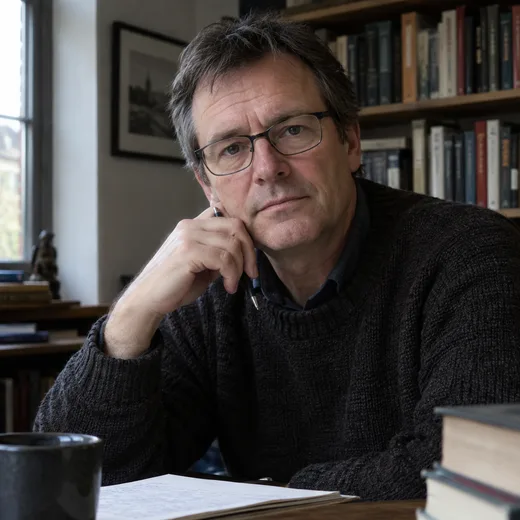
About Liam Barrantine
Liam Barrantine is 56 and lives in North Yorkshire with his family. He holds a degree in criminology and worked for many years as a forensic investigator, an experience which informs the procedural detail and the slow unravelling of evidence in his fiction. He has a particular interest in murder mysteries, the mechanics of a crime, the inconsistencies in witness accounts, the small things that do not fit. The Rain Over Leeds is his first novel.
Author Page
Reader Comments
Leave a Comment or a Book Review
We would love to hear your thoughts on this chapter, or even a complete book review.