
The Fifth of November
Chapter V — A Question of Loyalty
← Liam Barrantine / The Fifth of November
The meeting began at seven minutes past seven. Mercer had insisted that everyone arrive separately, although the instruction had done little to disguise the fact that they were all gathering at the same address. Rooke watched from the upstairs window as the cars appeared along the road and their occupants made their way to the front door. Matthew Vale arrived first. Andrew Shaw followed ten minutes later, carrying a small rucksack. Mercer came last.
He entered the room without removing his coat and placed a sheet of paper on the table.
"Someone has been talking," he said.
Vale looked at Shaw.
"Do you know something we don't?"
Shaw frowned.
"Why are you looking at me?"
"Because you've been quiet for days."
"I've been working."
"You haven't answered my messages."
"I've been working," Shaw repeated.
Mercer raised a hand.
"Enough."
The room fell silent. He looked around the table, making a point of meeting each man's eyes.
"We have a serious problem. Information about this group has reached someone outside it. We need to establish how much they know, who they have told and whether the plan has been compromised."
Rooke leaned forward.
"Then we need to stop discussing the plan here."
Mercer ignored him.
"We also need to know whether anyone has acted independently."
Vale stared at the sheet of paper.
"What's that?"
"A summary of the messages."
"Where did you get them?"
"From someone who has access to them."
Rooke felt a familiar tightening in his stomach.
"You've seen the original messages?"
"No."
"Then how do you know they're genuine?"
Mercer looked at him with open irritation.
"Must every statement be turned into an interrogation?"
"If we're trying to establish what happened, yes."
For several seconds, neither man spoke. Shaw broke the silence.
"Perhaps we should ask the obvious question. What if one of us has contacted the police?"
Vale shook his head.
"Why would anyone do that?"
"Because they changed their mind."
Mercer turned towards Shaw.
"Have you?"
"No."
"Then you have nothing to worry about."
Shaw gave a short, humourless laugh.
"That isn't how it works, Stephen."
Mercer pulled out a chair and sat down. He seemed suddenly older. His face had lost some of its colour, and the confidence with which he had entered the room had been replaced by something more brittle.
"You don't understand what is at stake," he said.
"Then explain it," Vale replied.
Mercer looked at him.
"We have spent months preparing for an event that will force people to confront what they've chosen not to see. We have accepted risks. We have made sacrifices. If we retreat now, everything we have done will have been for nothing."
Rooke felt a wave of exhaustion.
"That's not a reason to continue."
Mercer turned sharply.
"What would you know about sacrifice?"
The question was delivered quietly, but its effect was immediate. Rooke thought about the evenings he had spent in this room, the conversations he had concealed from friends and colleagues, the gradual narrowing of his life around a secret he could no longer comfortably defend. He thought about how often he had described his involvement as temporary, a way of keeping the others within limits. He had sacrificed something, certainly. But sacrifice did not make a decision right.
"Nothing I've lost obliges me to lose more," he said.
Vale looked up. For a moment, Rooke thought the younger man might finally speak openly. Instead, Vale looked away.
Mercer stood and walked to the window. He pulled the curtain aside and examined the road.
"There's a car parked outside."
Shaw turned in his chair.
"Where?"
"Opposite."
They all moved towards the window. A grey car stood near the pavement, its windows reflecting the streetlights. It was not unusual for vehicles to be parked along the road, and there was nothing about it that proved anyone inside was interested in the house. Nevertheless, the men stared at it as though the car itself had delivered the warning.
"Have you seen it before?" Vale asked.
"No," Mercer said.
Rooke studied the vehicle.
"Neither have I."
Shaw moved away from the window.
"This is ridiculous. We're treating an ordinary car as evidence of something."
"Then why are you frightened?" Mercer asked.
"I'm not."
"Your hands are shaking."
Shaw looked down. His fingers were trembling slightly. He pushed them into his pockets.
Mercer turned back towards the room.
"We need to know where everyone stands."
"I'm standing here," Shaw said. "That's all you need to know."
"No. I need to know whether you still believe in what we're doing."
Shaw stared at him.
"I believed that there was something worth changing. I believed that the people in charge had become so comfortable with their own authority that they no longer listened to anyone else. I believed that a public shock might force a debate that would otherwise never happen."
He paused.
"But I never believed that every decision we made was automatically justified because we had a grievance."
Mercer said nothing.
"I have a family," Shaw continued. "I have a job. I have people who depend on me. I am not prepared to destroy all of that because you want to prove that your life wasn't wasted."
The words seemed to surprise even Shaw himself. Vale looked down at the table. Rooke remained motionless.
Mercer walked back to his chair and picked up his coat.
"Then perhaps you should leave."
Shaw hesitated.
"Is that what you want?"
"I want people who understand what we're doing."
"And if I leave?"
Mercer looked at him.
"Then you leave."
Shaw took his rucksack and walked towards the door. Nobody tried to stop him. When the front door closed, Vale exhaled slowly.
"That's one less person."
"No," Rooke said. "That's one person who has finally said what he thinks."
Mercer turned on him.
"You seem determined to undermine everything."
"I'm trying to understand whether anything we're doing still makes sense."
"You agreed to the plan."
"I agreed to a discussion that became something else."
Mercer stared at him for a long moment. Then he spoke in a voice so quiet that Rooke had to lean forward to hear it.
"If you walk away now, Daniel, don't expect to walk back into your old life as though nothing happened."
Rooke looked at the man who had once persuaded him that he was helping to correct a broken system.
"I don't expect that," he said.
The meeting ended without agreement. Vale left first. Mercer remained behind, gathering his papers with unnecessary care. Rooke stood by the door, waiting for him to finish.
"You think you're doing the right thing," Mercer said.
"I think I should have asked myself that question sooner."
Mercer slipped the papers into his folder.
"It's easy to be wise when the moment has passed."
"No," Rooke said. "It's easy to pretend you were never wrong."
For a second, Mercer looked as though he might strike him. Instead, he picked up his coat and left.
Rooke locked the door behind him. The house was silent. He went upstairs and stood beside the stopped clock. He had begun to associate it with the meeting, with the date and with the strange conviction that events were moving towards a point beyond which nothing could be repaired. He reached towards it, then stopped. There was no significance in the clock. Only the significance he had given it.
He took out his phone and opened the number he had been given by the police contact he had quietly located that afternoon. His thumb hovered above the screen. He could still tell himself that he needed more information. He could still wait until the morning, speak to Lawson again or see whether Mercer would reconsider.
Instead, he began to type.
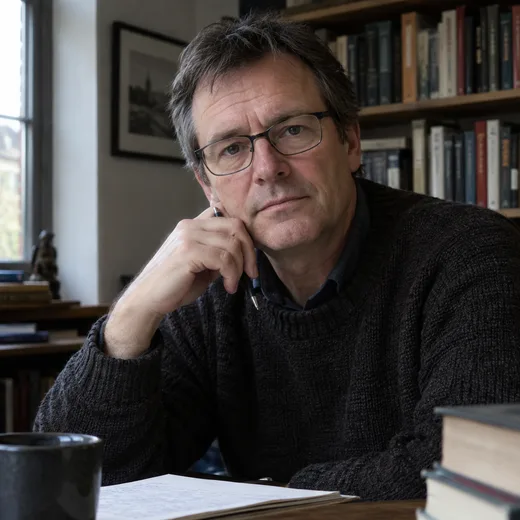
About Liam Barrantine
Liam Barrantine is 56 and lives in North Yorkshire with his family. He holds a degree in criminology and worked for many years as a forensic investigator, an experience which informs the procedural detail and the slow unravelling of evidence in his fiction. He has a particular interest in murder mysteries, the mechanics of a crime, the inconsistencies in witness accounts, the small things that do not fit. The Rain Over Leeds is his first novel.
Author Page
Reader Comments
Leave a Comment or a Book Review
We would love to hear your thoughts on this chapter, or even a complete book review.