
The Fifth of November
Chapter VII — The Search
← Liam Barrantine / The Fifth of November
By Wednesday morning, the house in Alwoodley had become a place of waiting. Daniel Rooke had not returned since leaving before dawn. His absence had been noticed, though nobody could agree on what it meant. Stephen Mercer had called him twice and received no answer. Matthew Vale had sent a message asking whether the meeting would still take place that evening. Neither man had received a reply.
Mercer took this as evidence of betrayal. He had always been inclined to interpret uncertainty as a personal challenge. When people agreed with him, he considered it proof of their good judgement. When they disagreed, he suspected that someone had influenced them. Now that the group was beginning to fragment, he could no longer distinguish between ordinary doubt and deliberate opposition.
He sat alone in the upstairs room, looking at the papers on the desk. The stopped clock remained at eleven eighteen. He had begun to dislike it.
At nine, his phone rang. The caller was Andrew Shaw, who had left the meeting two nights earlier.
"What do you want?" Mercer asked.
"To tell you that I'm finished."
Mercer closed his eyes.
"We've discussed this."
"No. You've talked, and I've listened. That's not the same thing."
"You gave your word."
"I gave my word before I understood what you intended to do."
"You knew perfectly well what we intended."
Shaw was silent for a moment.
"I knew what you said you intended. I don't think you ever understood the difference."
Mercer gripped the phone.
"Have you spoken to anyone?"
"I'm not discussing that with you."
"Have you contacted the police?"
"I am not discussing that with you either."
"Then you leave me no choice."
"What choice do you think you have, Stephen?"
Mercer ended the call.
He remained seated for a few moments, breathing heavily. Then he gathered the papers into the folder and placed it inside a drawer. He checked the front door, looked through the downstairs windows and returned to the kitchen.
There was a knock at the door. He froze. The knock came again, measured and unmistakable.
Mercer walked into the hallway and looked through the glass panel beside the door. Two people stood outside. One was a woman in a dark coat, the other a man wearing a plain jacket. Neither appeared hurried.
He opened the door a few inches.
"Mr Mercer?" the woman asked.
"Yes?"
"My name is Detective Inspector Helen Ward. This is Detective Sergeant Collins. We'd like to speak to you about some information we've received."
Mercer looked from one officer to the other.
"What information?"
"Could we come inside?"
"Do you have a warrant?"
"Not at this stage. We're making enquiries into a report concerning a possible threat."
Mercer considered closing the door. He had spent years advising people about their rights and responsibilities. He knew that a question could be answered in ways that revealed more than intended, and that an apparently harmless conversation could become significant when placed beside other evidence. He also knew that refusing to speak would not make the matter disappear.
"What sort of threat?" he asked.
"That's something we'd like to discuss with you."
He opened the door.
The officers entered the hallway. Ward glanced around without appearing to study anything in particular. The house was tidy, almost unnaturally so. There were no coats scattered over the furniture, no shoes beside the stairs and no photographs on the walls.
"Do you live here alone?" she asked.
"Most of the time."
"Most of the time?"
"I have visitors."
"What sort of visitors?"
"Friends. Business associates."
Ward took out a notebook.
"We understand that a number of people have met here recently."
"People meet in houses all over Leeds."
"Of course they do."
Her tone was neutral, and Mercer found it more unsettling than an accusation.
They sat in the front room. Ward explained that the police had received information suggesting that a group was discussing a planned act of violence in early November. She asked Mercer whether he knew anyone who might be involved in such a plan.
"No."
"Have you discussed an attack on a parliamentary event?"
"No."
"Have you spoken about causing a national emergency to bring about political change?"
Mercer looked at her.
"People discuss politics all the time."
"I'm asking whether you've discussed using violence."
"No."
Ward wrote something in her notebook. Mercer watched her pen move.
"You haven't told me who made this allegation."
"We don't discuss the identity of people who provide information."
"Then how am I supposed to answer it?"
"You can answer the questions I've asked you."
He gave a faint smile.
"You've already decided what you think."
"No," Ward said. "I've decided that the information is serious enough to investigate. Those are different things."
For a moment, Mercer had no answer.
The officers continued their questions. They asked about Rooke, Vale and Shaw, and about the nature of the meetings. Mercer admitted that he knew all three men but described their discussions as political and philosophical. He denied that they had agreed to carry out an attack. Ward listened. She did not accuse him of lying. She did not threaten him. She simply made a note whenever his answers appeared to leave something unexplained.
After half an hour, she closed the notebook.
"Thank you for your time, Mr Mercer. We may need to speak to you again."
"Am I free to go about my business?"
"Yes."
"And you have no intention of searching the house?"
"Not at present."
The officers left.
Mercer stood in the hallway, listening to their footsteps retreat along the path. He watched through the window as they returned to their car and drove away. He had escaped nothing. He understood that much. But the encounter had revealed something he had not expected. The police were not merely responding to a vague rumour. They had names. They had an address. They knew that the group had met in the house.
Someone had spoken.
He went upstairs and opened the drawer. The folder was still there. He removed it, carried it to the desk and stared at its contents. For months, the papers had represented progress: the gradual movement from grievance to intention, from intention to commitment. Now they looked like the record of a mistake. He wondered whether the others were thinking the same thing.
At eleven forty, his phone rang again. This time it was Matthew Vale.
"They've been to the house," Vale said.
Mercer said nothing.
"I heard from someone who saw them. Two officers."
"Then you know as much as I do."
"No, Stephen. I know something you don't."
"What?"
Vale paused.
"Daniel has spoken to them."
Mercer gripped the edge of the desk.
"Who told you that?"
"It doesn't matter."
"Who told you?"
"Someone who wants this stopped."
Mercer looked towards the clock. Eleven eighteen. He suddenly understood that he had been watching the hands for days, expecting the object to provide some kind of reassurance. But the clock had no answer. It had stopped long before the men gathered in the room, and it would remain stopped after they had gone. The time belonged to the clock. The consequences belonged to them.
Mercer replaced the folder in the drawer and locked it. Then he picked up his coat. He had one remaining meeting to attend, and this time he intended to make certain that nobody left without hearing what he had to say.
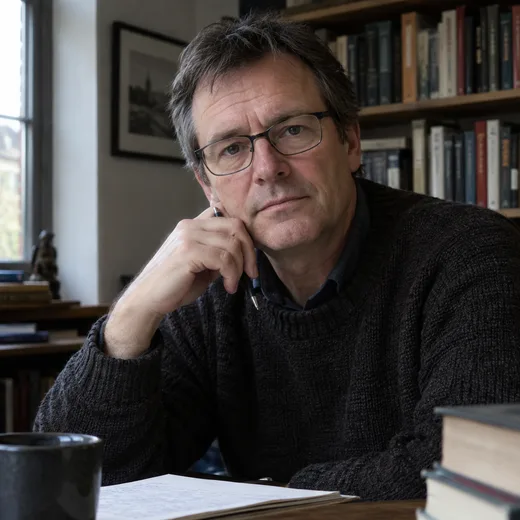
About Liam Barrantine
Liam Barrantine is 56 and lives in North Yorkshire with his family. He holds a degree in criminology and worked for many years as a forensic investigator, an experience which informs the procedural detail and the slow unravelling of evidence in his fiction. He has a particular interest in murder mysteries, the mechanics of a crime, the inconsistencies in witness accounts, the small things that do not fit. The Rain Over Leeds is his first novel.
Author Page
Reader Comments
Leave a Comment or a Book Review
We would love to hear your thoughts on this chapter, or even a complete book review.