
The Fifth of November
Chapter IV — The Man Who Knew Too Much
← Liam Barrantine / The Fifth of November
By Monday morning, Daniel Rooke had stopped sleeping properly. He lay awake in the dark, listening to the house settle around him. Pipes clicked behind the walls. The heating came on and went off again. Occasionally, a car passed along the road, its tyres whispering over the wet tarmac before the sound faded into the distance. None of it should have mattered. Yet every small noise seemed to demand his attention, as though the house had become an unfamiliar place and he was waiting for something to reveal itself.
At six thirty, he gave up trying to sleep and went downstairs. The kitchen was cold. He filled the kettle, opened the curtains and looked towards the houses opposite. A man was putting his bins out. Two schoolchildren walked towards the main road, their bags bouncing against their shoulders. Somewhere nearby, a garage door opened with a low mechanical groan. Alwoodley was waking up.
Rooke wondered how many people in the street had secrets of their own. Not necessarily criminal ones. Most secrets were smaller than that: money worries, failing marriages, private disappointments, things people had said and wished they could withdraw. The world was full of people maintaining an appearance while something else occupied their thoughts. He had once regarded that as ordinary human behaviour. Now it seemed like a weakness.
His phone lay on the kitchen table. He picked it up and read the messages again.
The warning has been sent. Now you need to decide what happens next.
The sender had offered no name. Rooke had tried calling the number, but the call had gone straight to voicemail. He had left no message.
At seven fifteen, Stephen Mercer called.
"You've seen it," Mercer said.
Rooke did not ask how he knew.
"Yes."
"Have you any idea who sent it?"
"No."
"Could it be Vale?"
"Why would he tell us?"
"Because he wants us to believe he's innocent."
Rooke looked out of the window.
"Have you spoken to him?"
"Not yet."
"Then perhaps you should avoid accusing him until you have something to support it."
Mercer exhaled sharply.
"You're still thinking like an investigator."
"That's because somebody has given us information we need to investigate."
"This isn't a professional exercise, Daniel."
"No. It's worse than that."
The silence that followed was long enough to make Rooke check whether the call had disconnected. Then Mercer spoke again.
"We meet tonight. Seven o'clock. Everyone."
"Where?"
"Here."
Rooke glanced towards the ceiling, as though the others might already be standing in the room above him.
"That's a mistake."
"Why?"
"Because the address has already been mentioned in a message to the police, if the writer is telling the truth."
"You don't know that the police have been told."
"We know someone has sent a warning. We don't know what else they've done."
Mercer lowered his voice.
"Are you suggesting we abandon the house?"
"I'm suggesting we stop behaving as though nothing has changed."
For a moment, Rooke thought Mercer might agree. Instead, he heard the familiar shift in the older man's tone, the movement from discussion to certainty.
"We meet tonight," Mercer repeated. "Seven o'clock."
The call ended.
Rooke remained at the table, holding the phone in his hand. He had two choices. He could go to the meeting and attempt to influence what happened, or he could remove himself from the group and leave the others to make their own decisions. Neither option offered a clean escape. If he stayed, he remained part of the conspiracy. If he left, he would still know what the others intended. He had spent months convincing himself that his presence might prevent the worst outcome. He was beginning to suspect that this belief had become an excuse for his own failure to act.
At ten, he drove into the city centre. He parked near the station and walked towards the shops, passing office workers hurrying beneath umbrellas and a delivery driver struggling with a trolley on the uneven pavement. Leeds looked much as it always did. There were people who seemed to be in a hurry and people who appeared to have nowhere particular to go. A bus pulled away from the kerb. A cyclist rang his bell at a pedestrian who had stepped into the road without looking. Nothing announced the presence of a conspiracy. That was the difficulty.
At a café, Rooke chose a table near the window and ordered coffee. He had arranged to meet someone there: a former colleague named Peter Lawson, a man who had spent twenty years working in security and had since moved into corporate investigations. Lawson arrived five minutes late, carrying a briefcase that looked older than the suit he wore.
"You sounded worried on the phone," he said.
"I am."
"About what?"
Rooke watched the barista place a cup on the counter.
"I need to know what happens when somebody reports a credible threat but doesn't provide enough information to prove it."
Lawson sat down slowly.
"That's a very specific question."
"It's a hypothetical."
"Of course it is."
Rooke told him as much as he could without identifying the group or describing the intended attack. He spoke about an anonymous warning, a location in Alwoodley and the possibility that a serious plan was being prepared for early November. Lawson listened without interrupting. When Rooke had finished, he folded his hands on the table.
"If this is real, you need to contact the police."
"I know."
"Do you?"
Rooke looked at him. Lawson's expression had changed. The mild amusement with which he had arrived was gone.
"You don't call me to discuss hypothetical threats unless you're trying to decide whether to report something," he said. "And you don't mention a location unless you think it's important."
Rooke said nothing.
"Daniel, if you know about a planned attack, you cannot sit on the information while you work out what it means for you personally."
"I'm not trying to protect myself."
"Then what are you trying to protect?"
Rooke looked down at his coffee. He had no answer that he could give without hearing how it sounded.
Lawson stood.
"I'll give you one piece of advice. Don't assume you can control the consequences simply because you were present at the beginning."
He left the café without finishing his drink.
Rooke remained by the window for another half hour. He watched the people passing, thinking about the message, the meeting and the decisions that had brought him to this point. When he finally returned to his car, there was a folded piece of paper beneath the windscreen wiper. He looked around the car park. Nobody appeared to be watching him. The note contained a single sentence.
You are not the only one who wants to stop this.
Rooke read it once, then again. For the first time, he felt something stronger than fear. He felt relief. And almost immediately, he distrusted it.
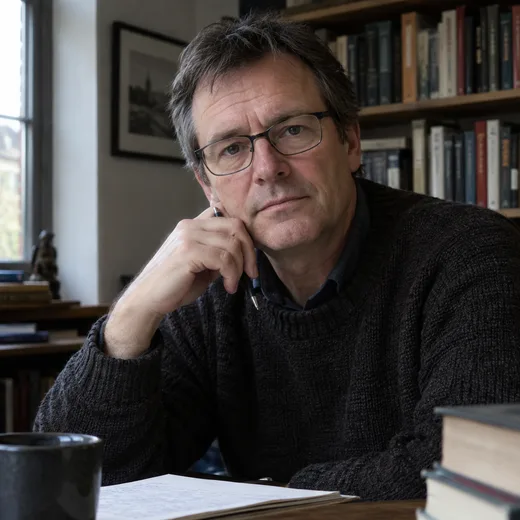
About Liam Barrantine
Liam Barrantine is 56 and lives in North Yorkshire with his family. He holds a degree in criminology and worked for many years as a forensic investigator, an experience which informs the procedural detail and the slow unravelling of evidence in his fiction. He has a particular interest in murder mysteries, the mechanics of a crime, the inconsistencies in witness accounts, the small things that do not fit. The Rain Over Leeds is his first novel.
Author Page
Reader Comments
Leave a Comment or a Book Review
We would love to hear your thoughts on this chapter, or even a complete book review.