
The Fifth of November
Chapter III — The Letter
← Liam Barrantine / The Fifth of November
Eleanor Whitaker had been a member of Parliament for eleven years, long enough to understand that the most alarming messages were not necessarily the ones written in angry capital letters. The letters that demanded resignations, threatened legal action or promised to expose some supposed conspiracy were familiar features of political life. Most came from people who wanted to be heard. Some came from people who needed help. A smaller number were written by individuals whose grievances had become so consuming that ordinary boundaries no longer seemed to apply.
The message she received on the Tuesday morning in late October was different. It contained no insult, no demand and no obvious attempt to attract attention. It was short, formal and almost painfully restrained. The sender claimed to know of a plan to disrupt a major parliamentary event in London. The people involved, the message said, had been meeting in Leeds. The threat was serious, and the authorities needed to be informed before the beginning of November. The final sentence read: Please do not assume that silence means there is no danger.
Whitaker read it again.
Her constituency office was quiet. Beyond the window, rain drifted across the road and gathered on the roof of a parked car. In the adjoining room, her office manager, Priya Shah, was speaking on the telephone to someone who wanted assistance with a housing dispute. Whitaker called her in.
"Can you look at this?"
Priya stood beside the desk and read the message.
"Do we know who sent it?"
"No."
"Have you checked the address?"
"It's not one I recognise."
Priya studied the screen.
"It could be somebody trying to cause trouble."
"Yes."
"Or somebody who genuinely thinks there's a threat."
Whitaker nodded.
"That's the difficulty."
They discussed whether the message might be connected to a recent political demonstration, an online dispute or a threat previously reported to the police. Nothing immediately explained it. The sender had provided no names, no precise details and no evidence that could be checked without further investigation. Whitaker had learned over the years that uncertainty did not excuse inaction. Nor did it justify treating every alarming statement as fact. She forwarded the message to the appropriate parliamentary security contact and asked for advice. Within the hour, she had received a request to preserve the original email and avoid replying to the sender. By lunchtime, the matter had passed beyond her office.
She might never have heard anything more about it had the anonymous writer not sent a second message. It arrived three days later. This time there was no explanation. There was no new claim about the proposed attack. Instead, the sender referred to a house in Alwoodley and said that a small group of men had been meeting there.
Whitaker read the sentence while standing beside her desk. Then she sat down. She knew Alwoodley. She had attended community events there, spoken to residents about planning applications and visited local businesses. It was a residential area, not the sort of place most people associated with a serious security threat. But that was not what concerned her. The writer had provided a location. Someone, somewhere, appeared to know more than they had been willing to say in the first message.
Whitaker contacted the security team again. By late afternoon, the information had been passed to the police. Officers would need to establish whether the claims were credible, whether the people described could be identified and whether there was any evidence of a threat beyond the messages themselves. Nobody treated the matter as a solved case. There was no dramatic confrontation, no immediate raid and no certainty that the anonymous writer was telling the truth. There was only a warning.
And a warning, Whitaker knew, could be ignored, misunderstood or acted upon too late.
That evening, she drove home through the rain. The city lights reflected across the wet road, and the traffic slowed near the junctions. She thought about the message and the unknown person who had sent it. What kind of person knew enough to be frightened but not enough to come forward openly? Someone involved, perhaps. Someone who had overheard a conversation. Or someone who wanted the police to look in the wrong direction.
At home, she made tea and sat at the kitchen table, leaving her phone beside the mug. She had intended to read through the papers she had brought home, but she found herself returning to the same sentence.
Please do not assume that silence means there is no danger.
It was an awkward sentence, almost too carefully composed. She wondered whether the writer had spent a long time deciding how to phrase it. She wondered, too, whether the writer was afraid.
At nine thirty, her phone rang. The caller introduced himself as a police officer dealing with the information she had forwarded.
"We're making preliminary enquiries," he said. "At this stage, we can't confirm the claims in the messages."
"Do you think they're credible?"
"We think they warrant investigation."
Whitaker looked through the kitchen window at the dark garden.
"Is there anything I should do?"
"Keep the messages. Don't contact the sender. If you receive anything further, let us know immediately."
After the call ended, she sat for a while without moving.
Across Leeds, in the house in Alwoodley, Daniel Rooke was reading the same two sentences on his phone. He had received them from a number he did not recognise.
The warning has been sent.
A second message followed.
Now you need to decide what happens next.
Rooke lowered the phone. He knew that the plan had been built on secrecy, but he had never seriously considered what secrecy would feel like once it began to fail. Until now, the unknown people beyond the group had been abstractions: the public, the authorities, the people who would eventually discover what the men had intended. Now one of those people had acted. Somewhere, somebody had decided that silence was no longer acceptable.
Rooke walked to the desk and looked at the brass clock. Eleven eighteen. He picked it up, turned it over and examined the back. There was nothing unusual about it. No hidden compartment, no message, no explanation for why its hands had stopped at that particular time. He placed it carefully on the desk. Then he switched off the light.
In the darkness, he understood that the most dangerous moment in any conspiracy was not necessarily the moment when the plan was put into action. It was the moment when someone outside it began to understand what was happening. And that moment had arrived.
End of Part One
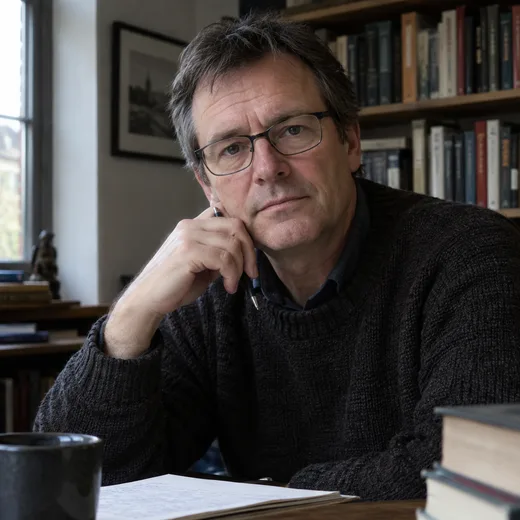
About Liam Barrantine
Liam Barrantine is 56 and lives in North Yorkshire with his family. He holds a degree in criminology and worked for many years as a forensic investigator, an experience which informs the procedural detail and the slow unravelling of evidence in his fiction. He has a particular interest in murder mysteries, the mechanics of a crime, the inconsistencies in witness accounts, the small things that do not fit. The Rain Over Leeds is his first novel.
Author Page
Reader Comments
Leave a Comment or a Book Review
We would love to hear your thoughts on this chapter, or even a complete book review.