
The Fifth of November
Chapter II — The Necessary Men
← Liam Barrantine / The Fifth of November
Stephen Mercer had never considered himself an extremist. He disliked the word because it suggested a man who had abandoned reason, and he had spent most of his adult life insisting that he was the only person in any room prepared to follow an argument to its proper conclusion.
He had been a solicitor once. Not a particularly famous one, nor a particularly wealthy one, but successful enough to own a house, support a family and believe that the world operated according to rules which could be understood by anyone willing to study them. Then his career had collapsed. An investigation into his handling of a commercial dispute had resulted in disciplinary proceedings. Mercer maintained that he had been made a scapegoat for failures that reached much further than his own office. He had lost his practice, his marriage and, eventually, the confidence of people who had once sought his advice. He had never forgiven the system.
For years, his resentment remained a private matter. He wrote letters to newspapers, attended meetings and contributed to online discussions in which people exchanged evidence of corruption, incompetence and political hypocrisy. Some of his arguments were persuasive. Others depended upon assumptions he was unwilling to examine. Gradually, he began to believe that the country had reached a point at which persuasion was no longer enough. It was a conclusion he reached alone, then presented to others as though it were a discovery they had made together.
The first meeting had taken place in a room above a private office near the city centre. There had been six people present, though one had left before the discussion became serious. Mercer had spoken for almost an hour about the distance between government and ordinary citizens, the concentration of influence among wealthy interests and the way public anger could be absorbed without producing meaningful change. At the time, Daniel Rooke had listened with cautious interest. He agreed that institutions could become complacent. He understood that people who believed themselves insulated from consequences often made decisions they would never tolerate if the consequences fell upon them personally. But Mercer had gone further. He had argued that a sufficiently dramatic event could expose the weakness of the establishment and force a national reckoning.
"People have to see it," Mercer had said.
"See what?" Rooke had asked.
"That the system isn't as secure as it pretends to be."
"And then?"
Mercer had looked around the room.
"Then everything changes."
It was an answer that appealed to the others because it required no further explanation. Each man could imagine the change he wanted. None had to confront the possibility that the others wanted something entirely different. Matthew Vale wanted vindication. Andrew Shaw wanted power over the people he believed had humiliated him. Mercer wanted history to reverse the verdict it had passed on his life. Rooke was less certain about his own motives. He had begun by observing, then advising, then assisting. At each stage, he had found a reason to remain involved. By the time he understood how far the group had travelled, leaving seemed more difficult than staying. He told himself that he could still influence events. It was a familiar justification.
On the afternoon of the meeting at Alwoodley, Mercer arrived carrying a thin folder. He placed it on the table and took the chair nearest the window.
"We need to discuss the warning," he said.
Vale looked up sharply.
"What warning?"
"The possibility that somebody has become suspicious."
"Who?"
"We don't know."
Rooke watched Mercer closely.
"Have you received something?"
"Not directly."
"Then why are we discussing it?"
Mercer opened the folder, revealing several sheets of paper covered in handwritten notes.
"Because one of our contacts has heard that questions are being asked."
"What kind of questions?"
"About meetings. About people speaking to one another. Nothing definite."
Shaw had joined them ten minutes earlier. He leaned back in his chair and folded his arms.
"That could mean anything."
"It could," Mercer said. "Or it could mean that somebody has decided to do the right thing."
Vale stared at him.
"Are you saying one of us has talked?"
"I'm saying that the possibility exists."
"Then we should stop."
Mercer turned towards him.
"Stop what?"
"All of it."
The room fell quiet.
Mercer did not raise his voice. He did not need to. His authority had always depended less upon force than upon his ability to make disagreement feel like a personal failing.
"You agreed to this," he said.
"I agreed to a discussion."
"You attended every meeting."
"Because I wanted to understand what you were proposing."
"And now you understand."
Vale looked at Rooke, apparently hoping for support. Rooke said nothing. He had spent the morning considering the same possibility. If the group had attracted attention, their assumptions about secrecy might already be wrong. The men had become so accustomed to discussing the plan among themselves that they had begun to treat the outside world as a passive audience, unaware of what was being prepared. That was a dangerous mistake.
"What matters," Rooke said at last, "is whether the information is credible."
Mercer nodded, apparently satisfied that the conversation had returned to practical ground.
"Exactly."
"Then we need to establish what has actually happened."
"And if someone has betrayed us?"
Rooke looked at him.
"Then we need to understand why."
Mercer closed the folder.
"People don't always act for reasons we can understand."
"No," Rooke said. "But they usually act for reasons they can explain to themselves."
For several seconds, Mercer studied him.
"You've become cautious."
"I was always cautious."
"You didn't used to let caution dictate your decisions."
Rooke glanced at the stopped clock.
"Perhaps I should have."
Nobody answered.
Outside, the rain had returned. It ran down the window in narrow lines, blurring the houses across the road. A woman walked past carrying shopping bags. A child followed her, jumping over puddles and laughing at something she had said. The ordinary world again, close enough to see and somehow impossibly distant.
Mercer stood.
"We are not abandoning the plan because of a rumour," he said. "We have a date. We have a purpose. We have made commitments to one another."
He looked at each man in turn.
"If any of you has doubts, speak now."
Vale opened his mouth, then closed it. Shaw looked away. Rooke remained still.
Mercer nodded as though their silence had settled the matter.
"Good. Then we proceed."
He collected his folder and left the room.
Vale waited until the front door had closed.
"Tell me honestly," he said. "Do you believe him?"
Rooke looked towards the landing.
"I believe he believes himself."
"That isn't the same thing."
"No," Rooke said. "It isn't."
He stood and walked to the window. The rain had thickened, and the street was almost empty. At the far end of the road, a car was parked beneath a tree. It had been there when Mercer arrived. Rooke could not remember seeing it before. He watched it for a while, waiting for some indication that the driver was inside. No light appeared behind the windscreen. No door opened. The vehicle remained motionless, its windows dark with moisture.
Then his phone vibrated. A message had arrived from an unknown number.
You don't know who else is involved.
Rooke read it twice. He looked up at the parked car. It was gone.
About Liam Barrantine
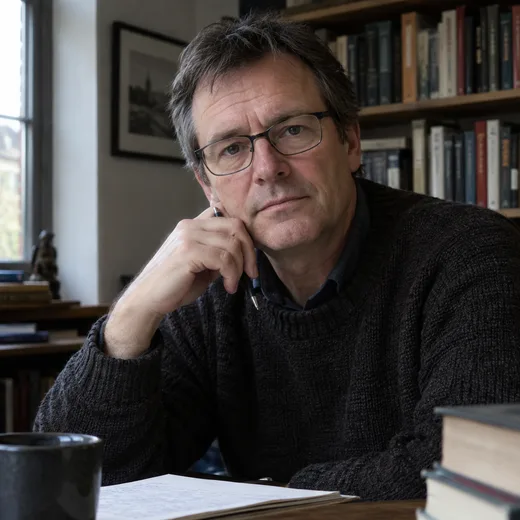
Liam Barrantine is 56 and lives in North Yorkshire with his family. He holds a degree in criminology and worked for many years as a forensic investigator, an experience which informs the procedural detail and the slow unravelling of evidence in his fiction. He has a particular interest in murder mysteries, the mechanics of a crime, the inconsistencies in witness accounts, the small things that do not fit. The Rain Over Leeds is his first novel.
Author Page
Reader Comments
Leave a Comment or a Book Review
We would love to hear your thoughts on this chapter, or even a complete book review.