
The Fifth of November
Chapter I — The House on the Hill
← Liam Barrantine / The Fifth of November
The rain had been falling over Alwoodley since early morning, softening the outlines of the houses and turning the leaves along the pavements a dark, metallic green. It was the sort of rain that rarely caused anyone to change their plans. People still walked their dogs along the quiet residential roads. Cars moved towards the Ring Road with their headlights on. Outside the shops, customers hurried between doorways with their collars turned up, thinking about the day ahead rather than the weather.
From a distance, Alwoodley appeared untouched by the anxieties of the city. Its detached houses stood behind hedges and carefully maintained gardens. The roads were broad, the streets comparatively quiet, and the evening lights that appeared behind the windows gave the impression of lives proceeding according to familiar arrangements. But appearances, Daniel Rooke had learned, were often the most effective form of concealment.
He stood at the upstairs window of a large house on the outskirts of the suburb, watching a dark car pass through the rain. The vehicle slowed as it approached the junction, then continued towards the main road. Rooke waited until its rear lights disappeared.
He was forty-seven, with thinning hair and a face that seemed permanently tired. He dressed plainly, spoke quietly and had the habit of looking at people for a fraction longer than was comfortable. In another life, he might have been considered unremarkable. In his present circumstances, he regarded that as an advantage.
Behind him, the room had been stripped of almost everything that suggested it was inhabited. A desk stood against one wall. Four chairs had been arranged around it. On the desk lay a stack of printed documents, a closed laptop and a small brass clock that had stopped at eleven eighteen. Rooke had never liked the clock. It had belonged to the previous owner, a man who had died in hospital before completing the sale of the house. The estate agent had offered to remove it. Rooke had told him to leave it where it was, then spent several months forgetting it existed. Now he found himself looking at it every time he entered the room.
The front door opened downstairs. He heard the key turn, followed by the sound of wet shoes crossing the hallway.
"Daniel?"
"Up here."
Matthew Vale appeared in the doorway carrying a folded umbrella. He was younger than Rooke by more than ten years, neatly dressed and visibly uncomfortable with the weather. He placed the umbrella against the wall and glanced at the desk.
"Has everyone confirmed?"
"Nearly."
"What does nearly mean?"
"It means I'm waiting for one person."
Vale pulled out a chair but did not sit down.
"Are we still going ahead?"
Rooke looked at him.
"You've asked me that three times this week."
"And you haven't given me an answer."
"Because the answer hasn't changed."
Vale moved towards the window. He looked across the gardens towards the next house, where a man in a fleece jacket was loading something into the boot of a car.
"It's difficult to believe, standing here," he said.
"What is?"
"That anything serious could happen in a place like this."
Rooke turned back to the desk.
"That's precisely why people choose places like this."
The remark remained between them for a moment.
Vale had joined the group almost by accident. He had met Rooke at a private business event, where a conversation about government contracts had become a discussion about political power, and then something less clearly defined. He had been angry for years, though he had usually found respectable ways of expressing it. A failed business venture, an investigation that had damaged his reputation and the loss of a relationship had gradually persuaded him that the institutions he once trusted existed primarily to protect themselves. He had not always thought this way. Rooke suspected that everyone involved could say the same.
"Have you spoken to Mercer?" Vale asked.
"Last night."
"And?"
"He's certain."
Vale gave a short laugh.
"That's what worries me."
For the first time, Rooke looked interested.
"Why?"
"Because he was certain when we first discussed it. He was certain when we changed the plan. He was certain when we changed it again. I've begun to wonder whether he understands the difference between being determined and being right."
Rooke considered the question.
"Have you told him that?"
"No."
"Then perhaps you should."
Vale shook his head.
"You know what happens when someone challenges him. He starts talking about loyalty. He talks about history. He tells you that hesitation is a form of surrender."
"Sometimes hesitation is sensible."
"Tell him that."
Rooke almost smiled.
There had been a time when he would have welcomed such doubts. He had spent much of his professional life warning organisations about the dangers of decisions made too quickly. He had written reports about inadequate oversight, poor communication and the tendency of senior people to surround themselves with others who agreed with them. He had not expected to find himself participating in precisely the kind of process he had once criticised.
The doorbell rang. Both men turned towards the landing.
"That's him," Rooke said.
He went downstairs.
The man on the doorstep was Stephen Mercer, a broad-shouldered figure in his early sixties whose silver hair and expensive coat gave him the appearance of someone accustomed to being taken seriously. Rain glistened on his shoulders. He carried no umbrella.
"Is everyone here?" Mercer asked.
"Almost."
"Then let's begin."
He walked past Rooke without waiting for an invitation.
Upstairs, Mercer placed his coat over the back of a chair and surveyed the room. His eyes settled on the documents, then the stopped clock.
"Still hasn't moved, I see."
"Neither has the plan," Rooke said.
Mercer looked at him.
"Good."
He sat down.
For a moment, the three men listened to the rain. Then Mercer opened the folder he had brought with him.
"Five November," he said. "We have less time than you think."
Outside, the traffic continued along the wet road. A delivery van stopped at a neighbouring house. Somewhere in the distance, a dog barked and fell silent.
The world carried on.
That, Rooke thought, was the strangest part of it. Nothing in the street suggested that the ordinary course of events was about to be challenged. Nothing in the room suggested that the men sitting around the table had begun to confuse their private grievances with the fate of the country. Yet the date was approaching. And none of them had worked out how to turn back.
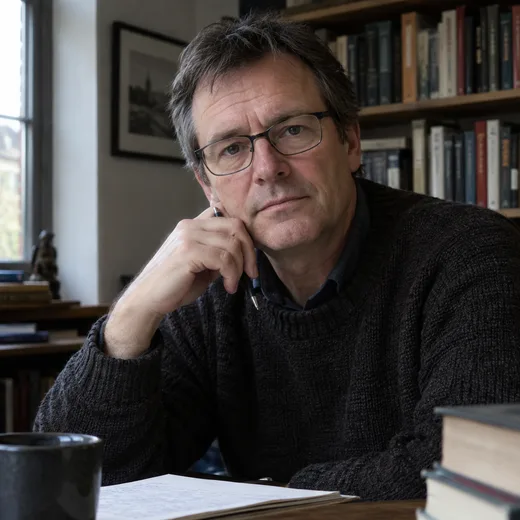
About Liam Barrantine
Liam Barrantine is 56 and lives in North Yorkshire with his family. He holds a degree in criminology and worked for many years as a forensic investigator, an experience which informs the procedural detail and the slow unravelling of evidence in his fiction. He has a particular interest in murder mysteries, the mechanics of a crime, the inconsistencies in witness accounts, the small things that do not fit. The Rain Over Leeds is his first novel.
Author Page
Reader Comments
Leave a Comment or a Book Review
We would love to hear your thoughts on this chapter, or even a complete book review.