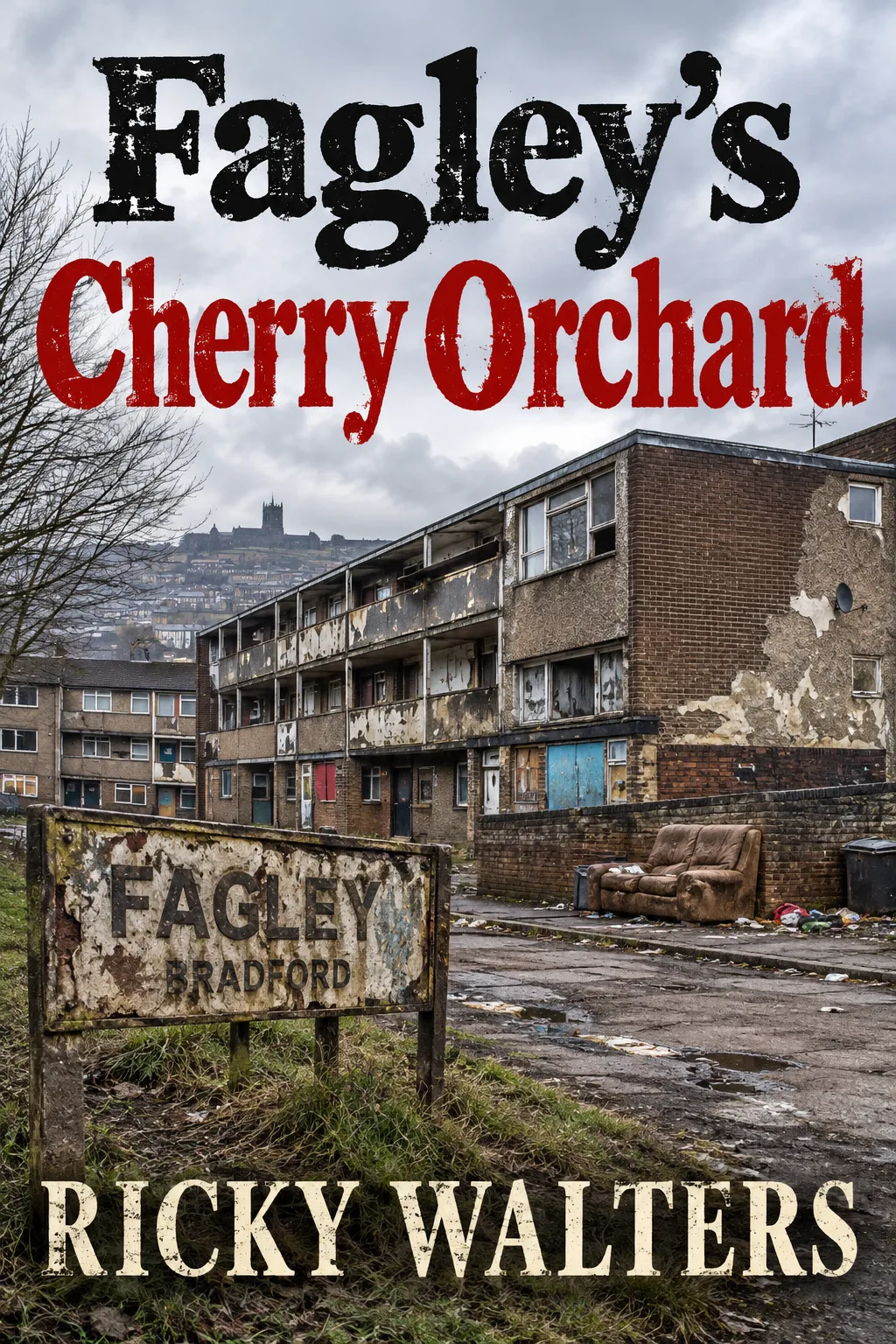
Fagley's Cherry Orchard
Chapter 4: The Auction
12 minute read
← Ricky Walters / Fagley's Cherry Orchard
There are few experiences quite so unpleasant as discovering that something you have regarded as permanently yours is about to become somebody else's property. The experience is made considerably worse when the thing in question is a house that has belonged to your family for generations, contains most of your possessions and represents the accumulated memories of a lifetime. It is worse still when the people responsible for the transaction appear perfectly cheerful about the whole business, particularly if they happen to be wearing smart suits and carrying briefcases.
At Cherry Orchard House, the days following Margaret Sutcliffe's party were marked by an increasingly uncomfortable awareness that the end was approaching.
The auction was scheduled for Thursday morning, and there was little prospect of stopping it. The bank had made its position clear, the solicitors had completed the necessary arrangements, and the auctioneers had begun advertising the property. A notice had appeared in the local property listings, describing the house as an attractive development opportunity with extensive grounds and potential for residential conversion.
Margaret had been particularly offended by the description.
She objected to the suggestion that her home was a development opportunity, and she was even more displeased by the phrase requiring modernisation. The house, she explained, was a family residence of considerable character, not some neglected building requiring the attention of speculative investors.
Valerie had pointed out that the roof leaked.
Margaret had declined to discuss the matter further.
Geoffrey, meanwhile, had become increasingly agitated. He had telephoned several former business acquaintances, contacted his bank and even approached a distant relative who had once expressed an interest in investing in property.
The relative had declined.
Geoffrey was now considering whether the family might have grounds to challenge the auction, although he had no clear idea what those grounds might be.
He had developed a particular interest in the possibility that the original mortgage arrangements contained some technical irregularity. This was largely because he had heard somebody mention the subject in a conversation several years earlier.
Valerie was not impressed.
"Geoffrey, the solicitor has looked at everything."
"Yes, but solicitors are not infallible."
"Neither are you."
He looked at her with considerable irritation.
"I am trying to help."
"I know. But perhaps we should concentrate on things that might actually work."
He returned to his newspaper.
On Wednesday morning, the house began to empty.
Hannah had packed several suitcases and arranged to stay with a friend in Bradford while she decided what to do next. She was reluctant to leave, although she understood that there was little practical alternative.
Valerie had made enquiries about temporary accommodation and was considering whether she might be able to rent somewhere nearby. She had also spoken to a housing adviser about her rights and the arrangements that might follow the sale.
Margaret, however, had not packed anything.
She had spent much of the morning sitting in the sitting room, looking at the furniture and occasionally asking Valerie whether there was any possibility of keeping the house.
Valerie explained that there was not.
Margaret then asked whether they might be able to purchase a smaller property somewhere in the area.
Valerie said that this would depend upon the amount of money remaining after the debts had been settled.
Margaret appeared disappointed.
She had imagined that the sale would produce a substantial sum for the family, but the mortgage, legal costs and other liabilities meant that very little was likely to remain.
The house was valuable.
The family, unfortunately, was not.
Outside, the ordinary life of Fagley continued.
Children were making their way to school, people were walking towards the bus stops, and the traffic along the surrounding roads was becoming heavier as the morning progressed. A 642 passed along its route towards Bradford, carrying passengers who were largely unaware that a family estate was about to change hands.
On Leeds Road, businesses were opening for the day. Shopkeepers were preparing their premises, deliveries were arriving and people were beginning their daily routines.
There was something almost offensive about the normality of it all.
Margaret looked out of the window and wondered how the world could continue so indifferently when her own life was falling apart.
Darren Walsh arrived shortly after eleven.
He had spent the previous evening examining the final figures and speaking to his planning consultant, Imran Hussain. They had discussed the access arrangements, the possible number of houses and the likely cost of preparing the site.
Imran had advised him that the development would not be straightforward.
There were questions about the existing trees, drainage, traffic and the relationship between the proposed housing and the surrounding neighbourhood. He had also suggested that the scheme should include some genuinely affordable accommodation, rather than relying entirely upon higher-priced properties.
Darren was prepared to consider this, although he remained concerned about the financial implications.
He was not a charitable organisation.
He was a businessman.
Nevertheless, he understood that any development would have to exist within a real community, and that the people living nearby would have to deal with its consequences long after the contractors had disappeared.
He found Margaret in the sitting room.
"Good morning."
She looked at him without smiling.
"Good morning, Darren."
He sat down.
"I wanted to speak to you before tomorrow."
Margaret folded her hands.
"I don't suppose there's much left to discuss."
"I've been looking at the figures again. I may be able to improve my offer slightly."
She looked at him.
"How much?"
He told her.
Margaret appeared unimpressed.
"That's nowhere near enough."
"I'm afraid it's a realistic figure."
"Your father worked for my father. He knew how much this place meant to us."
Darren looked at her.
"My father worked very hard here."
"Yes. He was a good man."
"He was."
Margaret seemed to expect him to say something further, but he did not.
Eventually she asked whether he would consider retaining the house.
Darren explained that this would be difficult. The building required considerable investment, and its condition made it an uncertain proposition. He was prepared to investigate whether part of the orchard could be preserved, but he could not promise that the house itself would remain.
Margaret shook her head.
"Then I don't think we have anything more to say."
Darren stood.
"I'm sorry it's come to this."
She looked away.
He left without another word.
That afternoon, Peter Whitaker came to see Hannah.
He had heard about the auction and wanted to know what the family intended to do afterwards.
Hannah was sitting on the old garden bench, looking towards the trees. She had spent much of the day sorting through her possessions and deciding which things she could keep.
Peter sat beside her.
"How are you?"
"Not particularly well."
He nodded.
"I suppose it's difficult."
She looked at him.
"Everybody keeps saying that."
"Well, it is."
Hannah picked up a fallen blossom petal.
"I've been thinking about the people who might eventually live here."
Peter looked towards the orchard.
"Perhaps that's not such a bad thing."
"Would you like it if your family home was demolished?"
"No."
"Then why do you keep defending it?"
Peter considered the question.
"Because I don't think the land should belong to one family indefinitely simply because their ancestors happened to acquire it. There are people in Bradford who desperately need decent housing."
Hannah looked at him.
"And there are people who need somewhere to remember their families."
Peter nodded.
"Of course. But those things aren't necessarily incompatible."
She smiled faintly.
"You're very good at making difficult things sound simple."
He laughed.
"I'm not sure that's a compliment."
They sat quietly for a while.
Peter told her about some of the work he had been doing with local community organisations. There were families struggling with housing costs, young people who had become disconnected from education and employment, and older residents who found it increasingly difficult to manage independently.
He described the difficulties faced by people living in overcrowded accommodation and the pressure on local services.
Hannah listened.
She understood that there was a genuine need for more housing, but she also wondered whether the disappearance of the orchard would make any meaningful difference to the circumstances of those people.
A development could provide houses.
It could also provide somebody with a considerable profit.
The two outcomes were not necessarily the same.
Thursday morning arrived with heavy rain.
Margaret woke early and went downstairs before anybody else. She made herself a cup of tea and sat in the kitchen, looking through the window towards the orchard.
The trees were almost bare now, their blossom having fallen during the previous week. The grass was wet, the garden paths were muddy and the old stone wall looked darker than usual.
She remembered her father.
He had been a stern man, although he had possessed a particular affection for the garden. He had spent many mornings walking among the trees, checking the fruit and complaining about the work of the gardeners.
Margaret had been a child then.
She remembered being carried through the orchard, being shown the old apple trees and being told that the land had belonged to the family for generations.
She had believed him.
It had never occurred to her that ownership could end.
Geoffrey appeared in the doorway.
"You're up early."
"I couldn't sleep."
He poured himself some tea.
"There's still a possibility that we can find a solution."
Margaret looked at him.
"Geoffrey, please."
He sat down.
For once, he did not attempt to offer any advice.
The auction took place in Bradford city centre.
The room was not particularly large, and there were fewer people present than Margaret had imagined. Several property investors had attended, along with representatives of local businesses and a handful of people who appeared to be interested in the surrounding land.
Darren Walsh sat towards the front.
He had brought Imran Hussain with him, although Imran was there primarily to advise him about the development possibilities.
Margaret, Geoffrey and Valerie arrived shortly before the proceedings began.
Hannah had chosen not to attend.
She had said that she could not bear to watch the house being sold.
Albert Sykes had remained at Cherry Orchard House.
The auctioneer began with the usual formalities. He described the property, outlined the legal arrangements and explained that the land was being offered subject to the conditions contained in the sale documents.
He spoke about the size of the plot, the existing buildings and the potential for redevelopment.
Margaret sat very still.
She found the language particularly unpleasant.
The house was described as a detached Victorian property requiring substantial modernisation. The orchard was referred to as an extensive area of development land. The surrounding grounds were described in terms of access, boundaries and potential residential use.
There was no mention of her father's trees, the family photographs or the years she had spent growing up in the house.
There was no mention of the people who had lived and worked there.
The auctioneer began the bidding.
Several hands went up.
The price increased steadily, although not as rapidly as Margaret had hoped. Darren entered the bidding after a short interval, and a representative of another property company continued against him.
For several minutes the figures moved upwards.
Geoffrey leaned towards his sister.
"This is encouraging."
Margaret said nothing.
Eventually the competing bidder withdrew.
Darren made another offer.
The auctioneer looked around the room.
There was a pause.
Then the hammer fell.
The estate had been sold.
Darren Walsh was the new owner of Cherry Orchard House.
For a moment nobody moved.
Geoffrey looked towards the auctioneer as though he expected some further announcement.
Margaret remained seated.
Valerie placed a hand on her arm.
It was over.
The family home had gone.
Outside, the rain had begun to ease.
Darren came over to speak to them.
He was pleased with the purchase, although he was careful not to show too much satisfaction. He knew that Margaret was distressed, and he had no desire to appear insensitive.
"I'm sorry," he said.
Margaret looked at him.
"Are you?"
He paused.
"Yes. I am."
She nodded, although she did not believe him entirely.
Darren explained that the legal process would take some time and that the family would have an opportunity to remove their remaining possessions. He also said that he would be prepared to discuss the future of the orchard with the local planning authority before making any final decisions.
Geoffrey asked whether there was any possibility of retaining a small part of the garden.
Darren said that he would look into it.
Margaret turned away.
She did not wish to discuss the future of the land with the man who had just bought it.
When they returned to Fagley, the house seemed different.
Nothing had physically changed. The furniture was still in place, the photographs remained on the walls and the old trees stood in the garden.
Nevertheless, the family no longer owned it.
Valerie went upstairs to begin packing.
Geoffrey sat in the sitting room and opened a newspaper, although he appeared unable to concentrate on the words.
Margaret walked through the hall.
She stopped beside the staircase, looked at the old family photographs and then entered the dining room.
There was a small mark on the wall where a picture had hung for many years.
She touched it with her fingers.
Then she went outside.
The orchard was quiet.
She walked slowly between the trees, stopping beside the largest apple tree. Its trunk was deeply marked, and one of its branches had broken during the previous winter.
She remembered her father standing beneath it.
She remembered her mother sitting in the garden.
She remembered the children playing among the branches and the summers when the house had been full of people.
She also remembered the years when she had spent money without thinking, the occasions when she had ignored the bills and the opportunities she had allowed to pass because she assumed that everything would somehow work out.
For the first time, she began to understand that the loss of the house was not entirely the result of bad luck.
Some of it had been her own doing.
She stood beneath the tree for a long time.
Then she heard Albert calling from the kitchen.
"Mrs Sutcliffe!"
She turned.
"Yes, Albert?"
"There's somebody at the door."
She walked back towards the house.
The visitor was Darren.
He had returned to discuss the arrangements for the transfer of the property and to explain that he would need access for a surveyor.
Margaret received him in the hall.
He looked around.
"It's a lovely house," he said.
She nodded.
"Yes."
"I'll do my best to make sure the development is done properly."
Margaret looked at him.
"That won't bring it back."
"No."
He appeared genuinely uncomfortable.
For a moment they stood facing one another.
Then Margaret asked whether he intended to keep the orchard.
Darren hesitated.
"I'll see what can be done."
It was not the answer she wanted.
But it was the only one he could honestly give.
After he left, Margaret returned to the sitting room.
The family had lost its home, Geoffrey had lost his comfortable position, and Valerie was facing an uncertain future.
Yet outside, the old orchard remained.
For the moment, the trees were still standing.
That evening, Albert Sykes went into the garden to close the gate.
He had worked at Cherry Orchard House for most of his adult life, and the thought of leaving was becoming increasingly difficult to bear.
He walked slowly along the path, stopping beside the old apple tree.
He remembered the family in its better days, the gardeners who had worked there, the visitors who had come and gone and the many people whose lives had briefly crossed his own.
He remembered Margaret as a little girl.
He remembered her father.
He remembered the years when the orchard had been full of fruit.
Now the house had been sold, and the future belonged to somebody else.
Albert looked towards the lights of Fagley.
A bus passed in the distance.
The rain began again.
He closed the gate and returned to the house.
The auction had settled the question of ownership.
It had settled very little else.
End of Chapter 4.

About Ricky Walters
Born and bred in Shipley. A joiner, poet and writer of plays, drama, and short stories. Lives with his wife and best mate, who's a bricklayer from Fagley.
Author Page
Reader Comments
Leave a Comment or a Book Review
We would love to hear your thoughts on this chapter, or even a complete book review.