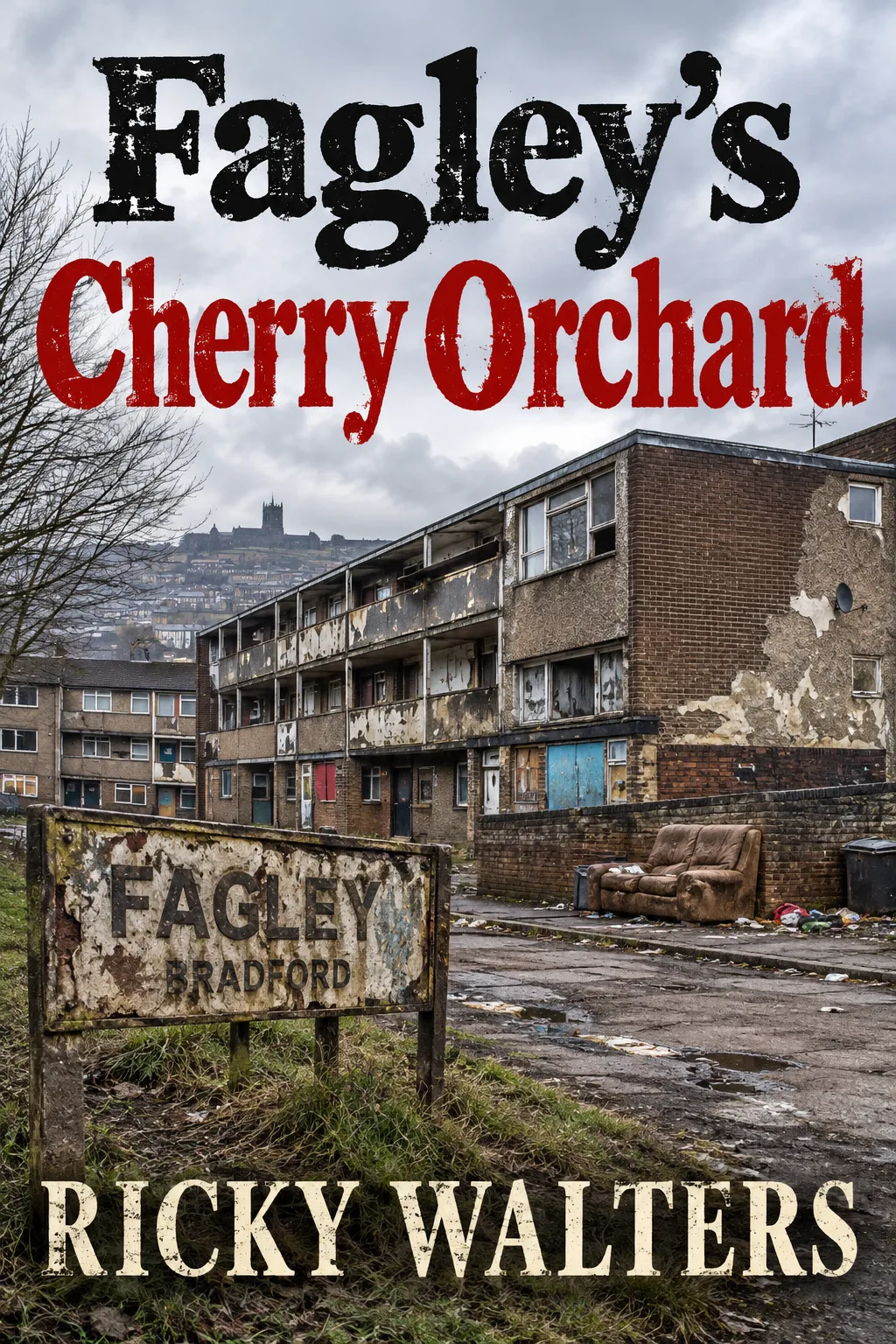
Fagley's Cherry Orchard
Chapter 3: The Last Ball
12 minute read
← Ricky Walters / Fagley's Cherry Orchard
By the beginning of June, Cherry Orchard House had acquired the peculiar atmosphere of a place where everybody knew something unpleasant was about to happen but nobody wished to be the first to mention it. The auction date was approaching, the bank had become increasingly insistent, and the various attempts made by Geoffrey Sutcliffe to find an alternative source of finance had produced little beyond a collection of telephone numbers and several rather discouraging conversations.
Margaret, however, had decided that the best response to the situation was to hold a party.
It was to be a proper family celebration, with food, music, dancing and a gathering of friends and acquaintances. She explained that the house had been rather neglected socially during her absence and that it would be a pity to allow financial difficulties to interfere with an occasion that might lift everybody's spirits.
Valerie pointed out that entertaining people cost money.
Margaret replied that she had already invited them.
This was, in her opinion, a perfectly reasonable answer.
The preparations began several days beforehand. Shirley Beaumont was asked to help organise the guest list, Hannah was instructed to arrange some flowers, and Geoffrey was given responsibility for obtaining refreshments. Geoffrey accepted the task with considerable enthusiasm, although his understanding of quantities was not always reliable.
He returned from the shops with enough food and drink to entertain a small wedding reception, having apparently forgotten that the household was already struggling to pay its electricity bill.
Valerie looked at the shopping.
"Geoffrey, how much did all this cost?"
"Not as much as you might think."
"How much?"
He examined the receipt.
"Well, there were some special offers."
"How much?"
He named a figure.
Valerie closed her eyes briefly.
"That's nearly a week's food money."
"Well, we can't have people arriving and finding nothing to eat."
"People would probably understand if we didn't have a party."
Geoffrey looked at her with genuine disappointment.
"Valerie, one must maintain a certain standard."
She looked at the bags.
"Yes. I suppose that's what got us into this position."
The party was to be held on Saturday evening.
By late afternoon, the house had been transformed. The old sitting room had been cleared, the dining table extended and the furniture rearranged to create space for dancing. Margaret had insisted on using the good china, although several pieces were chipped, and the family silver had been polished by Albert Sykes, who had spent much of the morning complaining about the state of the cutlery.
Outside, the orchard was looking particularly attractive.
The surviving trees were in leaf, and the grass had been cut for the occasion. Valerie had arranged a few chairs beneath the branches, and Hannah had placed flowers along the garden path.
For a short time, the old estate appeared almost prosperous again.
Guests began arriving shortly after seven.
They included former colleagues of Geoffrey, several of Margaret's old friends, local acquaintances and a number of people connected with the business community. Some arrived in expensive cars, others came by taxi, and a few had travelled on the buses from different parts of Bradford.
Among them was Imran Hussain, the planning consultant who had visited with Darren Walsh. He had been invited because Margaret considered it important to maintain good relations with people who might be able to influence the future of the estate.
Imran arrived with his wife, Nadia, who worked in education and knew several families in the surrounding district. She was a friendly, observant woman who had a habit of listening carefully before forming an opinion.
There were also guests from the local Pakistani and Bangladeshi communities, including a shop owner from the Leeds Road area and a retired teacher from Eccleshill. Their presence reflected the wider social world of Bradford, although Margaret had not given much thought to the significance of the gathering beyond the pleasure of seeing familiar faces.
Hannah was pleased to see them.
She had grown increasingly uncomfortable with the narrow social circle in which her mother had spent much of her life. Bradford was a diverse city, with people whose family histories, occupations and circumstances differed enormously. The old divisions of class and status remained, but they were no longer quite as simple as Geoffrey imagined.
The party was therefore a rather mixed affair.
Some guests were comfortably retired, others were still working, and a few were struggling financially despite maintaining the outward appearance of respectable middle-class lives. There were people who owned businesses, people employed in public services, people who had inherited property and people who had spent years trying to save enough money to buy their first home.
They all gathered beneath the same roof, although they did not necessarily share the same understanding of the world.
Margaret moved between them with considerable charm.
She introduced people, asked after their families and made a particular effort to ensure that nobody felt overlooked. She was at her best on such occasions, when the business of entertaining allowed her to forget the more unpleasant aspects of her circumstances.
For several hours she appeared to be the woman she had always imagined herself to be.
Darren Walsh arrived just after eight.
He was wearing a dark suit and appeared slightly uncomfortable at the prospect of an evening among people who remembered him as a boy. Nevertheless, he greeted Margaret politely and congratulated her on the arrangements.
"Lovely to see the house looking so well," he said.
Margaret smiled.
"Thank you. It has been rather a long time since we've had everybody together."
Darren looked towards the orchard.
"It's a beautiful site."
"Yes. It always has been."
He nodded.
"There's a lot of potential here."
Margaret's expression changed.
"Must we discuss business tonight?"
"Not at all."
He smiled and moved towards the dining room.
Valerie watched him go.
She had become increasingly aware that Darren was not quite the ruthless developer she had initially imagined. He was ambitious, certainly, and he had little difficulty discussing the demolition of buildings that other people considered important. But he was also practical, hardworking and more socially aware than his business interests sometimes suggested.
He knew that Bradford contained people who had been overlooked for years, and he understood that many families needed better housing.
His difficulty was that he tended to regard almost everything as an opportunity for development.
Valerie could not decide whether this was a strength or a defect.
Peter Whitaker arrived later in the evening.
He had travelled by bus from the city centre and was carrying a small gift for Hannah. He was wearing an old jacket and appeared to have made little effort to dress for the occasion.
Margaret greeted him warmly, although she had never entirely understood why Hannah was so interested in him.
Peter had a tendency to discuss social problems when other people wanted to talk about holidays, and he was occasionally rather careless about the feelings of people who disagreed with him.
Nevertheless, he was a pleasant enough man.
During the evening, he found himself talking to Imran Hussain and several other guests about the proposed development of the orchard.
Imran explained that the site presented a number of planning considerations. There were questions about access, drainage, parking and the impact of additional housing on the surrounding roads. The development would also have to take account of the existing neighbourhood, including nearby schools and health services.
Peter listened carefully.
"Would there be any affordable housing?"
"That would depend on the final scheme and the planning requirements."
"That's rather important, isn't it?"
"Of course."
Peter looked towards the garden.
"Because if you simply build expensive houses, you're not doing much for the people who already live here."
Imran nodded.
"I agree that affordability is an important issue. But it isn't as simple as putting a percentage into a drawing and assuming the problem has been solved."
Nadia joined the conversation.
"The same applies to schools and health services. People talk about building more houses, but they don't always consider what additional residents will need."
Peter smiled.
"Exactly."
Imran looked at him.
"Although I would add that refusing all development doesn't help people who need somewhere to live either."
The discussion continued for some time.
It was a sensible conversation, conducted without much agreement, which was perhaps why Margaret found it rather dull.
She preferred to move towards the dining room, where the music had started and several guests were dancing.
Geoffrey had become increasingly cheerful as the evening progressed.
He had consumed rather more wine than was advisable and had begun delivering speeches about the Sutcliffe family's history.
He described his father as a remarkable businessman, praised the achievements of previous generations and spoke at length about the contribution the family had made to Bradford.
He was particularly enthusiastic about the textile industry, although his knowledge of its modern economic history was somewhat limited.
Several guests listened politely.
One of them, a retired businessman from Eccleshill, asked whether Geoffrey had any intention of selling the estate.
Geoffrey looked offended.
"Certainly not. We are merely considering our options."
The businessman nodded.
"Well, I suppose that's sensible."
Geoffrey leaned closer.
"The difficulty with modern property development is that people have forgotten the importance of heritage."
The man glanced towards the orchard.
"Perhaps. But people need houses."
Geoffrey looked at him.
"Yes, well. That's another matter."
He returned to his drink.
Across the room, Margaret was laughing with Shirley Beaumont.
For a moment she seemed genuinely happy.
She had always enjoyed having people around her. She liked the noise, the conversation and the sense that the house remained a place where people wanted to gather. The thought of losing it was something she could almost forget when the rooms were full.
Hannah watched her mother from the doorway.
She knew that Margaret was not a bad woman. She was affectionate, generous in certain ways and capable of considerable kindness. But she had spent so much of her life surrounded by comfort that she had never learned how to live without it.
The party was another attempt to preserve the appearance of a life that had already begun to disappear.
Shortly before ten, the music stopped.
A few guests had gone into the garden, others were standing around the dining table, and Geoffrey was explaining something about the local economy to a man who appeared to have lost interest several minutes earlier.
Then Valerie noticed that Darren was missing.
She found him outside, standing beneath one of the old apple trees.
He was looking towards the house.
"Are you all right?" she asked.
He turned.
"Yes. Just getting some air."
Valerie stood beside him.
The garden was quiet, although the sound of traffic could still be heard in the distance. Beyond the boundary wall, the lights of Fagley were beginning to appear against the darkening sky.
Darren looked at the trees.
"My father used to work here."
"I know."
"He brought me along sometimes. I remember him cutting the grass and repairing that wall."
Valerie smiled.
"I remember him. He was very good at what he did."
"He was."
Darren was silent for a moment.
"Do you know what I remember most?"
"What?"
"Waiting outside while your grandfather spoke to him. Your grandfather always made him stand in the yard until he'd finished whatever he was doing."
Valerie looked towards the house.
"I didn't know that."
"Of course you didn't. You were a child."
He paused.
"I don't suppose anybody thought much about it at the time."
Valerie looked at him.
"Things were different then."
"They were."
He turned towards the orchard.
"I sometimes think people only notice how much things have changed when they start losing something."
Valerie did not answer.
She had the impression that he was talking about more than the trees.
Inside, Peter had found Hannah sitting near the window.
She had become increasingly unhappy with the direction of the evening. The guests were enjoying themselves, but she was conscious that the house was being prepared for a future that might not include any of them.
Peter sat beside her.
"Your mother looks happy."
"She always looks happy when there are people around."
"Perhaps that's not such a bad thing."
Hannah looked towards the garden.
"Do you think Darren will get the property?"
"Probably."
"Then what happens to us?"
Peter shrugged.
"Your mother and uncle will have to find somewhere else."
"And Valerie?"
"She'll have to decide what she wants to do."
Hannah looked at him.
"You make everything sound very straightforward."
"It isn't straightforward. But the house is only a building."
She looked towards the orchard.
"That's easy for you to say."
Peter understood that he had been rather insensitive.
He took her hand.
"I know you love the place."
"It's not just the place. It's everything that's happened here."
Peter looked at the garden.
"Perhaps that's the problem with places like this. People become so attached to what happened in them that they forget what's happening outside."
Hannah did not answer.
She thought about the families living in the surrounding streets, the children walking to school, the people waiting for buses and the residents struggling to manage on limited incomes. She thought about her mother's attachment to the house and Darren's plans for the land.
Both sides had arguments.
Neither seemed entirely concerned with the people who would be affected.
By eleven o'clock, the party had begun to wind down.
The guests collected their coats, said their goodbyes and promised to meet again. Several remarked on how lovely the house looked, while others expressed sympathy about the financial difficulties.
Margaret thanked everybody for coming.
She stood in the doorway, smiling and waving as the cars disappeared down the drive.
When the last guest had left, she returned to the sitting room.
The house was untidy. Empty glasses stood on the tables, plates had been left in the dining room, and several chairs had been moved into the garden. A half-finished bottle of wine stood beside the fireplace.
Margaret looked around.
"That was a lovely evening."
Valerie began collecting the glasses.
"Yes. It was."
Geoffrey had fallen asleep in an armchair.
Albert was clearing the dining room, moving slowly because his knees were troubling him.
Hannah had gone upstairs.
Margaret sat down and removed her shoes.
For a while she looked at the photographs on the mantelpiece.
Then she began to cry.
Valerie stopped what she was doing.
"Mum?"
Margaret shook her head.
"I'm sorry, darling. I'm just tired."
Valerie sat beside her.
"Everything will be all right."
It was an unfortunate thing to say, since neither of them believed it.
Margaret looked towards the window.
"I don't want to lose the house."
Valerie took her hand.
"Neither do I."
Outside, the orchard was dark.
The old trees stood motionless beneath the night sky, their branches barely visible against the clouds. Somewhere beyond the garden, a late bus travelled through Fagley, carrying people home from work, from visiting relatives or from an evening spent with friends.
The city continued as it always had.
At Cherry Orchard House, however, the old life was approaching its final hours.
The party had been intended as a celebration.
In retrospect, it was rather more like a farewell.
The following morning, Darren Walsh telephoned Valerie.
He had received further information about the auction and wanted to discuss the possibility of making a revised offer. He also explained that he had been considering the planning arrangements and believed there might be a way of retaining part of the orchard.
Valerie listened carefully.
"How much of it?"
"That depends on the layout."
"And the house?"
There was a pause.
"I'm afraid the house would probably have to go."
Valerie looked towards the sitting room.
The remains of the party were still being cleared away, and the smell of stale wine lingered in the air.
"Then I don't think my mother will agree."
Darren sighed.
"Perhaps she should think about it again."
Valerie said nothing.
He continued.
"The auction is getting closer. Once it goes through, your family may have very little control over what happens."
That was the first thing anybody had said that morning which she could not dispute.
After the call ended, Valerie walked through the house.
She passed the old family portraits, the staircase and the rooms that had been part of her life for as long as she could remember. She stopped at the front window and looked towards the orchard.
The blossom was beginning to fall.
A few petals had gathered on the grass, and the wind was carrying others towards the garden wall.
She watched them for a long time.
Then she went to find her mother.
End of Chapter 3.
About Ricky Walters
Born and bred in Shipley. A joiner, poet and writer of plays, drama, and short stories. Lives with his wife and best mate, who's a bricklayer from Fagley.
Author Page
Reader Comments
Leave a Comment or a Book Review
We would love to hear your thoughts on this chapter, or even a complete book review.