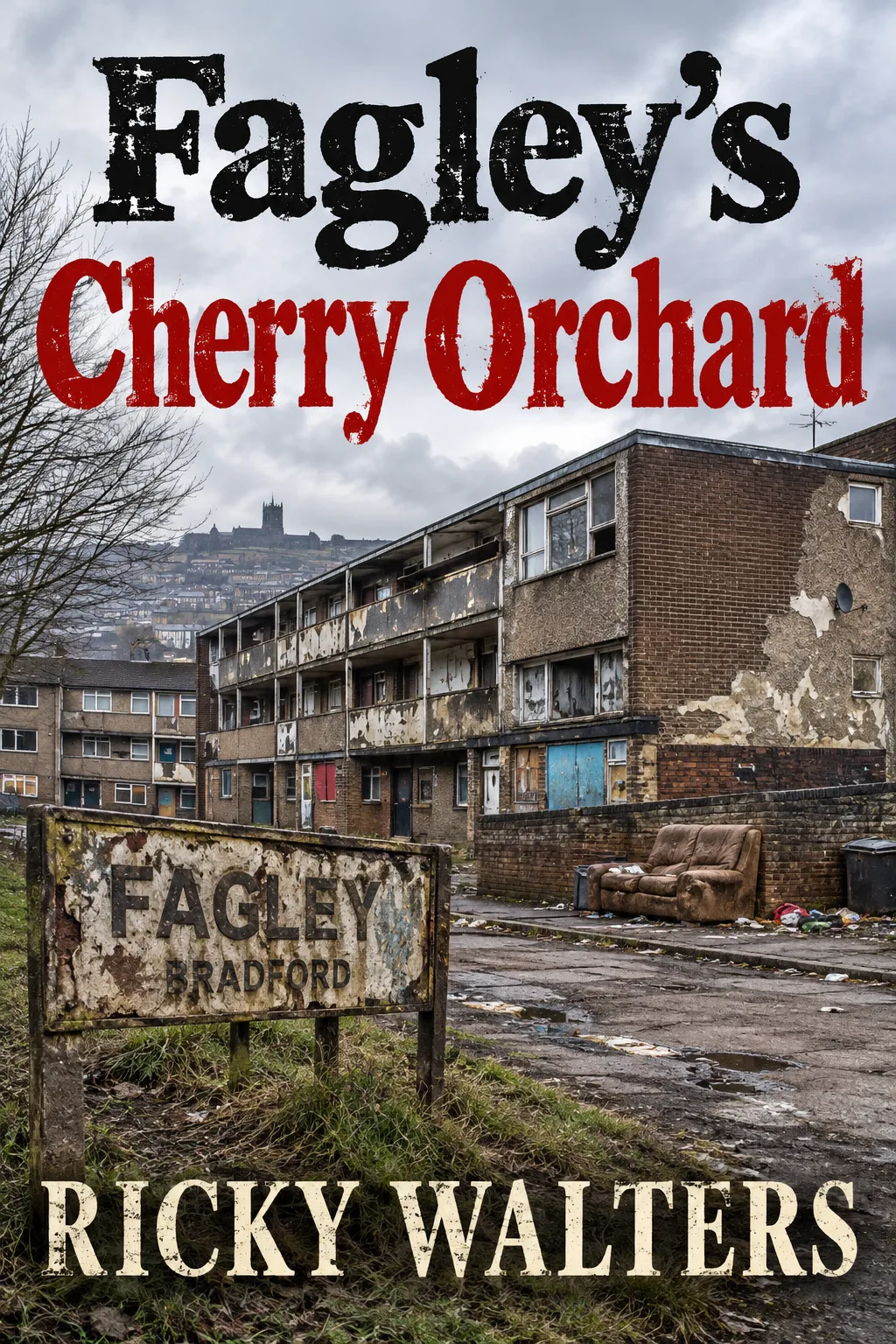
Fagley's Cherry Orchard
Chapter 2: The Price of the Land
17 minute read
← Ricky Walters / Fagley's Cherry Orchard
By the middle of May, the weather in Bradford had become sufficiently unpredictable to make planning anything outdoors a rather optimistic undertaking. One morning the sun would shine over Fagley, illuminating the hillsides and making the old stone houses look almost picturesque. By lunchtime the clouds would have gathered, the wind would have picked up and the rain would be coming down with the sort of determination normally associated with somebody trying to wash a particularly stubborn stain from a carpet.
At Cherry Orchard House, however, the weather was the least of anybody's concerns.
Margaret Sutcliffe had been home for nearly a fortnight, and already the household was beginning to discover that her return had not improved its financial circumstances. She had made several attempts to restore the house to what she considered its proper standard, which involved ordering flowers, replacing some rather unattractive kitchen crockery and enquiring whether the carpets could be professionally cleaned. Valerie had explained that none of these things was particularly urgent, although Margaret had received this information with the expression of somebody being asked to accept an unreasonable restriction on personal freedom.
The heating was still unreliable, the roof required attention and the electricity account remained unpaid.
Margaret nevertheless insisted that the house should feel welcoming.
She had also invited several old acquaintances to tea.
This was an unfortunate development, since the people she invited were generally of the opinion that Cherry Orchard House was a rather grand establishment, and Margaret was reluctant to disabuse them of the notion. She had spent much of her life cultivating the impression that the Sutcliffes were comfortably situated, and the possibility that the family might soon be forced to sell its property was something she preferred not to discuss.
Her brother Geoffrey was no more helpful. He had taken to spending his afternoons in the conservatory, where he read the newspaper and made telephone calls to people who might, in theory, be able to assist with the financial arrangements. He had spoken to a former colleague from the bank, a solicitor in Bradford city centre and an accountant whose name he had obtained from a friend.
None of them had offered a particularly encouraging solution.
Geoffrey's response was to suggest that the situation required further consideration.
Valerie, who had already spent several months considering it, was becoming increasingly impatient.
She was also beginning to resent the fact that she appeared to be the only person in the household who understood that money was not an abstract concept. It was required to pay the gas bill, purchase food, maintain the house and prevent the bank from taking possession of the property.
The family had lived comfortably for generations, and this had left them with a rather limited understanding of how quickly ordinary expenses could become overwhelming. They had become accustomed to treating household bills as administrative inconveniences rather than obligations that required actual payment.
Outside the gates, the neighbourhood continued with its ordinary business.
Children walked to Fagley Primary School, parents hurried along the pavements, and the familiar buses carried passengers towards Bradford. The 642 was particularly useful to residents who needed to travel into the city centre, although there were occasions when its arrival appeared to depend upon the personal preferences of the driver and the general condition of the traffic.
Along Leeds Road, the shops remained busy, and the various businesses serving the surrounding communities continued to trade. There were people who had lived in the district all their lives, others whose families had arrived in Bradford several decades earlier, and newer residents who were still learning their way around the neighbourhood.
The area was not without its difficulties.
Some households struggled with low incomes, rising housing costs and insecure employment. Others faced the additional pressures of caring for elderly relatives or managing health problems while attempting to remain in work. There were families living in overcrowded accommodation, pensioners trying to keep warm without spending more than they could afford, and young people who had discovered that qualifications did not necessarily lead to secure employment.
These were not subjects that Margaret and Geoffrey discussed particularly often.
They preferred to talk about the decline of the neighbourhood, the condition of the roads and the apparent disappearance of the standards they remembered from their younger days.
They had a tendency to confuse the deterioration of their own circumstances with the deterioration of society generally.
Darren Walsh, meanwhile, had a rather different view of Fagley.
He had spent much of his life working in and around Bradford, and he understood the district as a place where people needed practical things rather than sentimental speeches. Houses were required, roads needed maintaining, businesses needed customers and people wanted somewhere decent to live without spending most of their income on rent.
He was not particularly interested in the family's history.
He was interested in the land.
Darren arrived at Cherry Orchard House on a Thursday afternoon.
He drove a dark company vehicle up the private drive, parked beside the old stone wall and sat for a moment looking towards the house. He had been there several times before, although he had never quite become accustomed to the extraordinary contrast between the property and its surroundings.
The house was considerably larger than anything a modern family would ordinarily require. Its rooms were spacious, the ceilings high and the staircase impressive. Yet the property was also expensive to maintain, inefficient to heat and increasingly difficult to insure.
Darren had made enquiries about the condition of the building. The roof needed substantial work, several windows required replacing, and there were problems with the drainage. The orchard itself would require considerable clearance before any development could begin.
He knew the costs.
He also knew what the land might be worth.
Margaret received him in the sitting room.
She had dressed for the occasion, wearing a blue blouse and a necklace that had belonged to her mother. She greeted him warmly enough, although there was a certain formality in her manner that suggested she still regarded him as somebody who ought to remember his former position in the household.
Darren had not forgotten it.
His father had once worked for the Sutcliffes, doing maintenance and occasional building work around the property. Darren himself had spent time there as a boy, usually accompanying his father during school holidays.
He remembered the house, the orchard and the family who lived there.
He also remembered being told to wait outside while the adults discussed matters that did not concern him.
Those memories had not made him particularly sentimental.
"Tea?" Margaret asked.
"Thank you."
"Milk?"
"Yes, please."
She rang the bell for Valerie, who appeared shortly afterwards carrying a tray.
Darren thanked her and began discussing the estate.
He explained that his original offer remained open, although he was prepared to consider a slightly different arrangement if the family wished to retain a small part of the garden. He had looked at the access arrangements, spoken to a planning consultant and made preliminary enquiries about the possibility of developing the land.
Margaret listened politely.
"I still cannot understand why anybody would want to build houses here."
Darren looked towards the window.
"Because people need somewhere to live."
"There are already houses everywhere."
"There are also people looking for somewhere affordable."
Margaret gave a small sigh.
"I suppose you see everything in terms of money."
"Well, it is a property transaction."
She looked offended.
Darren continued.
"The land is valuable, Mrs Sutcliffe. You have a substantial plot, and the location is perfectly reasonable. People could live here and still get into Bradford easily. There are schools nearby, health services and bus connections. It would make a useful residential development."
Margaret looked towards Valerie, apparently hoping for some support.
Valerie remained silent.
"Surely," Margaret said, "there must be another way."
Darren closed his briefcase.
"I've looked at the figures. I don't think there is."
For a moment the room became uncomfortable.
Then Margaret asked whether he had known her father.
Darren smiled.
"Yes. My dad worked for him."
"Your father was a very good man."
"He was."
"He did a great deal for this family."
Darren looked at her.
"He did a great deal of work for this family."
Margaret appeared not to notice the distinction.
Later that afternoon, Valerie found Darren in the garden.
He was standing near the old orchard, examining one of the trees. Its trunk was twisted and covered with patches of lichen, and several branches had become brittle with age.
"You really do intend to get rid of them, don't you?" she asked.
Darren turned.
"If the development goes ahead, yes."
"They've been here for years."
"I know."
"My grandfather planted some of them."
"Then they've done well to last this long."
Valerie looked at him.
"You make it sound very easy."
"It isn't easy. But somebody has to be realistic."
She folded her arms.
"That's what everybody says when they want to take something away."
Darren smiled faintly.
"I don't want to take anything away from you, Valerie. Your family is in financial difficulty. I'm offering to buy the land. That's all."
"You're offering to make a fortune out of it."
"I'm offering to take a risk."
"You've already got enough money."
Darren looked towards the house.
"Perhaps. But I didn't get it by sitting in a big house waiting for somebody else to sort out my problems."
The remark was sharper than he had intended.
Valerie looked away.
She knew that Darren had worked hard. She also knew that his childhood had been very different from hers. There had been no comfortable rooms, no family holidays abroad and no expectation that somebody else would always pay the bills.
But she did not think that gave him the right to dismiss what the orchard meant to her.
They stood together for a while, listening to the distant traffic.
Eventually Darren said that he had to go.
Before leaving, he told her that he would be prepared to meet again if the family wanted to discuss the offer.
Valerie watched him walk towards his car.
She disliked him rather less than she had expected.
This was inconvenient.
The following Saturday, the family held a small gathering at the house.
Margaret had invited several people she had known for years, including Shirley Beaumont, a retired teacher who lived nearby and possessed a remarkable ability to obtain information about other people's affairs without appearing particularly interested in them.
Shirley had lived in Bradford all her life. She knew which families had moved away, which businesses had closed and which residents had become involved in disputes with their neighbours. She was also familiar with the local school system, the health services and the various changes that had taken place in the district.
She had a particular interest in the Sutcliffe family.
This was partly because she liked Margaret, but also because she had never entirely understood how the family had managed to retain such a large property while appearing to have very little money.
During the afternoon she spoke to Hannah about her travels, asked Valerie whether the house was still as cold as it had been during the winter and remarked that the orchard looked rather neglected.
"Everything looks neglected at the moment," Valerie replied.
"Well, you have had a difficult time."
Shirley lowered her voice.
"I heard that Darren Walsh has been making enquiries."
Valerie looked at her.
"Where did you hear that?"
"Oh, you know how these things travel."
Valerie did know.
By Monday morning, half of Fagley would probably have heard that the Sutcliffes were selling the house, although the other half would have a different version of events.
The conversation eventually moved towards the state of the neighbourhood.
Shirley mentioned that several families she knew were struggling with the cost of living. One of her former pupils had recently been made redundant, and another family was having difficulty finding suitable accommodation.
She also spoke about the pressures on local services.
The health centres were busy, appointments were not always easy to obtain, and people without reliable transport could find even ordinary medical arrangements inconvenient. There were families who depended upon buses to reach work, school and appointments, and who had little choice when services were delayed or disrupted.
Margaret listened with polite interest.
"How difficult everything has become," she said.
Shirley looked at her.
"Yes. Particularly for people who haven't got much money."
Margaret nodded.
She was not accustomed to thinking of poverty as something that might exist within a few streets of her own home.
For much of her life, she had understood the subject through newspaper articles, charitable appeals and occasional conversations with people who worked in public services.
The people affected by it had rarely been part of her immediate circle.
Hannah, however, had a rather different perspective. She knew people who worked in local shops, care homes and warehouses, and she had seen how easily a modest financial difficulty could become a serious problem.
She was also aware that Bradford's communities were far more complicated than the simple divisions sometimes described by outsiders. Families from British Pakistani, Bangladeshi, Indian and white British backgrounds lived alongside one another, with their own histories, businesses, religious institutions and family networks.
There were differences in income, education and opportunity, but there were also considerable differences within each community.
Hannah had friends whose parents had worked hard to establish successful businesses, and others whose families had struggled for years. She knew people who had gone to university, people who had entered the trades and people who were still trying to decide what they wanted from life.
She found it difficult to understand why some of the older residents spoke as though the neighbourhood had once been entirely harmonious and prosperous.
It had never been quite so simple.
That evening, Peter Whitaker came to see Hannah.
Peter was thirty-two and had studied sociology at university before returning to Bradford. He worked in community development and had become increasingly interested in housing, poverty and the changing character of urban neighbourhoods.
He was intelligent, articulate and inclined to believe that most problems could be understood if people were prepared to examine them carefully enough.
Unfortunately, he also had a habit of examining things at considerable length.
Hannah liked him, although she occasionally wished he would allow a conversation to proceed without turning it into a discussion about the structure of society.
They sat in the kitchen while Valerie prepared supper.
Peter asked how the family was managing.
"Not very well," Hannah replied.
"Your mother still doesn't want to sell?"
"No."
"And your uncle?"
"He thinks he can find somebody to lend us the money."
Peter shook his head.
"That sounds unlikely."
"It is."
He looked through the kitchen window towards the orchard.
"I suppose Darren Walsh is interested."
"He wants to build houses."
"Well, there's a housing shortage."
"Peter, don't start."
He smiled.
"I'm not starting anything. I'm just saying that there are people in this area who need somewhere decent to live."
Hannah looked at him.
"And you think the answer is to pull down the orchard?"
"Not necessarily. But you can't preserve every piece of land simply because somebody has an emotional attachment to it."
She considered this.
It was an uncomfortable argument because she could see some truth in it.
Peter continued.
"The important question is who benefits. If Darren buys the land and builds expensive houses, that doesn't necessarily help local families. But if the development includes genuinely affordable housing, that's a different matter."
"Do you think he'll do that?"
"I don't know."
"Neither do I."
Valerie entered carrying a plate.
"Well, whatever he builds, I hope he doesn't start knocking trees down before we've had time to think."
Peter looked at her.
"That's probably the one thing you can be certain of. Developers rarely spend much time thinking about trees once they've bought the land."
Valerie placed the plate on the table.
"Then perhaps somebody ought to make them."
For once, Peter had no immediate reply.
At the end of the week, Albert Sykes arrived at Cherry Orchard House.
Albert was the family's oldest servant, although he would have objected strongly to being described in such terms. He had worked for the Sutcliffes for more than forty years, first as a gardener and later as a general caretaker. He had known Margaret's father, remembered her childhood and had watched the family gradually lose the wealth and influence it had once possessed.
He was now seventy-eight.
His health was not particularly good, his hearing had deteriorated and he had developed a habit of falling asleep in the afternoon. Nevertheless, he remained devoted to the house.
Albert had never been a man of many words, but he remembered almost everything that had happened on the estate.
He knew which trees had been planted by Margaret's grandfather, where the old garden wall had originally stood and which parts of the house had been altered over the years.
He also remembered the days when the orchard had been maintained properly.
In those days, families from the surrounding district had sometimes been employed to pick fruit, and the garden had been full of activity during the summer months. The old house had been a place of considerable importance, although Albert had never been entirely convinced that its occupants understood how much work was required to maintain it.
He found Valerie in the kitchen.
"Morning, Miss Valerie."
"Morning, Albert. How are you?"
"Not too bad, thank you."
He looked towards the window.
"I saw Mr Walsh yesterday."
Valerie nodded.
"He's been here."
Albert was silent for a moment.
"He's after the orchard, then."
"Yes."
Albert shook his head.
"Your grandfather wouldn't have liked that."
Valerie smiled sadly.
"No. I don't suppose he would."
Albert removed his cap and placed it on the table.
"Funny thing, though. He always said the trees would outlast us all."
Valerie looked towards the garden.
For a moment she imagined the orchard as it had been when her grandfather was alive, the trees carefully pruned and the paths swept clean. She remembered running between the branches as a child, collecting fallen apples and being told not to climb the wall.
The memories were ordinary, but that was precisely what made them important.
There had been birthdays, summer afternoons, family arguments and Christmas gatherings. There had been people who were now dead and others who had moved away. The house had contained an entire family history, much of it forgotten except by those who had lived through it.
Albert looked at her.
"There's something about old places, Miss Valerie. You don't realise what you've got until somebody comes along and tells you it's worth a fortune."
Valerie smiled.
"Perhaps that's the trouble."
Albert nodded.
He had no particular interest in the financial value of the orchard. He was concerned with the fact that if it disappeared, there would be nowhere left for him to go.
His entire working life had been spent at Cherry Orchard House.
He had no family living nearby, no particular prospects and very little money of his own. The idea of leaving the property was something he preferred not to contemplate.
On Sunday evening, Darren Walsh returned.
This time he brought a planning consultant, a young man named Imran Hussain, who had been involved in several residential developments around Bradford.
Imran was a professional man in his early thirties, with a degree in planning and a considerable knowledge of local development requirements. He was British Pakistani, had grown up in Bradford and understood the practical problems of getting residential schemes approved in an area where housing demand, traffic, infrastructure and the preservation of green space frequently came into conflict.
He was not particularly interested in the family's emotional attachment to the property, although he was careful not to dismiss it.
He had already examined the site and identified several possibilities.
The land could potentially accommodate a modest residential development, subject to planning permission, access arrangements and the usual technical assessments. The existing house presented a more complicated question, since its condition and potential use would have to be examined before any decision could be made about its future.
Imran explained the proposals carefully.
Margaret listened with increasing discomfort.
Geoffrey asked several questions, most of which concerned the likely sale price rather than the practical arrangements.
Valerie wanted to know whether the orchard could be retained.
Imran explained that this would depend upon the final design, but there might be scope for preserving some of the mature trees and incorporating green space into the development.
Darren was less enthusiastic.
"The problem is that every tree we keep reduces the amount of land available."
Imran looked at him.
"Not necessarily. A decent design can work around existing features."
Darren shrugged.
"We'll see."
Hannah watched the two men.
She had the impression that Imran understood the neighbourhood rather better than Darren was prepared to acknowledge. He knew that a development in Fagley could not simply be designed as though it were an isolated piece of land. The people who lived nearby would have to deal with its consequences.
He also understood that housing was not merely a question of building houses.
There were questions of affordability, transport, schools, healthcare and the facilities required to support additional residents.
These were matters that rarely appeared in the glossy illustrations produced by property companies.
Eventually the meeting ended.
Darren gathered his papers, thanked the family and promised to return with a revised proposal.
As he walked towards his car, he turned to Margaret.
"I do hope you'll think about it."
Margaret looked at him.
"I shall think about it."
Darren nodded.
He knew that she would probably refuse again.
He also knew that the auction date was approaching.
There was time for sentiment, but not an unlimited amount of it.
After the visitors had gone, Margaret returned to the sitting room and stood looking out towards the orchard.
The evening light had begun to fade. The trees were dark against the sky, and the first drops of rain were falling against the windows.
Geoffrey sat behind her, reading the newspaper.
Valerie was in the kitchen, putting away the remains of supper.
Hannah had gone upstairs.
Albert was locking the garden gate.
The house was quiet.
Margaret placed her hand against the window.
She had spent much of her life believing that Cherry Orchard House would always belong to her family. She had never considered that the property might become unaffordable, or that the land might eventually be worth more to somebody else than it was to the people who had inherited it.
Outside, Fagley continued its ordinary business. A bus passed along the main road, its lights shining through the rain. Somewhere nearby, a television was playing, and a dog barked at a passing car.
The orchard stood between the old world and the new one.
And the new world was beginning to make its intentions clear.
End of Chapter 2.
About Ricky Walters
Born and bred in Shipley. A joiner, poet and writer of plays, drama, and short stories. Lives with his wife and best mate, who's a bricklayer from Fagley.
Author Page
Reader Comments
Leave a Comment or a Book Review
We would love to hear your thoughts on this chapter, or even a complete book review.