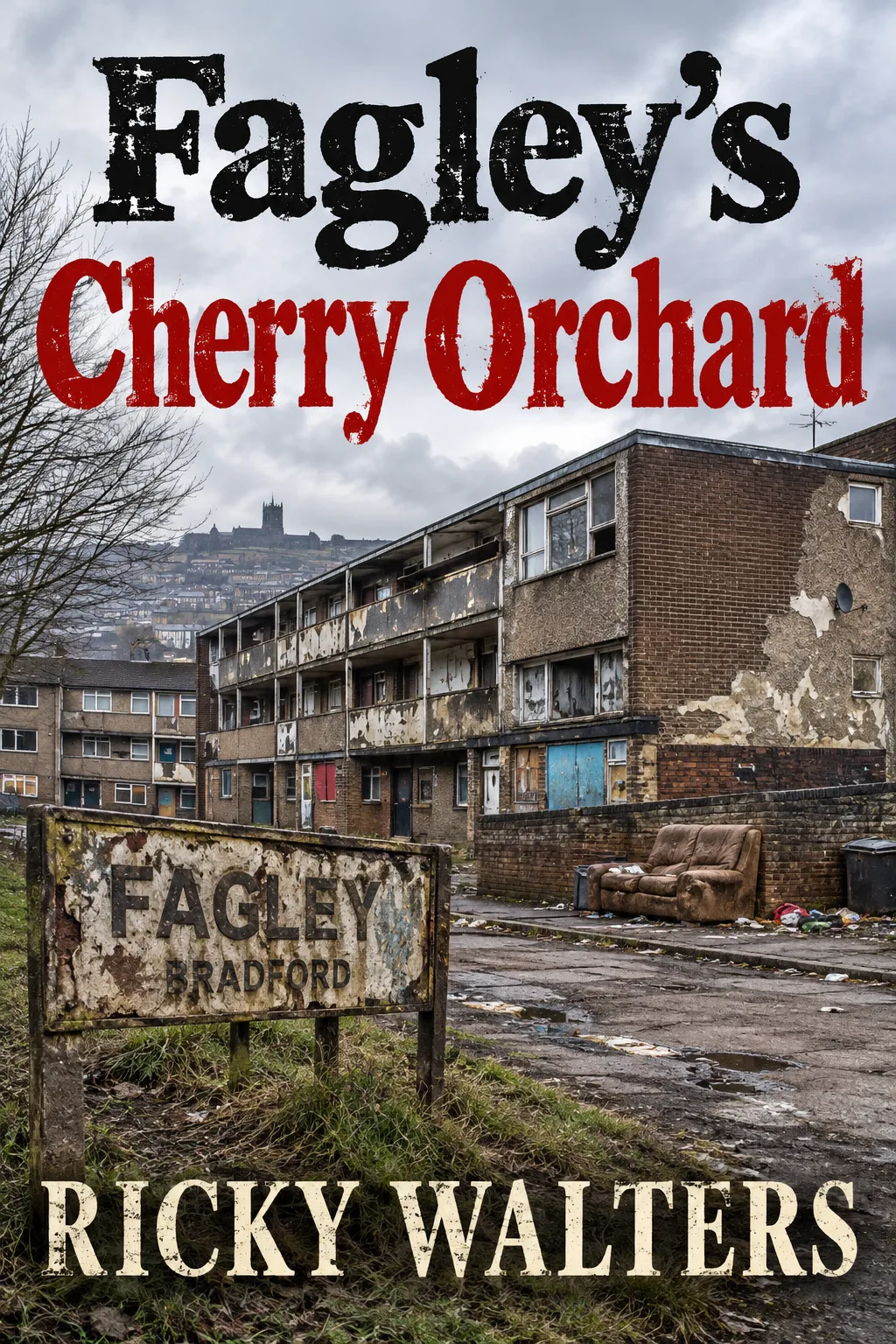
Fagley's Cherry Orchard
Chapter 1: The Return
12 minute read
← Ricky Walters / Fagley's Cherry Orchard
Fagley was not a place that generally attracted the attention of property developers, unless they had recently discovered that an inconvenient patch of green land could be converted into something considerably more profitable. It was a district of Bradford with its own particular character, a mixture of older stone houses, modest terraces, post-war housing and newer developments, all spread across a landscape that still retained occasional reminders of the countryside that had preceded them. There were people who spoke affectionately of the place, others who complained about it with the enthusiasm of lifelong residents, and a few who appeared to have spent so many years wanting to leave that they had forgotten to make any arrangements to do so.
The weather rarely helped. Rain had a habit of settling over the district, making the hills appear darker and the roads considerably less inviting. Cars negotiated the familiar streets, buses carried their passengers towards Bradford, and the ordinary business of getting children to school, attending medical appointments and making ends meet continued with little regard for anybody's personal difficulties.
At the end of a narrow private drive, just off Fagley Lane, stood a large Victorian stone house known locally as Cherry Orchard House.
The name had survived several generations, although the orchard itself had become increasingly difficult to recognise. There were still apple trees, a few pear trees and several ancient damsons, but many had grown crooked with age, their branches tangled and their trunks covered in moss. In spring, when the blossom appeared, the place possessed a remarkable beauty. During the rest of the year it looked rather like a neglected garden belonging to somebody who had been meaning to do something about it for the past twenty years.
The property had once belonged to the Sutcliffe family, whose fortunes had been established during Bradford's industrial expansion. Their ancestors had made money from textiles and associated businesses, and had subsequently acquired the sort of house that allowed a person to look down upon the surrounding district without necessarily having to mix with its inhabitants.
Times had changed, although the house had been slow to acknowledge the fact.
The Sutcliffes were no longer wealthy in any meaningful sense. They owned an expensive-looking property, a collection of old furniture, several family portraits and a considerable amount of debt. Their income had dwindled, their investments had performed disappointingly, and the maintenance of the house had become an increasingly embarrassing financial responsibility.
Nevertheless, Margaret Sutcliffe, the present owner, had continued to live as though the family fortune remained intact.
Margaret was sixty-one, an attractive woman who had once possessed considerable social confidence and still retained the ability to make an entrance. She dressed well, spoke warmly to strangers and had a natural talent for making people feel that they had been personally selected for her attention. Unfortunately, she also possessed a remarkable capacity for spending money that did not belong to her.
She had been married twice. Her first husband, Edward Sutcliffe, had died some years earlier, leaving behind a complicated financial arrangement and a daughter, Hannah. Her second marriage had ended unhappily, and Margaret had subsequently spent several years abroad, moving between rented accommodation and the homes of acquaintances, while gradually exhausting what remained of her capital.
She was now returning to Fagley, ostensibly to put her affairs in order.
The actual circumstances were rather less encouraging.
Cherry Orchard House was heavily mortgaged, the bank had become increasingly impatient, and the property was due to be sold at auction unless a substantial sum could be raised. The family had been warned about this repeatedly, although Margaret had developed the habit of putting official letters aside until she felt emotionally prepared to read them. Since she rarely felt emotionally prepared, the correspondence had accumulated in a drawer in the dining room.
Her brother Geoffrey had attempted to deal with the situation, but he was not a man naturally suited to financial management. He was sixty-four, had retired from a moderately successful career in banking and had subsequently devoted himself to the discussion of economic matters, particularly those involving other people's money.
Geoffrey was fond of newspapers, expensive coffee and long conversations about the decline of public standards. He had an extensive knowledge of subjects about which he possessed little practical experience, and he frequently expressed his views with such confidence that people occasionally mistook him for somebody who knew what he was talking about.
Margaret's adopted daughter Valerie had been left to manage the household during her absence. She was thirty-five, dependable, hardworking and rather serious. She had organised repairs, negotiated with contractors, kept track of the bills and attempted to prevent the family from falling into complete financial disorder.
It had been an exhausting undertaking.
Valerie had spent much of the previous year trying to explain to her mother that the house could not be maintained indefinitely through optimism and the occasional generous contribution from a distant relative. Margaret had listened sympathetically, thanked her for her efforts and then asked whether there was enough money to have the sitting-room curtains cleaned.
The situation was not helped by the fact that Valerie was emotionally attached to the house herself. She had grown up there, and although she understood its financial problems, she found the prospect of losing it almost unbearable.
She had also developed a particular dislike of people who described the estate as an opportunity.
The first person to arrive on the morning of Margaret's return was Hannah Sutcliffe, Margaret's twenty-three-year-old daughter. Hannah had spent the previous months travelling and studying, and had returned to Bradford with a mixture of affection and uncertainty about the place. She had grown up in the house but had never entirely understood the attachment her mother and uncle felt towards it.
To Hannah, Fagley was home, but it was also a place where many young people struggled to find decent employment, affordable accommodation and opportunities that did not involve travelling elsewhere. She had friends who worked long hours in shops, warehouses and care services, and others who were still looking for permanent employment. Some lived with their parents because they could not afford to move out; others had moved away and returned only when circumstances required it.
She had no romantic illusions about the district, although she could understand why people loved it.
The journey home had taken longer than expected. The traffic around Bradford had been particularly unpleasant, and the final stretch towards Fagley had been accompanied by the familiar sight of parked cars, wet pavements and people waiting at bus stops.
When the car finally turned into the drive, Hannah looked towards the house.
It appeared smaller than she remembered.
The stonework was darker, the windows looked tired, and several patches of the garden had become overgrown. Nevertheless, there was something comforting about seeing the old building again.
Valerie was waiting at the front door.
She had been up since six, had already spoken to the electricity company and had spent twenty minutes attempting to establish why the central heating was making a noise resembling a washing machine full of loose bricks.
She embraced Hannah warmly.
"You're looking well," she said.
"So are you."
Valerie smiled, although she was not entirely convinced.
"Your mother's going to be here in about half an hour. I've made sure there's food in the kitchen, although I don't know what she expects to eat after travelling."
"Probably something expensive."
"That would be about right."
They both laughed.
It was one of the few occasions during the morning when Valerie felt able to relax.
Margaret arrived shortly afterwards.
The car stopped outside the house, and she emerged wearing a pale coat, an expensive scarf and an expression of considerable satisfaction. She stood for a moment looking at the building, then turned towards the garden.
"Oh, Valerie," she exclaimed. "Look at it. It's exactly as I remember."
Valerie glanced towards the broken guttering.
"Not quite."
Margaret ignored the observation and hurried towards the front door. She embraced her daughter, kissed her repeatedly and announced that the house smelled wonderful.
It smelled of damp carpets, furniture polish and the remains of a radiator leak.
Margaret considered this a welcoming domestic fragrance.
Inside, she walked through the hall, touching the furniture and examining the photographs on the walls. She stopped in front of an old family portrait and smiled at the familiar faces.
There was a photograph of her father, Thomas Sutcliffe, standing beside one of the orchard trees in the 1950s. He had been a prosperous businessman, a formidable character and a man who believed that his family had a responsibility to maintain its position in Bradford society.
Margaret had inherited his confidence, although not his commercial ability.
She continued into the sitting room and looked through the window.
The orchard was visible beyond the lawn, its trees standing in the pale morning light. Further away, the roofs of Fagley descended towards the surrounding streets.
A bus could be heard approaching along the main road.
Margaret smiled.
"There's nothing quite like coming home."
Valerie looked at her mother and wondered whether she had any idea how much it was going to cost.
The financial situation was discussed after lunch, although not before Margaret had inspected the bedrooms, complained about the condition of the guest bathroom and asked whether anybody had arranged for fresh flowers.
Geoffrey arrived carrying a newspaper and a packet of biscuits. He had been delayed by traffic and was in a particularly poor mood.
"The roads are becoming impossible," he announced. "You can't get anywhere without sitting behind somebody who appears to have no idea where they're going."
He removed his coat and placed the newspaper on the table.
Margaret embraced him.
"Geoffrey, darling. It's wonderful to see you."
"Yes, well. You've been away long enough."
He kissed her cheek and sat down.
Valerie brought in tea.
For a while they discussed ordinary matters: the journey, the weather, the condition of the house and the various changes that had taken place in the neighbourhood. Geoffrey complained about the state of local roads, Margaret asked after several old acquaintances, and Hannah described some of the things she had been doing during her travels.
Eventually, Valerie placed a folder on the table.
"We need to talk about the auction."
Margaret looked at her.
"Must we do this now?"
"Yes, Mum. We really must."
Geoffrey adjusted his spectacles.
"I've been looking into it."
Valerie turned towards him.
"What have you found?"
"Well, the position is complicated."
"It isn't complicated, Geoffrey. The bank wants its money."
"That is one interpretation."
"It is the interpretation contained in the letters."
Margaret reached for her cup.
Geoffrey cleared his throat and began explaining that the estate had considerable potential, although the existing arrangements were unsatisfactory. He had spoken to a solicitor, although he was not entirely certain whether the solicitor had been able to offer a useful solution.
Valerie opened the folder.
There were statements, mortgage documents, unpaid invoices and correspondence from the auctioneers. She had arranged everything in chronological order, something she considered essential when dealing with people who had a habit of forgetting unpleasant facts.
"The auction is scheduled for next month," she explained. "Unless we can raise the money, the house and the land will be sold."
Margaret looked towards the window.
"But surely something can be done?"
"That's what I've been trying to tell you."
"Perhaps the bank would agree to another extension."
"They've already given us two."
Geoffrey nodded thoughtfully.
"Financial institutions are not what they used to be."
Valerie stared at him.
"That isn't going to help."
There was a silence.
Outside, somebody was reversing a car, and the intermittent warning signal carried across the garden.
Margaret looked down at the papers.
For the first time since arriving, she seemed to understand that the house might genuinely be lost.
She had spent years assuming that the property would always be there. It had been the background to her childhood, her marriages, her family celebrations and the ordinary events that made up a lifetime. Even when she had been living abroad, she had thought of it as a permanent refuge, somewhere she could return whenever the world became difficult.
The idea that somebody might buy it, pull down the house and remove the orchard was almost impossible to contemplate.
Then Valerie mentioned Darren Walsh.
Darren was forty-eight and had built a successful property and construction business from comparatively modest beginnings. His father had worked in the building trade, and Darren had spent much of his youth helping him on jobs around Bradford. He had subsequently established his own company, acquired several commercial properties and become increasingly involved in residential development.
He knew the district well.
He also understood the value of the land surrounding Cherry Orchard House.
Unlike the Sutcliffes, Darren had no particular interest in preserving the family's social standing. He was interested in what could be built, what could be sold and whether the investment would produce a reasonable return.
He had already approached the family with a proposal.
The orchard, he explained, occupied land that could accommodate several new houses. The property itself was in poor condition and would require substantial investment. The existing buildings could be demolished, the grounds redeveloped and the land put to considerably more productive use.
He had offered to purchase the estate.
His proposal was not entirely unreasonable.
It was simply unacceptable to Margaret.
She regarded the orchard as part of her family history and could not understand why anybody would consider replacing it with houses. She was also offended by the suggestion that the property might be worth more as development land than as the home of an established Bradford family.
Darren, for his part, regarded this as an unfortunate example of sentiment interfering with common sense.
He had grown up in a household where money was often short. He remembered his father returning from work with aching hands and his mother carefully dividing the weekly income between food, rent and bills. He remembered the embarrassment of not having enough money for school trips and the irritation of hearing wealthy people discussing their gardens as though they were the most important things in the world.
He had worked hard to escape those circumstances.
Now he had the opportunity to purchase a valuable piece of land in Fagley, and he saw little reason to allow somebody else's memories to prevent him from doing so.
There were other people in the neighbourhood who might have viewed the matter differently. Some would welcome new housing, particularly if it created opportunities for local families. Others would worry about the loss of green space, additional traffic and the disappearance of one of the older properties in the district.
The orchard, however, had become more than a question of planning permission.
It had become a question of who had the right to decide what happened to a place.
Margaret believed that it belonged to her family.
Darren believed that it belonged to whoever could afford to buy it.
And Valerie, who had spent the previous year trying to prevent the roof from leaking, was beginning to suspect that neither of them had fully understood the situation.
She looked towards the garden.
The blossom was beginning to appear on the old trees.
For the first time that day, she wondered whether there would be another spring in which she could look out of the same window.
End of Chapter 1 – continued in Chapter 2: The Price of the Land.
About Ricky Walters
Born and bred in Shipley. A joiner, poet and writer of plays, drama, and short stories. Lives with his wife and best mate, who's a bricklayer from Fagley.
Author Page
Reader Comments
Leave a Comment or a Book Review
We would love to hear your thoughts on this chapter, or even a complete book review.