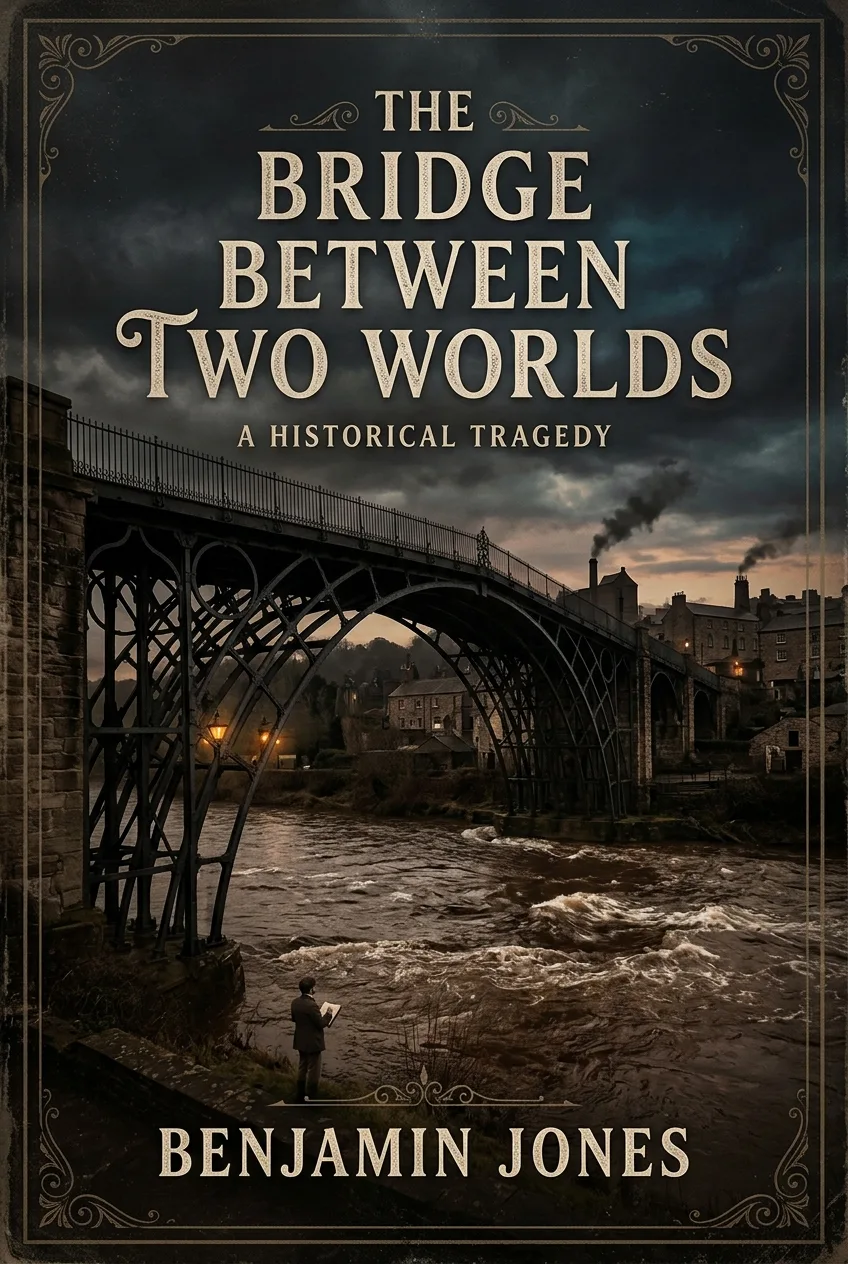
The Bridge Between Two Worlds
Chapter Two — The Inherited Lie (1816–1858)
7 minute read
← Benjamin Jones / The Bridge Between Two Worlds
The bridge opened on the twenty-fourth of July, 1816, and the town came out to celebrate as though the whole world had been rebuilt.
There were banners on the quay and a band on the bridge itself, and the mayor made a speech that lasted forty minutes and mentioned the word "progress" eleven times. The iron arches stood black against the summer sky, and the river ran beneath them, and the crowd cheered, and nobody thought of Thomas Vale at all.
Eleanor stood at the back of the crowd with her son in her arms.
Samuel was six months old that day. He had his father's grey eyes and his father's habit of staring at things as though he could see through them. Eleanor had wrapped him in a shawl and carried him down to the bridge to see the great iron arches, and she had told him—though he was too young to understand—that his father had helped to build them.
"Look," she said, as the band played and the mayor droned on. "Look at what he made."
Samuel looked. He did not understand. He would not understand for many years.
They lived in a rented room above a chandler's shop on the lower end of the High Street, and Eleanor took in sewing, and then washing, and then lodgers. She was not a proud woman—poverty had cured her of pride—but she was a careful one, and she kept her papers in a tin box beneath the floorboard, and she never once told Samuel the truth about his father.
She told him instead that his father had been a good man who had been taken from them too soon. She did not say how. She did not say why. She let the town's story stand—the story of the draughtsman who had stolen money and run away—because she could not prove anything else, and because she was afraid of what Harcourt might do if she tried.
Samuel grew up with the story the way a tree grows around a stone. It shaped him without his knowing it. He heard the whispers in the street and the sniggers at school, and he learned to hold his head up and say nothing, and he learned to hate the name of Vale because it was the name that had made his mother poor and his childhood small.
When he was twelve, he asked her about the money.
"What money?"
"The money they say he stole."
Eleanor put down her needle and looked at him for a long time.
"Your father never stole anything in his life," she said. "Don't you ever let me hear you say otherwise."
She never spoke of it again. Samuel never asked again. But the stone was still there, and he grew around it.
In 1841, when Samuel was twenty-five, his mother died.
She died in the spring, of a fever that had swept through the lower town, and she died quickly, and she left him the tin box and a letter that she had written in her own hand and never sent. Samuel buried her in the churchyard at the top of the hill and stood by the grave until the light went out of the sky.
Then he went home and opened the box.
There were papers inside—more papers than he had expected. The original survey of the Price property. A copy in his father's hand, with the boundary lines marked in red. A bundle of correspondence from a solicitor in Bristol, never sent, never answered. A page torn from a ledger, showing payments made to Nathaniel Pike by order of Sir Edmund Harcourt.
Samuel sat at the kitchen table and read them all, one by one, by the light of a single candle.
When he had finished, he sat very still.
He had spent his whole life believing that his father was a thief. It had been a comfort, in its way—a simple story that explained why they were poor and why he had no name and why his mother never spoke of the man who had left her. Now the story was gone, and in its place was something colder and more terrible: his father had been murdered, and the man who had murdered him had been paid by a gentleman, and nobody had ever been punished.
He thought about the tin box. He thought about his debts—the money he owed the chandler, the money he owed the tailor, the money he owed half the town. He thought about his livelihood, which depended on the goodwill of men who had known Sir Edmund Harcourt and who would not take kindly to a Vale who went around making accusations.
He thought about his mother's letter, which he had not yet opened.
It said: Tell no one until you have proof. Then tell everyone. Promise me, Samuel. Promise me.
He folded the letter and put it back in the box.
He did not promise.
He went to the Harcourt family's solicitor in the autumn, with the papers in a leather satchel and a story that he had rehearsed a hundred times. He was shown into a fine office with a fire burning in the grate, and a fine gentleman in a fine waistcoat heard him out without interrupting once.
When Samuel had finished, the gentleman said, "You have proof?"
"I have papers."
"Papers can be forged." The gentleman smiled. "Papers can be bought. Papers can be lost."
"There are people who remember—"
"People remember what they are paid to remember, Mr Vale. And you are not a wealthy man." The gentleman leaned forward. "Let me be frank with you. Sir Edmund Harcourt has been dead these fifteen years. Nathaniel Pike will deny everything. You are proposing to accuse a dead man of murder on the word of a servant and a bundle of old paper. You will be laughed out of court."
"I don't want a court," Samuel said. "I want—"
"Justice?" The gentleman smiled again. "Justice is expensive, Mr Vale. How do you propose to pay for it?"
Samuel said nothing.
The gentleman named a sum.
It was not a large sum. It was enough to clear his debts, and buy a little shop, and live quietly for the rest of his life. It was enough to make him respectable.
It was enough to make him forget.
Samuel took it.
He told himself he was being practical. He told himself that his father was dead and could not be helped, and that his mother was dead and could not be comforted, and that a man must live in the world as it is and not as it ought to be. He told himself all these things, and he believed them for a while, and then he stopped believing them, and by then it was too late.
He burned one of the papers—the ledger page, the one with the payments on it—and he put the rest back in the box and closed it, and he never opened it again.
A second letter from Eleanor came to him in the spring, forwarded by a neighbour who had found it in her things.
He opened it in the shop, by the window, with the river running past the end of the street.
It said: I know you will do the right thing. I know you will make him proud. I am sorry I could not stay to help you. Remember what I told you. He never stole anything in his life.
Samuel folded the letter and put it in the box with the rest of the papers.
Then he sat at the counter with his head in his hands for a very long time, and then he got up and opened the shop, because that was what a man had to do.
Samuel's widow had kept the tin box after he died, and her last act, before the fever took her, was to pass it on to her grandson.
William was eleven years old in 1858, and he was living with his mother in a cottage on the Welsh side of the river, and he had visited his grandmother every summer since he could remember. He knew her as a quiet woman with a tin box and a habit of looking at the bridge.
On the day before she died, she called him to her bedside and made him sit on the edge of the mattress, and she put the tin box in his hands.
"Keep this," she said. "Keep it safe. One day you will know what to do with it."
"What's in it?"
"Your great-grandfather's name." She smiled—a small, tired smile. "And a promise I want you to make me."
"What promise?"
"That you will find out what happened to him. And that you will not let anyone forget."
William promised.
He was eleven years old, and he did not understand what he was promising, but he kept the box, and he kept the promise, and thirty-one years later he would come back to Chepstow with the box in his hands and find out what his grandmother had known.
But that was not yet.
For now, he was eleven, and his grandmother was dying, and the bridge stood over the river the way it had stood for forty-two years—dark and silent and patient, waiting for the truth to come home.

About Benjamin Jones
Benjamin Jones is a historical fiction author fascinated by the people and engineering that shaped the British landscape.
Author Page
Reader Comments
Leave a Comment or a Book Review
We would love to hear your thoughts on this chapter, or even a complete book review.