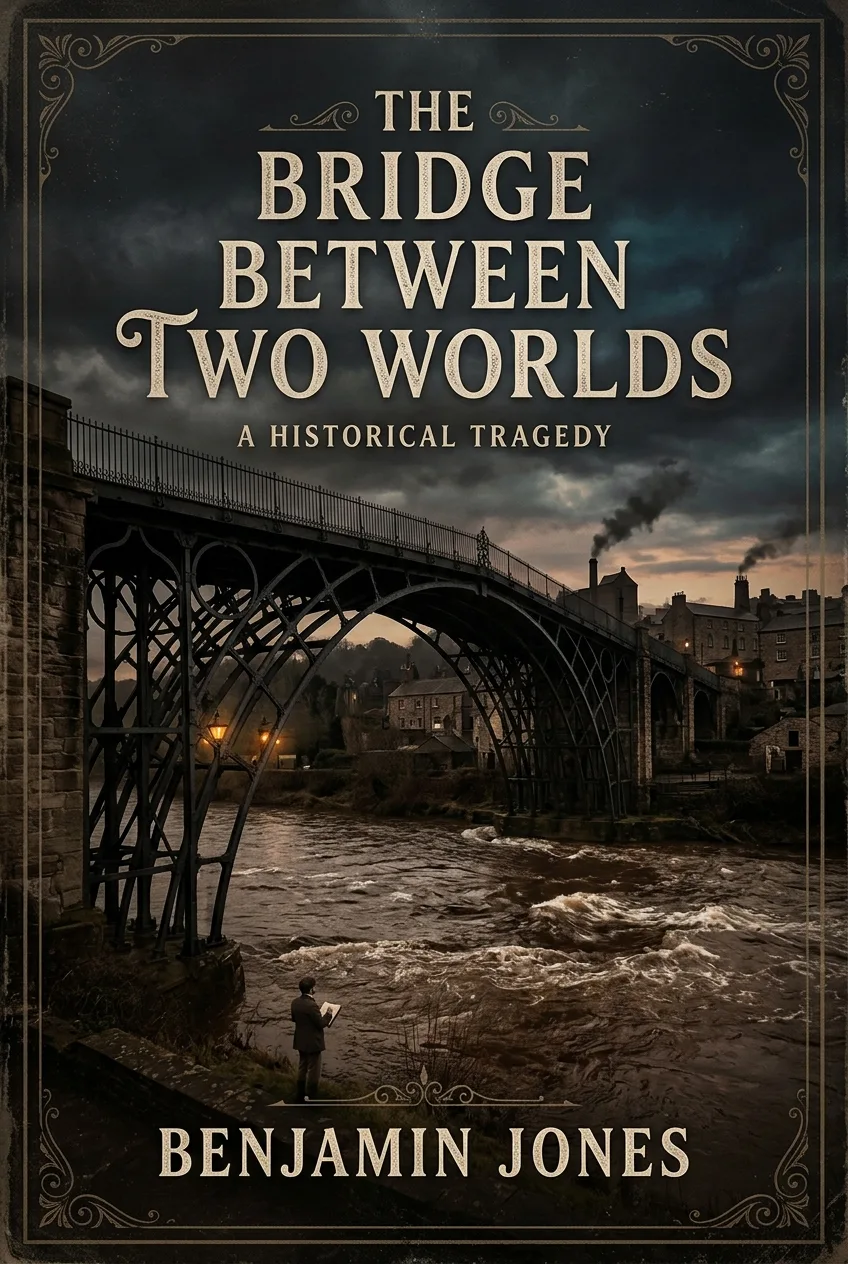
The Bridge Between Two Worlds
Chapter Three — The Evidence (1889)
6 minute read
← Benjamin Jones / The Bridge Between Two Worlds
The bridge was being taken apart, and William Vale stood on the Chepstow bank and watched it happen.
They were not pulling it down—that was the first thing the foreman had told him, with the weary patience of a man who had explained it a hundred times already. They were strengthening it. The old iron arches, designed for the carts and coaches of 1816, were being reinforced with steel to carry the weight of a new century: locomotives, traction engines, the great thundering drays that hauled timber down from the forest. The bridge would endure. It would simply be made stronger.
William was forty-two years old, and he had come home to bury a name.
He had the tin box under his arm. He had carried it from Bristol on the morning coach, and he had not let it out of his sight for a moment, and now he stood on the quay where his great-grandfather had walked and watched the men swarm over the scaffolding.
The river ran high and brown beneath the arches, the same colour it had been on the night Thomas Vale was rolled into it.
He took lodgings above a chandler's shop on the lower end of the High Street—the same shop, though the chandler was long dead and the sign above the door had been repainted twice. The landlady was a widow with a sharp eye and a sharper tongue, and she asked him no questions beyond the rent.
He opened the box on the first night and laid the papers out on the bed.
He had known, in a general way, what they contained. His grandmother had told him the story when he was old enough to understand it—the forged mortgage, the murdered draughtsman, the family that had been ruined and the gentleman who had done the ruining. But she had never shown him the papers. She had kept them hidden, and she had made him promise, and now she was dead and the papers were his and he could read them for himself.
He read them until the candle guttered and went out.
The original survey was there, and the copy in his great-grandfather's hand, with the boundary lines marked in red. The correspondence from the Bristol solicitor, never sent. The letter from Eleanor to Samuel, and the letter from Samuel to no one, which he had written and never posted and which William found folded inside the original survey.
I have done a wicked thing, Samuel had written, in a hand that shook. I have taken money from the men who killed my father, and I have told myself that it was for the best, and I know that it was not. I cannot undo it. I cannot even confess it. I can only hope that one day someone will find these papers and do what I could not do.
William sat on the edge of the bed with the letter in his hands and felt something cold settle in his chest.
He had never met his grandfather. Samuel had died when William was a boy, a quiet man who kept a shop and went to church on Sundays and never spoke of his father. William had thought him dull. He had thought him timid. He had not known that he was carrying a stone in his chest that had been growing since he was twenty-five years old.
He folded the letter carefully and put it back in the box.
The servant's name was Mrs Hale, and she lived in a cottage at the end of a lane that ran down to the river.
She was eighty-six years old, and she had been Nathaniel Pike's housemaid for thirty-six years before his death in 1851, and she remembered the night of the murder as though it had been the night before.
"I was not there," she told William, when he had introduced himself and explained his business. "I was at the house. But I heard him come in, and I heard him washing, and I heard him crying."
"Crying?"
"He was a soft man, Mr Vale. He was not a wicked man—or he did not think he was. He did what he was paid to do and he told himself it was not his fault, and then he came home and washed the blood off his hands and cried like a child." She looked at him steadily. "I never told anyone. Who would have believed me? And he was good to me, in his way. He gave me a roof and a wage and he never raised his hand to me. I could not bring myself to speak against him while he lived."
"And after he died?"
She was silent for a moment.
"He confessed," she said. "At the end. He was ill for a long time, and he sent for a priest, and he told him everything. I heard it through the door. He said he had killed a man on the quay and rolled him into the river, and he said he had done it on the orders of a gentleman, and he said he had never known a moment's peace since."
"Did he name the gentleman?"
"He said 'Harcourt.'" Mrs Hale's eyes were old and clear. "I remember it because it was the only word he said that I understood."
The letter was in the box, at the bottom, beneath the surveys and the correspondence and the letters that had never been sent.
It was addressed to no one, and it was dated the year of Pike's death, and it was written in a firm, deliberate hand that had not yet begun to shake.
I, Nathaniel Pike, being of sound mind and knowing that I have not long to live, do hereby confess that on the night of the twelfth of November, 1815, I did wilfully and deliberately murder Thomas Vale, draughtsman, of Chepstow, and did dispose of his body in the River Wye. I did so at the urging and on the instruction of Sir Edmund Harcourt, who had paid me to procure the Price property by fraudulent means and who feared exposure. I have carried this sin for thirty-six years and I can carry it no longer. I ask forgiveness of God and of the man I killed, and I ask nothing of men.
It was signed, and witnessed, and dated.
William read it three times.
Then he put it back in the box and closed the lid and sat for a long time in the dark of the lodging-house room, listening to the river run past the end of the street.
Edward Harcourt received him in the study of the great house above the town.
He was a heavy man in his fifties, with the same soft hands and careful smile that his grandfather had carried, and he listened to William's account without interrupting once. When William had finished, he set down his glass and folded his hands on the desk.
"You have proof?"
"I have a confession. I have a forged survey. I have correspondence that shows your grandfather paid Nathaniel Pike to procure the property by fraud."
"You have paper." Harcourt smiled. "My grandfather has been dead for more than sixty years. Pike has been dead for nearly forty. You cannot prosecute a dead man, Mr Vale."
"I don't want to prosecute. I want the truth published."
"Then publish it." Harcourt spread his hands. "And I will deny it. And my solicitors will deny it. And the world will conclude that a disappointed man has come to Chepstow to make trouble for a family that has done nothing but good for this town. Who will believe you? A shopkeeper's grandson with a bundle of old paper? You will be laughed out of the county."
"My great-grandfather was murdered."
"Your great-grandfather was a draughtsman who disappeared in the night. The rest is speculation." Harcourt picked up his glass again. "I am sorry for your loss, Mr Vale. I am sorry for whatever your family has suffered. But I cannot help you, and I will not apologise for a crime I did not commit."
William stood up.
"You know it's true," he said.
Harcourt said nothing.
"You know it's true, and you will spend the rest of your life knowing it, and every time you look at that bridge you will know that it was built by a man your grandfather had killed."
"The bridge," Harcourt said, "was built by John Rastrick. Your great-grandfather was a draughtsman. He drew lines on paper. Let us not exaggerate his importance."
William walked out of the house and down the hill to the town, and he did not look back.
About Benjamin Jones
Benjamin Jones is a historical fiction author fascinated by the people and engineering that shaped the British landscape.
Author Page
Reader Comments
Leave a Comment or a Book Review
We would love to hear your thoughts on this chapter, or even a complete book review.