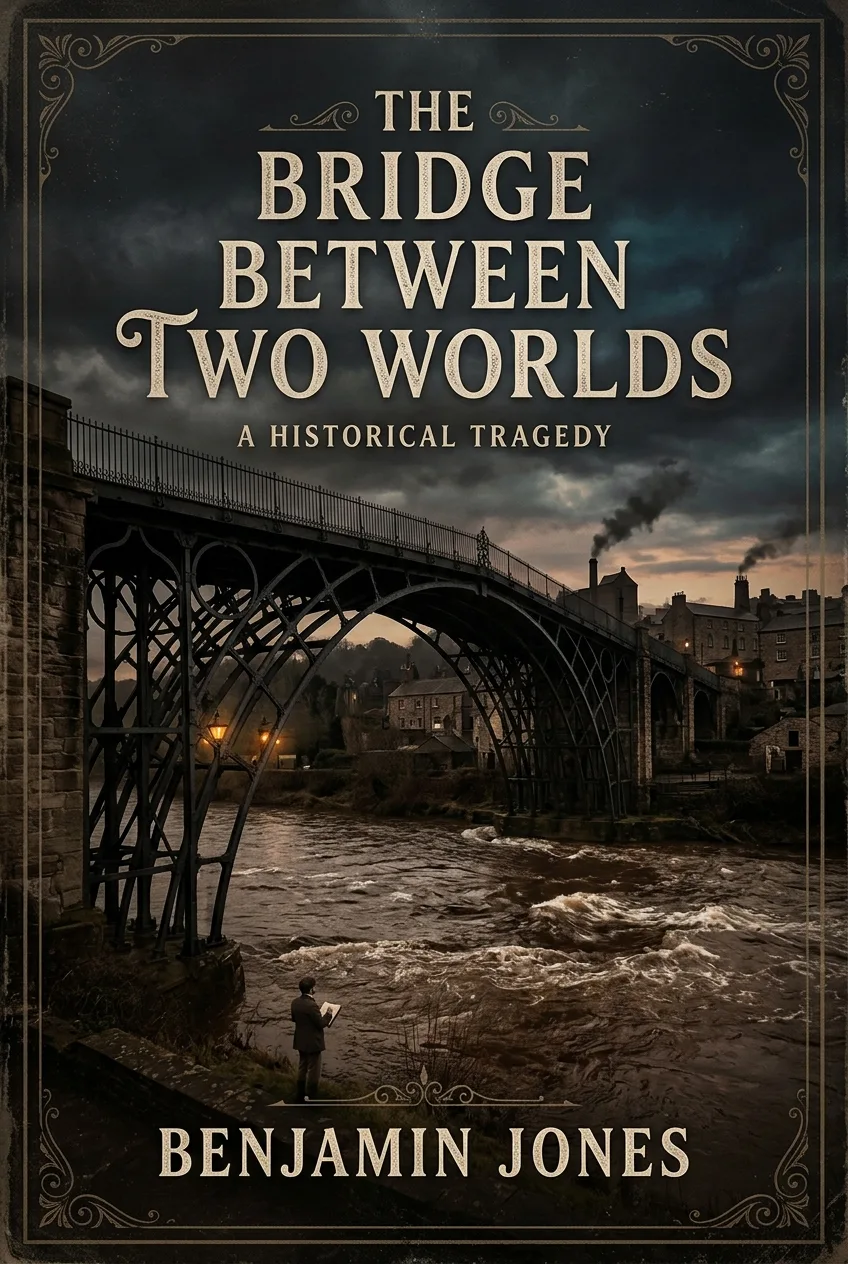
The Bridge Between Two Worlds
Chapter One — The Forgery (1815)
7 minute read
← Benjamin Jones / The Bridge Between Two Worlds
The river did not forgive; it remembered.
Thomas Vale kept his head down against the rain as he walked the Chepstow quayside, his collar turned up and his sketchbook clamped beneath his arm like a shield. The Wye ran high and brown that November, swollen with the autumn floods, and the sound of it grinding against the timber wharves was the sound of a beast chewing its chains. He had grown up with that sound. He no longer heard it.
He was twenty-six years old, a foundry draughtsman with ink on his cuffs and a future he could almost touch. In eight months he would marry Eleanor Price, and in eight months the new iron bridge would span the river from the Chepstow bank to the Monmouthshire shore, and the two facts had become tangled in his mind until he could not think of one without the other. The bridge was his first great work. Eleanor was his first great love. He intended to deserve both.
The bridge works had begun in the spring—a lattice of cast-iron ribs rising from the mud, designed by men in London who had never smelled the Wye at low tide. Thomas was one of a dozen draughtsmen employed to translate their elegant drawings into something the foundries at Bridgnorth could actually cast. It was not glamorous work. It was the work of a man who noticed things.
That was the trouble with Thomas Vale. He noticed things.
It happened on a Tuesday, in the surveyor's office above the iron merchant's yard, with the rain drumming on the slates and a fire spitting in the grate. Two sets of drawings lay open on the table—the original survey of the Price riverside property, and a competing survey submitted by Sir Edmund Harcourt's agent. The two documents were meant to be identical. They were not.
Thomas leaned closer. The boundary line along the eastern meadow had been shifted. Not by much—a rod or two, no more than a careless eye would miss—but shifted all the same, and shifted in Harcourt's favour. He traced the line with his finger, then opened the original survey and traced that too. The discrepancy was not an error. An error would have been random. This was deliberate.
He sat back in his chair and stared at the fire for a long moment.
The Price property was not a great estate. It was a modest riverside holding—an orchard, a meadow, a few acres of good grazing, and the old house where Eleanor had been born. But it had one thing that Sir Edmund Harcourt wanted, and wanted badly: it commanded the eastern approach to the new bridge. Every cart, every coach, every head of cattle that crossed from England into Wales would pass within a stone's throw of Josiah Price's meadow. Harcourt had already bought up every other parcel of land on the approach. He had offered Josiah a price for the meadow, and Josiah had refused. Now, it seemed, Harcourt had found another way.
Thomas copied the original survey that night by candlelight, his hand steady and his stomach cold. He copied the forged boundaries too, side by side, and marked the discrepancy in red ink. Then he folded both sheets into his coat and walked out into the rain.
He found Nathaniel Pike in the bar of the Three Cranes, as he had known he would. Pike was Harcourt's agent—a soft, well-fed man with a smile that never reached his eyes and a habit of touching his watch chain as though checking that time had not run out on him. He was drinking claret and talking loudly about the price of timber. He stopped talking when Thomas sat down opposite him.
"You're the draughtsman," Pike said.
"I'm the draughtsman," Thomas agreed. He laid the two surveys on the table between them. "And you're a forger."
Pike did not look at the papers. He looked at Thomas's face, and something in his expression shifted—a door closing, quietly, somewhere behind his eyes.
"You're mistaken," he said.
"I'm not." Thomas tapped the red marks. "You moved the boundary. You forged the mortgage. You mean to take Josiah Price's meadow, and you mean to do it with a piece of paper that wouldn't survive five minutes in a court of law."
Pike was silent for a moment. Then he smiled, and the smile was worse than his silence.
"How much?" he said.
"Not enough."
"Everyone has a price, Mr Vale."
"Not everyone." Thomas folded the surveys and put them back inside his coat. "I'll be taking these to a solicitor in the morning. I thought you should know."
He stood up. Pike caught his sleeve—a soft, damp hand closing on the wool—and for a moment the two men looked at each other across the table.
"You're making a mistake," Pike said quietly. "You don't know what you're meddling in."
"I know exactly what I'm meddling in," Thomas said. "That's the point."
He walked out into the rain, and he did not look back, and he did not see Pike's face as he watched him go.
Pike came to him three days later, on a night so dark the river was invisible beneath the bridge works.
The message was waiting at Thomas's lodgings when he came home from the foundry: a note in a careful hand, asking him to meet at the old warehouse on the quay, promising documents that would settle the matter of the Price property beyond any dispute. Thomas read it twice. He knew it was a trap. He went anyway, because he was twenty-six years old and he had never yet met a trap he could not walk out of.
The warehouse was cold and empty, lit by a single lantern that Pike had set on a crate. The river lapped at the pilings beneath the floor, and the whole building smelled of tar and rot. Pike was standing by the lantern with his hands behind his back.
"You came," Pike said.
"You asked me to."
"I asked you to be sensible." Pike's voice was almost sorrowful. "I offered you money. You refused. I'm offering you again."
"And I'm refusing again." Thomas took out the copied surveys and held them up. "These go to a solicitor tomorrow, Pike. You can offer me the whole of Harcourt's fortune and it won't change that."
Pike sighed. It was a soft, almost regretful sound, and it was the last gentle thing that happened in that warehouse.
"You should have taken the money," he said.
Thomas saw the iron bar a moment before it swung. He threw up his arm, and the bar caught him across the shoulder with a crack that sent him staggering into the crates. He shouted—he thought he shouted—and then Pike was on him, and the bar was rising and falling, and the lantern had gone over and the warehouse was full of shadows and the smell of hot oil.
The last thing Thomas Vale saw was the river through the open door, black and patient, waiting for him.
Pike dragged him to the edge of the quay and rolled him into the water. There was a splash, and then a silence, and then nothing but the rain and the tide and the grinding of the bridge works upstream.
Harcourt heard the news the following morning, over breakfast, from a servant who had heard it from a carter who had heard it from a constable.
"The draughtsman," Harcourt said. "Vale."
"Gone, sir," the servant said. "They say he stole money from the foundry and ran off."
Harcourt buttered a slice of bread and ate it slowly.
"Did they," he said.
He finished his breakfast, and then he wrote a letter to Nathaniel Pike, and then he burned the letter, and then he stood at the window of his study and looked out at the river, and he felt nothing at all.
The story spread the way such stories always spread—from the foundry to the tavern, from the tavern to the market, from the market to the church porch. Thomas Vale had stolen money. Thomas Vale had abandoned his bride. Thomas Vale had been a scoundrel all along, and the respectable people of Chepstow had always known it.
Eleanor Price heard the story from her father, who heard it from the vicar, who heard it from Harcourt himself. She did not believe it. She stood in the kitchen of the old house by the meadow and listened to her father explain, gently, that the wedding would have to be postponed, and that perhaps in time the scandal would die down, and that she must think of her reputation, and that the child—when the child came—would need a name.
"I know what he was," Eleanor said.
"Nobody knows what anybody is," her father said.
"I know what he was," Eleanor said again.
She went up to her room and closed the door and did not come down for three days. When she came down, she had decided that she would live, and that her son would live, and that one day—somewhere, somehow—the truth would be found.
She did not know that it would take seventy-four years.
She did not know that it would take three generations.
She only knew that she had loved a man who noticed things, and that the river had taken him, and that the bridge he had died for would stand over the water whether anyone remembered him or not.
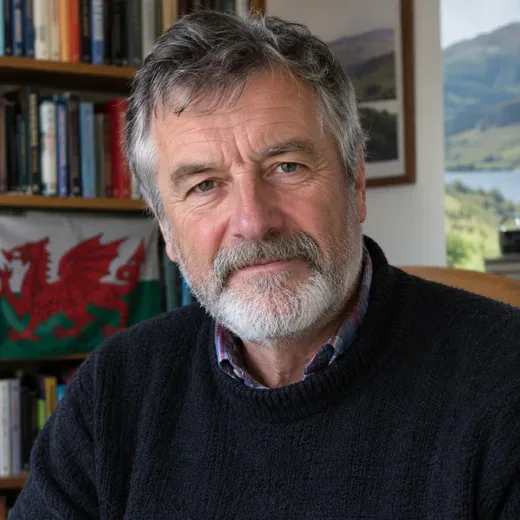
About Benjamin Jones
Benjamin Jones is a historical fiction author fascinated by the people and engineering that shaped the British landscape.
Author Page
Reader Comments
Leave a Comment or a Book Review
We would love to hear your thoughts on this chapter, or even a complete book review.