The Anchored Dead
Chapter 3: The Tunnels of King Street
← Terry Farland / The Anchored Dead
The damp air inside Mrs. Gable’s hallway seemed to freeze solid around Arthur’s chest. He stared at the dark, glistening footprint on the rag-rug, the smell of deep-sea rot filling his nostrils until his gorge rose.
He knelt down, his fingers shaking as he touched the edge of the puddle. It was frigid—colder than the sea fog outside—and caked with a gray, silty mud that felt like powdered slate between his fingertips. He brought his stained hand to his nose. It carried no trace of the salt spray that washed over the Slipway during high tide; this was stagnant water, heavy and lifeless, squeezed from some suffocating abyss where light had never reached.
A sharp knock echoed through the front door, making Arthur leap backward with a choked cry.
"Arthur? Are you in there, lad?"
The voice belonged to Caleb Ward, the village constable and a former coastguard who had spent thirty years watching the Yorkshire cliffside. Arthur scrambled to his feet, threw open the heavy oak door, and pulled the tall, broad-shouldered man inside out of the sea fret.
"Caleb," Arthur breathed, shutting the door fast against the wall of white vapor. "Thank God. Look at the rug."
Caleb stepped into the hall, removing his oilskin cap. He glanced down at the wet footprint, his weathered brow furrowing as he noticed the dark trails of silt leading toward the darkroom. "I see it," Caleb said quietly. "And I smell it, too. It’s the same smell coming up through the floorboards at the Bay Hotel."
Arthur wiped his hands on his trousers. "What do you mean?"
"The lower cellars along King Street," Caleb said, his voice dropping to a low, grim rasp. "The old smuggler channels under the village—the ones that run from the beach up through the rock to the upper houses. An hour ago, the publican went down to fetch a cask of ale. The cellar floor is drowned in two feet of black water. But the tide is at dead low, Arthur. The sea's half a mile out on the Scars, yet the water under King Street is rising."
Caleb paused, looking Arthur dead in the eye. "And there’s more. Old Thomas sent me up here. He said you took a likeness of that cursed vessel before you ran up the hill."
Arthur hesitated, then led the constable into the tiny crimson glow of the darkroom. He picked up the wet glass plate, still dripping with fixer solution, and handed it to the old coastguard.
Caleb held the plate up toward the amber lamp. As the light passed through the silver emulsion, the old man’s face turned gray. His rough thumb brushed the glass right where the crowded deck of the Dolphin sat rendered in dark, impossibly crisp shadows.
"God preserve us," Caleb whispered. "That's not a crew. That's the whole damn roster."
"You recognize them?" Arthur asked, stepping closer.
"I was a boy of fifteen when the Dolphin went down off Ravenscar," Caleb said, his voice trembling. "October of '54. A Great Fire Gale hit the coast—turned three schooners into firewood against the shale. The Dolphin tried to ride out the gale in the deep water, but her anchor chain snapped. We found pieces of her stern two days later, but not a single body ever washed ashore. The sea kept all twelve of them."
Caleb pointed a calloused finger at the edge of the glass, right beside the wooden legs of Arthur's tripod where the dripping, sunken-faced figure stood in terrifying clarity.
"That man there," Caleb whispered, his fingernail scratching against the glass. "That’s Captain Jonas Vance. I'd know that broad jaw and crooked collar anywhere. He went down with his ship twenty years ago."
Arthur felt a cold sweat break out across his forehead. "Caleb... when I took this picture, the beach was empty. The ship was empty. The boarding party walked those decks an hour ago and found nothing but rotted timber and mud."
"Then your chemical glass is seeing what eyes can't," Caleb said, setting the plate down on the wooden bench as if it were white-hot iron. "The silver on this plate isn't just taking a picture, Arthur. Look at the edges."
Arthur leaned down. Around the outline of the specter’s feet, the silver nitrate layer on the glass was physically corroded. The gelatin had peeled away in delicate, fern-like frost patterns, encrusted with microscopic crystals of salt.
"It’s a bridge," Arthur realized, the horror dawning on him with absolute clarity. "The light... the silver salts... it's giving them weight. It's drawing them out of the image and into the stone."
Before Caleb could reply, a low, grinding vibration rattled the small window frame of the darkroom. The glass jars of ether and varnish on the shelves clicked against one another in a frantic, rhythmic chatter.
From deep beneath the floorboards—down in the dark, hand-hewn smuggler tunnels carved into the cliff rock below New Road—came a sound that made both men freeze.
It was the heavy, agonizing scrape of massive iron links being dragged across wet slate, pulling slowly, relentlessly upward toward the surface.
About Terry Farland
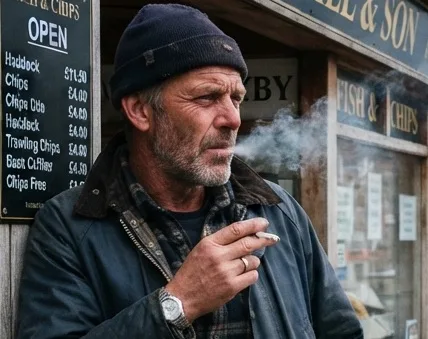
Terry Farland writes gothic fiction set on the North Sea coast. His work draws on the photography, fishing and folklore of Yorkshire's coastal villages, and the uneasy line between what the camera records and what the sea returns. The Anchored Dead is his first novel for Tales From A Harrogate Caravan.
Author Page
Reader Comments
Leave a Comment or a Book Review
We would love to hear your thoughts on this chapter, or even a complete book review.