The Anchored Dead
Chapter 19: The Smelter at Grosmont
← Terry Farland / The Anchored Dead
The black steam train pulled out of Whitby Station at dawn, laboring against the steep gradient up the Esk Valley. Inside the second-class compartment, Arthur, Caleb, and Sterling sat in silence as the winter rain lashed against the carriage glass.
On the floor between them rested a lead-lined iron trunk—Sterling’s collection box. It contained the eleven recovered glass plates, stacked between sheets of sulfur-free felt to prevent contact between the emulsions.
"Silas Thorne didn't disperse the plates at random," Sterling explained, opening a leather map of the North Riding across his knees. "He tracked down the old alum accounts from 1790. Every photographer who bought a box from him was located along the original iron-ore veins that feed into the Esk."
"Grosmont," Caleb said, looking out at the looming dark hills of the North York Moors. "The old iron furnaces."
"Precisely," Sterling agreed. "The ore was mined at Ravenscar, but it was smelted at Grosmont. If the chain is an unbroken electrical circuit formed of silver and iron, the blast furnaces are where the circuit was first fused. Thorne’s ledger shows the remaining eighty-five unexposed plates were delivered to a commercial processing workshop built right over the old furnace foundations."
Forty minutes later, the train hissed to a halt at Grosmont siding. The air here was heavy with the smell of sulfur, wet coal ash, and slag heaps.
They walked up the cinder path toward the ruined stone engine house. Its towering chimney stood like a broken pillar against the leaden sky. Beneath the shadow of the brick stack stood a newly erected corrugated iron shed—the commercial studio of Vane & Sons, Photographic Wholesalers.
As they approached the timber doors, Arthur stopped.
The ground beneath his boots was vibrating—a low, rhythmic thrumming that shook the cinder path. It wasn't the distant rumble of the railway engine. It was the same metallic pitch that had echoed off the lead box on the Bay Scars.
Caleb stepped forward, drew his service pistol, and kicked open the latch.
Inside, the long shed was bathed in an eerie red glow. Dozens of ruby safety lanterns hung from the rafters, illuminating three massive zinc chemical troughs that ran the entire fifty-foot length of the floor. Standing over the troughs were four men in rubber aprons, their arms submerged to the elbows in bubbling silver nitrate solution.
Along the far wall, arranged in long rows over iron racks heated by coal burners, were hundreds of drying glass negatives.
"Stop!" Arthur screamed, rushing into the room. "Turn off the gas burners! Don't heat the glass!"
The studio proprietor, a stocky man with chemical-stained sleeves, spun around in alarm. "What is the meaning of this intrusion? We are fulfilling a contract for—"
"The heat is opening the emulsion!" Arthur shouted, pointing to the iron racks.
It was already too late.
Over the heated racks, the air was shimmering with a dense, white, ice-cold mist. The silver film on dozens of plates was liquefying, running down the glass panes into the floor gutters. But the liquid did not pool on the concrete—it was being drawn into the old iron drainage grate in the center of the floor, where the subterranean channels of the old blast furnace ran deep into the earth.
From deep within the ironworks' underground culverts came a deafening, metallic screech—the sound of a hundred iron links tearing free from the bedrock.
About Terry Farland
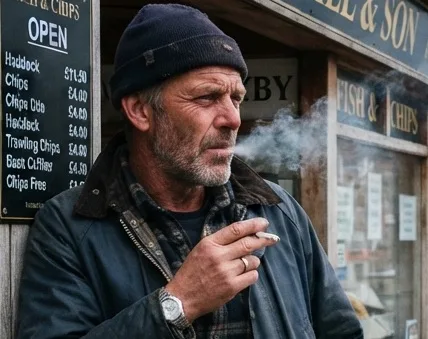
Terry Farland writes gothic fiction set on the North Sea coast. His work draws on the photography, fishing and folklore of Yorkshire's coastal villages, and the uneasy line between what the camera records and what the sea returns. The Anchored Dead is his first novel for Tales From A Harrogate Caravan.
Author Page
Reader Comments
Leave a Comment or a Book Review
We would love to hear your thoughts on this chapter, or even a complete book review.