We Are All Vampires
XIX — Deluded Entitlement and Its Consequences
← Karl Swainston / We Are All Vampires
A knock rapped on the door, followed by a police officer. After drawing aside the ambulance man and learning the facts, the police officer was satisfied with the probable cause of death. He turned to Racid and said, ‘Mr...?’
‘Racid.’
‘Was the old man your father?’
‘No, but he was like a dad to me. I lived here with him.’
‘How long have you lived here?’ asked the police officer.
‘About two years or so now, Officer.’
‘Mr Racid, I’m very sorry for your loss.’ The police officer continued, ‘However, because of the nature of death and your relationship with Mr Earnest, we will have to conduct an autopsy and go through the necessary lines of enquiry and investigation. Don’t worry about it; it’s all perfectly normal, and I’m sure it will be conducted promptly and with the least amount of distress to yourself. Now, if you’ll accompany me to the station and let others do their duty, Mr Racid.’
‘Certainly, Officer,’ replied Racid calmly.
The investigation rolled into work as soon as the officer and Racid had left the property. It was deemed highly likely that the old man had left his bed for some reason late into the night and had tried to go downstairs when he fell and killed himself. There were no suspicious circumstances to suggest otherwise. Later, the autopsy confirmed this, and accidental death was officially pronounced as the cause.
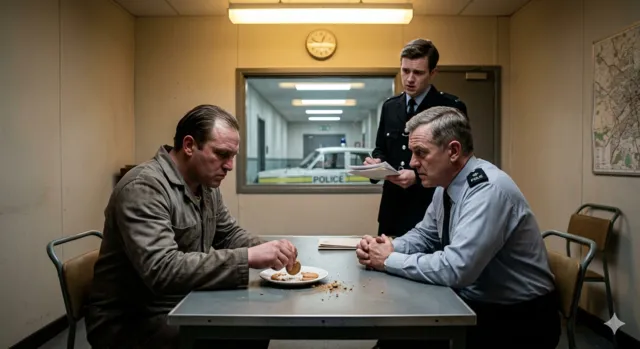
At the station, Racid was given tea and biscuits during his interview. The questions put to him, although clinical and measured to elicit the most revealing events of that night and the nature of his relationship with the old man, were asked most politely and respectfully that would usually be practised in questioning someone who had lost someone so dear.
Since Racid had nowhere else to stay that night and was not allowed to go back to the farm until the investigation had run its course, he was allowed to sleep in a cell.
Extra blankets and tea were brought to him. He slept soundly and felt utterly refreshed when morning arrived.
The cell door opened, and the Inspector, who had interviewed Racid the night before, stood before him.
‘I’m glad you slept soundly, Mr Racid, after what you had to endure yesterday. I hope you will forgive us, but we had to do our duty.’
‘You were only doing what you had to do, Inspector.’
‘The preliminary report has just arrived from the autopsy, which concurs with earlier investigations, and initially confirms that your friend, old Earnest, died of an accident. You are free to go and to return to the farm.’
‘Thank you, Inspector.’
Racid collected his coat and looked around to see if he had left anything significant in the cell. He had not, but noticing a single biscuit amidst brown crumbs on a white plate, he bent down and picked the biscuit up.
‘Waste not, want not!’ he uttered as he strode past the Inspector.
A junior officer approached the Inspector and asked him, ‘Could you sign these, Inspector?’
‘There’s something not right about that man,’ the Inspector muttered but quickly shrugged his shoulders and signed the papers whilst asking his junior, ‘I heard your team, Leeds, beat Man U 4 - 0 last night?’
Racid did not bother to attend the old man’s cremation, claiming to the odd few who asked that it would be too distressing for him to see the dead body of a friend burnt.
Racid took charge of the property. Although he felt a great sense of entitlement to the property on account of looking after it and the old man, he made no application to legally secure the farm by initiating proceedings set down in the will, thinking that he might ‘...disturb some distant relative, who would have stronger claims than himself...’ He thought it best to do nothing but continue living on the property as if it were his own.
Years passed, and no one did arrive, knocking at the door to claim the land and house.
Over time, the last vestiges of what looked like a farm disappeared, and the place took on the aspect of a scrap yard without ever being one. Large fences were erected around its perimeter, and a triple-headed pack of hounds roamed the confines within so that it was impossible for anyone to gain access to the property without an invite.
These acts of vampiric entitlement and murder may appear extreme, but prisons and other penal institutions are full of vampires who have taken what is not theirs.
The vampiric acts have not always led to murder, but they invariably lead to untold suffering for the victim.
It is important not to confuse the common thief or a career criminal with these vampires. The common thief and career criminal may feel remorse for their victim, and they will know that what they have committed and taken was indeed not theirs.
The common thief and career criminal are acutely aware of this.
The vampire is not. The vampire believes they are entitled to whatever it is they have taken. And they certainly do not feel any compassion or remorse for their victims.
Racid was a vampire, possessing a unique sense of deluded entitlement: vampiric entitlement.
He felt he had saved the old man and the farm from death and from ruin. Murdering the old man was a just act, a warrantable act by Racid because it was his farm.
The vampire is incorrigible. The vampire sees those around it, including family members, as a means to get what they are entitled to. They are nothing more than that. Racid’s parents only did for Racid what was dutiful.
Friends and acquaintances are no different. Old Earnest was no different.
The first point to notice is that the vampire has very little or no merit to the entitlement. The entitlement is merely fictitious in their head. The property will, almost certainly, belong to the industry and the efforts of others. Injustice and harm will come to others if the vampire receives or steals the entitlement.
As earlier stated, taking something they are not entitled to but feeling and knowing that they are, the vampire will go to any lengths, even murder in Racid’s case.
Receiving something cherished is a positive vibration in them. Their hunger for positive energy and reward breathes deep within them. The result is that even though they are not entitled to something, it doesn’t matter because their whole being believes they are. The vampire now believes with the whole force within its body that it should receive. The vampire believes its hunger for the positive should be satiated at any cost. They are not bothered.
But not all vampires have to commit murder to receive their entitlement. Modern society and businesses almost give the vampire the warrant of entitlement.
Just before the financial crash of 2008, there were hordes of these entitled vampires around the globe. So-called ‘fat-cats’ ate their way through incredible salaries they felt entitled to.
Who said they were entitled to such ridiculous and amoral salaries when most people taking out mortgages or loans made each day meet?
However, these vampiric bankers were not fazed or conscience-laden over their salaries and cavalier actions with other people’s money. No. They were entitled to the money, and as for those with mortgages and loans: tough.
When the crash happened, these vampiric bankers simply disappeared: they ‘did one’ as the saying goes. My God! They were not responsible for the crash! A vampire is never responsible. A vampire will never admit guilt because it sincerely, faithfully, and without remit does not believe itself guilty of any crime. These vampires simply disappeared because the well of energy and money had dried up.
Isn’t it a travesty that after the collapse of many major financial institutions, after many ordinary folks had lost their money, not one vampiric banker was brought to justice?
Vampires indeed rule the financial markets and sectors. Their entitlement to huge salaries, and sod the rest, is the day’s action for them. Not only does the vampire exude vampiric entitlement and demonstrate grandiosity and self-exaggeration, but they are also often creatures full of rage.
Prefer to listen? Watch the video reading below.
Reader Comments
Leave a Comment
We would love to hear your thoughts on this chapter.

About Karl Swainston
Karl Swainston is a writer and storyteller whose work is forged from a life lived across the North of England and far beyond. Growing up on a Leeds council estate in the 1960s, Karl's journey was anything but linear. By the age of thirty, he had already lived a dozen lives: from the rigors of grammar school to a degree in Latin, a stint as a fishmonger, a period of discovery living in Marseille, and a return to the hustle of London. Whether working as a postman, a builder, or competing as a county-level chess player, he was, above all, an avid reader—constantly documenting the world around him. This restless spirit continued into his professional life. Karl later taught in Bradford, where he ran a specialist unit for 244 of the most excluded students from across the region—young people whom even the local Pupil Referral Units could not accommodate. Working alongside his old friend Malcolm, Karl spent his days navigating the volatility of Bradford's most aggressive and dysfunctional teenagers. Throughout his life, Karl has been an avid runner and has always shared his home with a rotating cast of beloved dogs and cats—companions who have been constant witnesses to his work. As a writer, Karl's range is as expansive as his history. He works across a wide breadth of genres, including fiction and short stories, autobiography and memoir, biography, non-fiction, and metaphysical writing, as well as providing sharp commentary, opinion, analysis, and essays. Whether writing about his years managing the Harrogate Arms or offering insights from his current adopted home in South East India, where he lives in a simple village with his dog, Bambi, Karl's voice reflects the full, untidy, and deeply human breadth of life. He continues to draw on the rich, decades-long tapestry of his experiences to tell stories that matter, proving that no matter where you live, the human story remains the same.
Author Page