We Are All Vampires
XVIII — Racid and the Old Man
← Karl Swainston / We Are All Vampires
It was a beautiful summer’s afternoon when Racid had finished fixing an old wheelbarrow to sell at the factory.
He felt the heat unbearable in his choking bedsit and decided to take a fresh stroll through Middleton Woods.
On the way along a deserted lane leading to the woods, Racid heard a groan from a semi-derelict farm across a short field. He ignored it at first, but upon hearing it a second time, he went to investigate.
When he neared the perimeter fence, he saw a hunched and significant piece of cloth on the ground; another groan rose from the strange pile on the grass. Not knowing what to do since the fence barred any access to the figure on the ground, Racid stared at the strange lump.
At last, a pink, bald head lifted itself from the figure’s clothes and looked towards Racid.
‘Help me,’ it called.
Racid realised the man on the floor was old and needed help, but rather than starting into action and helping the man, Racid concentrated his mind on what could be gained by the accident the old man had.
‘I wonder if he’s got any money on him,’ thought Racid.
‘Help me get into the house. Please. The dogs are tied up in the backyard, and you can let yourself in through the front gates. Help me, please,’ the old man pleaded.
Racid didn’t answer but walked casually down to where the front gates were. He entered, but rather than hurrying up the field to the old man, he set off towards the house.
He knocked first. There was no answer; he then banged hard with his fist.
Again, there was no answer. Racid tried the door handle, but it was locked.
Racid ventured around the property, trying to find access inside it, carefully avoiding the backyard with the dogs, but to no avail. There was no open access.
Realising nothing else could be done to get into the property aside from breaking into it, Racid walked off towards the old man on the ground.
‘You’ve been some time. Couldn’t you get in through the gates?’ muttered the old man.
‘I didn’t know how to do it,’ Racid replied calmly.
‘I feel a bit better and don’t think I’ve broken any bones. Help me up.’
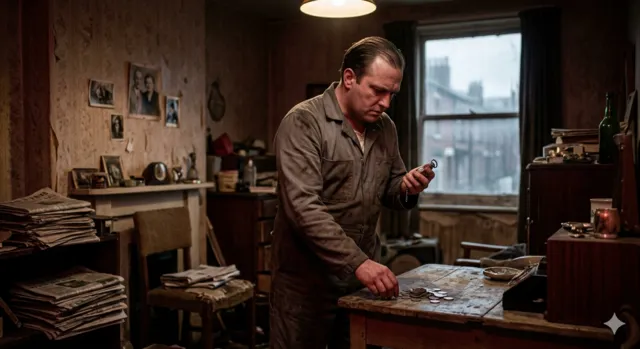
Racid put his right arm out to help the old fellow, but with his left arm, he began searching the old man’s pockets for anything valuable. He found nothing but scraps of old paper.
‘I’ll take you to your house.’
‘Cheers,’ stammered the old man.
Racid helped him back to his farmhouse, where the old man unlocked the door, and he and his helper, Racid, entered the property.
Upon entering the property, Racid’s eyes widened as his gaze latched onto a veritable treasure house.
All sorts of junk littered the property. As Racid regularly bought, stole, and sold old junk, he quickly determined the old man’s house was easy pickings. The two entered the kitchen and sat down at the kitchen table.
Racid began, ‘It was good to help you. I don’t know what you’d have done if I hadn’t helped you.’
‘You’ve done well, lad; you’ve done well.’
‘What’s yer name?’ Racid questioned.
‘Earnest, and this is my farm.’
Earnest was 88 years old and had owned the farm all his life; his parents had passed it on to him. He never married, had no children, and the farm had fallen badly into disrepair. He led a reclusive life. There was no livestock on the farm, only a few knackered, old horses chomped endlessly upon the grass of Earnest’s two minor fields.
‘I used to be able to look after the farm, but now I’m old, I cannot. The kids keep getting through the fence and nicking things.’
Racid’s fingers began to twitch.
‘I’ll sort out the fence, Earnest; don’t worry about that.’
Racid did sort out the fence and everything else, for that matter. He befriended the old man and curried his way, unswervingly, into the old man’s favour and trust.
A few weeks passed before Racid left his bedsit and moved into Earnest’s farm.
Racid’s plan was simple: get the farm off the old man. He bided his time, carrying out every conceivable task for the old fellow, which he made a particular point of making old Earnest aware of.
Just less than a year later, Racid was convinced the time was right to approach Earnest to discuss the old man’s will.
‘You don’t have any children, Earnest, do you? You’ve never mentioned any relatives; have you any?’
‘I don’t think so, lad, and if I had, I wouldn’t know where or who they are. There’s only you and me now, son.’
Racid smiled and pursued his line of attack.
‘I know I shouldn’t mention it, but what would happen to me should you…?’
‘Die? Don’t shy away from the word, lad. We all must die one day. I’ve been thinking lately about that. I don’t have any money, and this farm is all I have left, if you can call it that now. I have decided that you shall have it when I die.’
Racid tried to keep calm, but he trembled all over. He sincerely believed that the farm was his entitlement to look after it.
‘You must fill a will out for that to happen, Earnest.’
‘I will do the will tomorrow. Will do the will!’
Both men fell to laughing.
The will was signed the next day, and Racid was now the sole beneficiary of old Earnest’s property.
A year passed without any changes in old Earnest and Racid, but in the 90th year of the old man’s life, an accident of questionable nature occurred, which saw the sad demise of the old farmer.
On a cold night in January 1968, a 999 call from a phone box on Dewsbury Road was made to the Leeds Ambulance Service, informing them that an old man had had an accident and that the caller, a man, thought him dead.
Racid made the call. The old farmhouse did not have a phone. Racid had made his way along Middleton Grove to the public phone box on Dewsbury Road.
When the ambulance men arrived at the farm, they were met by Racid, who escorted them into the house and to the place at the bottom of the stairs where old Earnest’s body lay.
An ambulance man quickly confirmed that the old man was dead and that the most probable cause of death was falling down the stairs and his old age.
‘I’ve seen many dead bodies before in my job,’ commented one of the paramedics to a colleague, ‘but look at the horror, shock, and twisted anger on that old man’s face; it makes you wonder what was he thinking at the time of his death, doesn’t it?’
Racid concealed a smile.
Prefer to listen? Watch the video reading below.
Reader Comments
Leave a Comment
We would love to hear your thoughts on this chapter.
About Karl Swainston
Karl Swainston is a writer and storyteller whose work is forged from a life lived across the North of England and far beyond. Growing up on a Leeds council estate in the 1960s, Karl's journey was anything but linear. By the age of thirty, he had already lived a dozen lives: from the rigors of grammar school to a degree in Latin, a stint as a fishmonger, a period of discovery living in Marseille, and a return to the hustle of London. Whether working as a postman, a builder, or competing as a county-level chess player, he was, above all, an avid reader—constantly documenting the world around him. This restless spirit continued into his professional life. Karl later taught in Bradford, where he ran a specialist unit for 244 of the most excluded students from across the region—young people whom even the local Pupil Referral Units could not accommodate. Working alongside his old friend Malcolm, Karl spent his days navigating the volatility of Bradford's most aggressive and dysfunctional teenagers. Throughout his life, Karl has been an avid runner and has always shared his home with a rotating cast of beloved dogs and cats—companions who have been constant witnesses to his work. As a writer, Karl's range is as expansive as his history. He works across a wide breadth of genres, including fiction and short stories, autobiography and memoir, biography, non-fiction, and metaphysical writing, as well as providing sharp commentary, opinion, analysis, and essays. Whether writing about his years managing the Harrogate Arms or offering insights from his current adopted home in South East India, where he lives in a simple village with his dog, Bambi, Karl's voice reflects the full, untidy, and deeply human breadth of life. He continues to draw on the rich, decades-long tapestry of his experiences to tell stories that matter, proving that no matter where you live, the human story remains the same.
Author Page