Tales From A Harrogate Caravan
Chapter 51 — The Stolen Cats
← Karl Swainston / Tales From A Harrogate Caravan
Before the Unit opened at the bottom of Burnett Street, all the students were educated in the top unit. Anna and Rita would patrol the corridors of that building, whilst other staff patrolled other areas. During break and dinner time the workshops were all cleared of students, checked, and then locked up, so that students could only access controlled areas.
At about this time, catalytic converters were worth £30 plus if you could get one, and the students went to any lengths in order to nick them from the cars they worked on. Because of this, the first thing we would do when getting a new batch of cars for the kids to work on, or more appropriately wreck – because that’s what they invariably did – was to relieve the cars of their catalytic converters and pass them back to the scrap man.
The scrap man would drop off five cars, which he charged £100 each for, and the students worked on the beaten cars until there was nothing left to remove from them. The scrap man then returned, replaced the old cars and provided another batch.
One such morning, he’d delivered five new cars, and dinner time had arrived before we had a chance to remove the catalytic converters or ‘cats’, as the kids called them. There was always an unhealthy interest in motor vehicle studies on one of these days, and nearly every student had already inspected each of the cars and declared to their accomplices, ‘They’ve all got cats on them.’
We had it covered, though, and every student had been accounted for when leaving the workshop. What had we to worry about?
Malcolm, a man of seventy and a sprightly seventy, too, prepared and kept clean the brickwork area, but at break and dinner time he would sit and have lunch with the students in the canteen, so that they were monitored. On this particular day, one of the students shouted down the corridor to him, ‘Malc, I’ve bought you a sandwich for helping me with building that wall. Here, d’ya want it?’
Malc duly left his patrol station and headed off for the sandwich, where he was ‘detained’ by the most oily praises of support from the student out there. Meanwhile, in the canteen, two tiles were deftly removed from the suspended ceiling, and two students, Billy and Kane, quickly jumped up and into the low roof and replaced the tiles again before Malc returned a couple of minutes later, complete with sandwiches, and none the wiser as to what was afoot. But by this time Billy and Kane had shuffled over the stud wall, and were now removing another two tiles from the motor vehicle workshop, and were climbing in to claim their treasure of cats.
We learned about all this from the students afterwards.
***
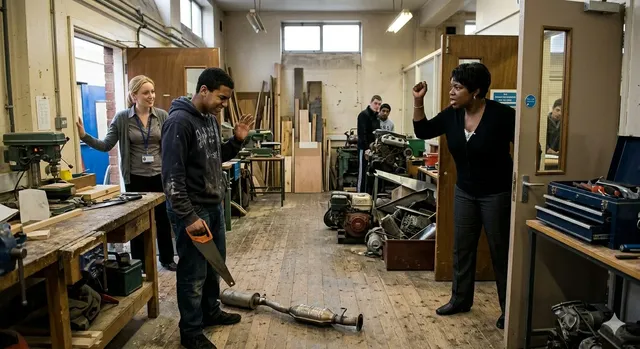
The two set to work, and in no more than a few minutes had removed that part of the exhaust which contained the cat, and were heading off in the direction of the joinery workshop to cut out the cat. They would have gotten away with it, but for one mistake. The joinery floor was all made of wooden floorboards and very old too, which gave out every peculiar creak and groan that old floorboards do. It wasn’t long before Rita’s ears picked up one of these sounds from below.
‘Anna, are you there?’ she whispered on her walkie-talkie.
‘Yes. What do you want?’
‘I can hear noises coming from upstairs. Can you hear them?’
‘Yes. Stay there, and I won’t be a minute.’
The two women met and gave further attention to the old floor above. ‘There’s definitely someone up there,’ confirmed Anna.
‘Right, I’ll go by the steps, and you go by the motor vehicle route, and we’ll pincer them, and they won’t be able to escape being caught.’ And off the two women went: one in one direction, and the other by another direction to ‘pincer’ whoever was up there.
It has to be mentioned here that there wasn’t, at any point, any fear of violence or anything sinister, since both women knew the cats, and the students’ attempts to get them was more of a game.
When they had both stationed themselves outside each of the opposite doors to the workshop, Rita radioed. ‘Right, are you ready, Anna?’
‘Yes, Rita.’
‘On the count of three: one, two, three!’ And both women simultaneously burst through each of their respective doors.
Billy was busy hacking away with a saw at the exhaust containing the cat, and the first thing he did when noticing his ‘capture’ was to raise his hands, and declare, ‘It’s not me!’
‘Then who the bloody hell is it if it isn’t you, Billy?’ laughed Rita.
Billy was on his own, but Anna knew there must be an accomplice. Rita confirmed her suspicions when she shouted across the workshop, ‘Check around, Anna, there must be another one of them somewhere.’
The two women then fell to looking, with Billy looking on, but revealing nothing.
The workshop was searched from top to bottom, and no accomplice could be found.
‘I know there’s another one, and he,’ pointing the finger at Billy, who was now stroking the cat on the bench, bemoaning his loss, ‘knows where he is,’ declared Anna. ‘Let me look in this old toilet.’
The toilet room was small, and it didn’t possess a toilet, but only a sink and some old bits of wood. It possessed no light, either, and everyone knows that when you enter a dark room from a light one, you have to give your eyes a little time to readjust to the change in light. Anna made the mistake of not doing that. She thrust her head around the door and bent down to peer into the gloom behind it.
Her face was inches away from Kane’s, who was crouched in the corner. She couldn’t see him, but Kane could see Anna’s face right in front of his nose.
‘No, there’s no one here, Rita,’ and she returned to Rita and Billy, who was still stroking his cat, or in this case, now, our cat. All three then left.
Kane waited until students had come back into the joinery workshop after dinner, and made his ‘getaway’. Later that day, both he and Billy were in the office waiting for their bus tickets to leave, and Rita and Anna were still puzzled about the execution of their deed.
‘You were there, weren’t you, Kane?’ she asked, as he was laughing.
Kane then related the whole story and finished with his account of how Anna was an inch from his face in the darkness, and she didn’t see him.
‘You were that close, I could have kissed you, Anna,’ and he pursed his lips and blew a kiss out to her.
Prefer to listen? Watch the video reading below.
Reader Comments
Leave a Comment
We would love to hear your thoughts on this chapter.

About Karl Swainston
Karl Swainston is a writer and storyteller whose work is forged from a life lived across the North of England and far beyond. Growing up on a Leeds council estate in the 1960s, Karl's journey was anything but linear. By the age of thirty, he had already lived a dozen lives: from the rigors of grammar school to a degree in Latin, a stint as a fishmonger, a period of discovery living in Marseille, and a return to the hustle of London. Whether working as a postman, a builder, or competing as a county-level chess player, he was, above all, an avid reader—constantly documenting the world around him. This restless spirit continued into his professional life. Karl later taught in Bradford, where he ran a specialist unit for 244 of the most excluded students from across the region—young people whom even the local Pupil Referral Units could not accommodate. Working alongside his old friend Malcolm, Karl spent his days navigating the volatility of Bradford's most aggressive and dysfunctional teenagers. Throughout his life, Karl has been an avid runner and has always shared his home with a rotating cast of beloved dogs and cats—companions who have been constant witnesses to his work. As a writer, Karl's range is as expansive as his history. He works across a wide breadth of genres, including fiction and short stories, autobiography and memoir, biography, non-fiction, and metaphysical writing, as well as providing sharp commentary, opinion, analysis, and essays. Whether writing about his years managing the Harrogate Arms or offering insights from his current adopted home in South East India, where he lives in a simple village with his dog, Bambi, Karl's voice reflects the full, untidy, and deeply human breadth of life. He continues to draw on the rich, decades-long tapestry of his experiences to tell stories that matter, proving that no matter where you live, the human story remains the same.
Author Page