Tales From A Harrogate Caravan
Chapter 52 — Holiday in Majorca
← Karl Swainston / Tales From A Harrogate Caravan
The autumn of 2010 arrived and with it half-term, and we set off for a short holiday in Ca’n Picafort, Majorca. John moved into the family home to look after the dogs and cats and everything was wonderful. We’d booked two rooms at the Iberostar Hotel in San Baolo, which was all-star. We’d never gone all-star before, but we didn’t like it; having to be there when they served dinner, having to be there when they served tea, or having to be there when they served breakfast. We ate there for the first couple of days, but after that we didn’t, as we much preferred dining out at different venues.
They have a wonderful beach in San Baolo, and the waves can get reasonably high, which happened on one occasion when the lifeguard on duty raised the amber flag. I’d been for a run, and when running back home, I noticed how lively the sea was. I wouldn’t class myself as a strong swimmer but a reasonable one. I love being tossed around by an angry sea, but only in so far as I know the beach isn’t that far away and safety is within reach. I ran off back to the hotel and within a half hour or so, we were back at the beach.
Anna wasn’t a swimmer, and she only tip-toed in the edges of the water. Jack could swim, and he ventured out a little and let the waves crash him back in, which he loved. I decided to grab the lilo we had and made my way past the breaking waves and out to where the waves were still yet full and unbroken. I can remember lying on the great swell of sea and being raised up and down in the billowing troughs. It was almost mesmeric and hypnotic too, as you feel the paradox of being completely separated from people, but you can still hear the screams and shouts of them from afar through the sounds of the sea.
I must have laid there for a good ten minutes, aimlessly gazing up at the great vault of blue sky above when I became conscious that I could no longer hear the cacophony of people, only the sound of a screeching whistle which, I learned afterwards, was being blown by the lifeguard. It only took another second to realise that the lilo was being tossed around a bit too viciously, and it was then I looked up and saw before me a mass of rock with the waves crashing against it.
***
In times of great emergency, or great danger, one can be either incredibly stupid or incredibly creative; as a deep thinking chess player, I chose the former, and I started with utmost ferocity to paddle away from the rocks while still lying on the air-filled lilo. The angry sea, though, was having none of it, and the more I paddled, the more the waves flung the air-filled lilo back towards the jagged rocks.
Another bout of quick thinking was necessary, but there was only one option: the lilo had to go. I flung myself off the lilo, and with all my might I started to swim against the strength of the sea. At one point, I’m sure I felt a rock touch my toe, but that only spurred me on, and I swam with every conceivable atom of energy I possessed. My heart was pounding, and I could feel it crashing against the sides of my ribs. If I hadn’t been fit from running, I’m sure I would have had a heart attack there and then in the thrashing waters.
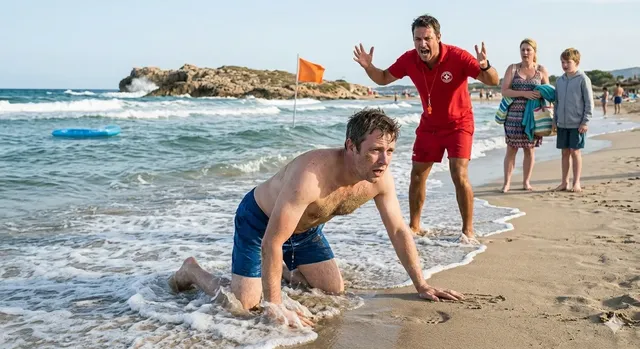
Gradually, the waves felt a little calmer, and I finally felt the beach beneath my feet. I didn’t walk out of the water, but crawled out of it and lay totally spent on the sand with my head buried in it, gasping for breath. The lifeguard stood above me screaming and waving his arms, but I wasn’t listening and still struggling to breathe properly. I must have lain on that beach ten minutes before finally getting to my feet and heading back to Anna.
‘What’s up with you? You look like you’ve seen a ghost. Come on, anyway, I fancy a drink. Jack, get your stuff, we’re off. Where’s the lilo?’
***
During the early part of our holiday, Anna complained of some type of muscular seizure in the back of her neck and chest. We would normally go for a long walk by the side of the sea, but on this morning, she asked if I didn’t mind going alone, as her neck was hurting. I said I didn’t and left the hotel. I returned some time later, and Jack was in the room with a game.
‘Where’s your mam?’
‘She’s having a lie down.’
I went in, and Anna was indeed in bed.
‘Are you okay?’ I asked.
Anna related how the pain had increased, and the painkillers she’d taken earlier were not really having that much of an effect. I asked her to get dressed, and we’d go see a doctor.
At the doctor’s we waited, and after a short while we were asked to go into a room, where the doctor was sat at his desk. Anna related the problem, and he asked her to remove her top, so he could examine the complaint. I sat in the chair and watched. Anna was now fifty, and I noticed she’d begun to look a little thin. I hadn’t really noticed before. Anna was a well-figured, buxom woman, but as she stood there that day being examined by the doctor, her loss of weight was noticeable. I put it down to age and thought no more about it.
The doctor concluded his examination and prescribed some strong painkillers for a pulled muscle. The painkillers worked, and within a day or two, Anna was back to her bubbly self.
Prefer to listen? Watch the video reading below.
Reader Comments
Leave a Comment
We would love to hear your thoughts on this chapter.

About Karl Swainston
Karl Swainston is a writer and storyteller whose work is forged from a life lived across the North of England and far beyond. Growing up on a Leeds council estate in the 1960s, Karl's journey was anything but linear. By the age of thirty, he had already lived a dozen lives: from the rigors of grammar school to a degree in Latin, a stint as a fishmonger, a period of discovery living in Marseille, and a return to the hustle of London. Whether working as a postman, a builder, or competing as a county-level chess player, he was, above all, an avid reader—constantly documenting the world around him. This restless spirit continued into his professional life. Karl later taught in Bradford, where he ran a specialist unit for 244 of the most excluded students from across the region—young people whom even the local Pupil Referral Units could not accommodate. Working alongside his old friend Malcolm, Karl spent his days navigating the volatility of Bradford's most aggressive and dysfunctional teenagers. Throughout his life, Karl has been an avid runner and has always shared his home with a rotating cast of beloved dogs and cats—companions who have been constant witnesses to his work. As a writer, Karl's range is as expansive as his history. He works across a wide breadth of genres, including fiction and short stories, autobiography and memoir, biography, non-fiction, and metaphysical writing, as well as providing sharp commentary, opinion, analysis, and essays. Whether writing about his years managing the Harrogate Arms or offering insights from his current adopted home in South East India, where he lives in a simple village with his dog, Bambi, Karl's voice reflects the full, untidy, and deeply human breadth of life. He continues to draw on the rich, decades-long tapestry of his experiences to tell stories that matter, proving that no matter where you live, the human story remains the same.
Author Page