Tales From A Harrogate Caravan
Chapter 12 — The Quick Sale
← Karl Swainston / Tales From A Harrogate Caravan
What should have happened was that the whole affair should have been left. I was still financially quite comfortable and could have easily rented somewhere for Isla and Rachel, and Isla would have easily secured employment and everything would have been fine. The two women who Isla had convinced to leave their jobs on the basis of getting jobs with her would have been the only casualties, but they would have survived, and they had done the same as Isla, as they had resigned from their present employment by their own will in the hope of getting further employment.
But no, when you’re desperate and committed to a particular endeavour, all reason is lost and sheer abandonment prevails.
I’d previously looked at the ‘quick sale,’ but as I’ve said, the prices were merely 60–70% of the value of the property and no more. The only advantage was that the sale would go through within the week, and that would end the dreadfulness of the present situation.
The sale did go through at 65% of the value of the property, and the deed was done, and the Harrogate Arms, soon to become the Harlow Hotel, was bought. It shouldn’t have been bought, but it was. It shouldn’t have been bought on two major counts, but it was.
The first was that the delay in buying the business meant that the best times of the summer months had elapsed, important months whereby much needed income was to be had to provide important reserves for the needy times of winter and the dark nights. You have to remember that the pub was ‘out in the sticks’ as it were, and it relied totally upon attracting nearly all its clientele from further afield to succeed, and the drizzly, dreary evenings of November were not good times.
Secondly, the business relied heavily upon major developments to the property in order to turn it from a basic pub into an establishment which would be attractive for visitors to want to come and stay. Selling the house at a knocked-down price meant that there was no available capital for investment.
But the deed was done, and we now had a new home.
I moved out with the dogs on the Monday, and Jack decided to stay with Rachel and Donald for a week until things became settled at the Arms, and I had the time to buy him a caravan to live in. I hired a van, and Donald helped me to move. It was evening when I arrived, and Isla was already there and busy making ‘changes’ as she said. Lucy and Sarah, the two women, were already there, too, clearing the old caravan out at the back of the Arms and moving in their new furniture.
There was a little keep to the side of the property, which used to be an entrance to an old nightclub downstairs, but which was now abandoned and rotten with damp. This little keep above the stairs was perfect for the dogs, as there was a little gate to pen them in and easy access to and from the property without having to go through the pub.
The décor of the pub was jaded, and it had that musty redolence common of a council estate pub, but with the rustic stonework of North Yorkshire. The pub was a traditional one, and had a big open fire, which attracted all manner of characters passing by and walking their dogs, and many of these characters would regularly call into the pub for a quick pint before heading off home for tea in surrounding houses scattered across the northwest of Harrogate.
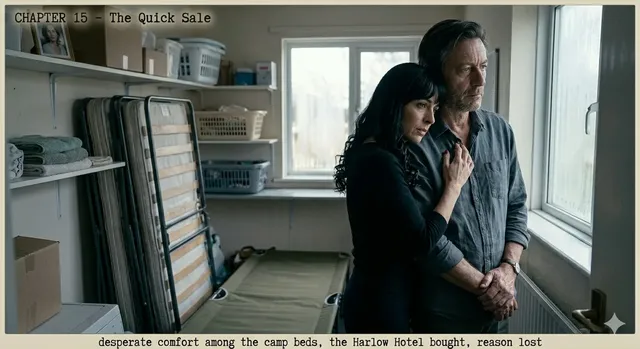
In the first days at the pub, all the rooms had been booked out, and there was nowhere for Isla and me to sleep, and the caravan which housed the previous owners, Isla had given over to Sarah and Lucy, who now set up their little nest in it. I could never understand why Isla gave them the caravan to reside in, and we were left to live like hobos, but that was what happened, and each night Isla and I would find whatever vacant room, laundry room, or cupboard was available, and sleep in there. On the third day, I secured some camp beds, and they became our beds for the next couple of months which saw out the summer.
Prefer to listen? Watch the video reading below.
Reader Comments
Leave a Comment
We would love to hear your thoughts on this chapter.

About Karl Swainston
Karl Swainston is a writer and storyteller whose work is forged from a life lived across the North of England and far beyond. Growing up on a Leeds council estate in the 1960s, Karl's journey was anything but linear. By the age of thirty, he had already lived a dozen lives: from the rigors of grammar school to a degree in Latin, a stint as a fishmonger, a period of discovery living in Marseille, and a return to the hustle of London. Whether working as a postman, a builder, or competing as a county-level chess player, he was, above all, an avid reader—constantly documenting the world around him. This restless spirit continued into his professional life. Karl later taught in Bradford, where he ran a specialist unit for 244 of the most excluded students from across the region—young people whom even the local Pupil Referral Units could not accommodate. Working alongside his old friend Malcolm, Karl spent his days navigating the volatility of Bradford's most aggressive and dysfunctional teenagers. Throughout his life, Karl has been an avid runner and has always shared his home with a rotating cast of beloved dogs and cats—companions who have been constant witnesses to his work. As a writer, Karl's range is as expansive as his history. He works across a wide breadth of genres, including fiction and short stories, autobiography and memoir, biography, non-fiction, and metaphysical writing, as well as providing sharp commentary, opinion, analysis, and essays. Whether writing about his years managing the Harrogate Arms or offering insights from his current adopted home in South East India, where he lives in a simple village with his dog, Bambi, Karl's voice reflects the full, untidy, and deeply human breadth of life. He continues to draw on the rich, decades-long tapestry of his experiences to tell stories that matter, proving that no matter where you live, the human story remains the same.
Author Page