Tales From A Harrogate Caravan
Chapter 3 — The Leek Street Flats & 255 Belle Isle Road
← Karl Swainston / Tales From A Harrogate Caravan
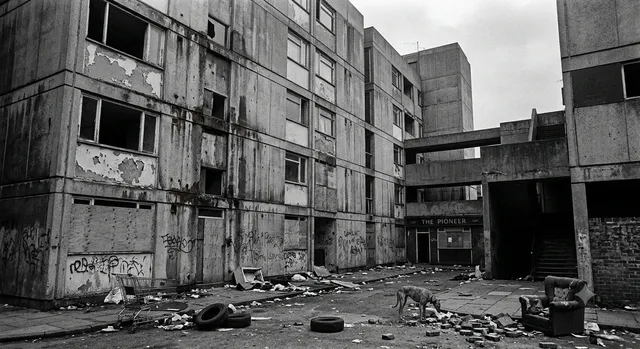
In Hunslet they had the Leek Street Flats, or the ‘Leakies’ as the locals called them. Arraign the architect who designed them, and which survived no more than fifteen years and brought untold misery to those dwelling there. Built 1968, demolished 1983. Miserable.
I know it was 1983 because that was when I found my dog Colonel, a stray greyhound. I ripped the ply-board off the dilapidated flats to build a kennel for him. I also acquired the communal aerial – but enough of that.
The flats had a true name and did ‘leak’. Damp and darkness, rotting walls, dripping ceilings, cold and feverish vapours, accompanying wagons of illness, coughs, sniffs, sneezes and deaths. No wonder the Council called time on what the natives called Hell.
‘Time!’ The Leakies had a pub called the Pioneer. I never went in. I only went down those steps when we were sacking the flats. I can remember as a youth standing in a dank, strange place, wallpaper peeling, hanging off the wall, water dripping, carpets musty and wet, looking around and thinking how could anyone ever drink and socialise in such a den?
But people do, all the time. What we find disgusting, abhorrent, they find enjoyable. They seek a place – give their soul to a place. I think the landlord, whoever he was, with his wife, whoever she was, would have given their soul and life to the Pioneer, but flawed architecture and the nastiness of Father Time conspired against them. Like all beautiful summers, they eventually fell into the fall and death of autumn.
The Leek Street Flats are no more. In their place is Morrisons, wrapped-in by a collection of cheap shops and cash-collecting banks with a giant car park and fuck all else; it was another product of Thatcher’s modernisation of Britain.
Belle Isle was anything but modern. On arriving in Belle Isle, there was a stone plaque, erected by the council, which read, 'Welcome to Belle Isle.' Belle Isle means Beautiful Island. Come on, which city Councillor thought of that one? Some villain had painted over Belle Isle, though, and wrote instead, 'Welcome to Hell.' That didn't last long before another graffiti artist, refusing to be beaten, substituted 'Hell' for 'My shit-hole,' but left 'Welcome to....'
My brother and I had inherited the tenancy of 255 after my mam left around our 17th year on this earth. It was customary then for kids to leave the parental home at 17 and to find either some bed-sit or meet a lass, have a kid together, and then get a council house, which is what most teenagers did. My brother and I were lucky, as my mam decided she'd had enough of the depressive Mansard house, and she bought a house in Beeston instead, which has since been demolished; 255 still stands, though.
255 had four bedrooms and was eternally cold. Since we were still kids in all but age, the house was forever full of other kids from off the estate who didn't have a house of their own. On weekends, after a night on the town, all the living room was filled with Belle Isle bodies, and all the four bedrooms in the house, too, were stuffed with party goers, often comatose. On a few occasions, the large dog kennel also accommodated a severe case of alcohol overdose.
Along with the human inhabitants of 255, there were the animals too: a greyhound called Colonel, and two Alsatians, named Lassie and Rebel. To keep the mice at bay, at that time, there was a cat called Moscow. I remember seeing an advert in the Yorkshire Evening Post advertising a cat/kitten to a good home, and with the mice entrenched in every item of furniture, and the three hounds being scoffed at by them, I decided it was time to bring in the cat.
I took a bus ride from the tired and dreary looking council houses in Belle Isle and ventured on the number 76 bus to Headingley, posh part. Folk had it good there, and you could tell. Cars were in every driveway, and there wasn't a burnt out car to be seen. I knocked on the rattle of this big door. An old lady answered.
I was reasonably dressed and had a cat carrier, too, which no doubt allayed the old woman's fears somewhat.
'What do you want the cat for?'
I lied. 'I have a little sister who wants one, as she lost her other cat.'
'Do you have a garden?'
'Oh, yes: back, front, and side of house, too, Missus.'
I felt to allow the inquisition to prolong any further would seriously expose any more lies, and I began to place the feline creature in the cage.
'There, the kitten's not bothered,’ and I began to head for the door.
'Do you have an address if we need to contact you?'
I gave her the address of 255 Belle Isle Road and left the woman in a dreadful state of anxiety, but I wasn't going all that way to Headingley and not getting the cat.
When I placed the kitten down on the mat with a greyhound and two eager Alsatians looking at it, the poor little thing's back bristled like some porcupine.
You might think the kitten's life was in danger, but you'd be wrong. Dogs are extremely clever at knowing when a 'cat' or 'kitten' is yours, and within ten minutes or so, the dogs daren't even look at the timid creature trying to hide behind the ripped settee.
Within a few days, the little thing had not only ventured out, but she was now sauntering around the house and property as if she'd been Queen there since the time that the dreadful house was flung up.
It was at this time the poor old woman, who gave up the kitten, knocked on the door with her big son, or at least I presumed him to be. I knew they were posh and dressed posh, too, and had the nerve to trespass onto our estate, but this bloke was big, and he had that menace in his eyes, and you don't look at the clip of his tailor when he's eye-balling you. The dogs were going wild behind the second door.
'What have you done with the cat?' the old woman hissed.
'I've done nothing with it.'
'You don't have a little sister! Do you?' she demanded.
I'd had enough of her by this time and trusted completely in my ability to get to the second door, where the dogs were gnashing and away from the 'thug' lest he lunge for me.
'Look, missus, your kitten's in here, and if you don't believe me, come and have a look.'
'Grab a hold of the dogs, Mick,' I called to my brother, and when he'd done so, I let the visitors through.
In between the three large canines, screaming to be unleashed, little Moscow, the kitten, trotted and walked over to the old woman and her 'thug.'
The pair left shortly afterwards without the cat and thoroughly convinced their little feline was safe.
Reader Comments
Leave a Comment
We would love to hear your thoughts on this chapter.

About Karl Swainston
Karl Swainston is a writer and storyteller whose work is forged from a life lived across the North of England and far beyond. Growing up on a Leeds council estate in the 1960s, Karl's journey was anything but linear. By the age of thirty, he had already lived a dozen lives: from the rigors of grammar school to a degree in Latin, a stint as a fishmonger, a period of discovery living in Marseille, and a return to the hustle of London. Whether working as a postman, a builder, or competing as a county-level chess player, he was, above all, an avid reader—constantly documenting the world around him. This restless spirit continued into his professional life. Karl later taught in Bradford, where he ran a specialist unit for 244 of the most excluded students from across the region—young people whom even the local Pupil Referral Units could not accommodate. Working alongside his old friend Malcolm, Karl spent his days navigating the volatility of Bradford's most aggressive and dysfunctional teenagers. Throughout his life, Karl has been an avid runner and has always shared his home with a rotating cast of beloved dogs and cats—companions who have been constant witnesses to his work. As a writer, Karl's range is as expansive as his history. He works across a wide breadth of genres, including fiction and short stories, autobiography and memoir, biography, non-fiction, and metaphysical writing, as well as providing sharp commentary, opinion, analysis, and essays. Whether writing about his years managing the Harrogate Arms or offering insights from his current adopted home in South East India, where he lives in a simple village with his dog, Bambi, Karl's voice reflects the full, untidy, and deeply human breadth of life. He continues to draw on the rich, decades-long tapestry of his experiences to tell stories that matter, proving that no matter where you live, the human story remains the same.
Author Page