Tales From A Harrogate Caravan
Chapter 4 — The Chess Board and the Doctor
← Karl Swainston / Tales From A Harrogate Caravan
In the early eighties there wasn't that much work around for a young lad without any qualifications, and the Government, under Thatcher, decided to create the 'Community Programme' so that, at least, youngsters had something to do. I had a little window cleaning round, and that brought in the necessary funds to live and I didn't enrol on the programme, but many of the unemployed folk on the estate did.
The window cleaning round meant that I could work when I chose to work, and when the weather was bad, you weren't able to work. I think I was around the age of nineteen when a local lass brought around a chess board, complete with pieces, her brother had made in prison. I knew how to play chess from my days back in primary school, and for some inexplicable reason then, it never held that fascination for me, but when this prison board and its pieces arrived, it somehow mesmerised my mind.
About five or six of us would play regular tournaments to see who would be champion, and I know for them it was simply a way to pass the idle hours away, but for me it quickly became a passion. I would sit for hours staring at these sixty-four squares, totally enchanted with the game.
On one particular day, I'd gone down to my mam's house, and I told her I'd been playing chess. She suggested calling at the library and seeing if they had any books on the game. Books on chess? Why would they have books on chess? But they did, and I took out, that day, as many as was allowed.
I didn't have a chess board, or the money to buy one, but I possessed a satanic obsession with the game. I cut the legs down from a decrepit kitchen table, a seventies one with a laminated red top. It was scratched to fuck, but an angle grinder whipped off the laminate and in its place appeared a low, newly varnished chess table with teak and mahogany squares stuck on – and a strip of dado rail for show.
For show? The rest of our council house was a veritable tip: three dogs, one brother, a gambling, fun-loving lodger, two cats, Moscow and a new stray, Schubert, one named after Russian chess and the other because it sounded good to council estate chicks frequenting our hovel at three am after the nightclub.
It was at this time I met the Doctor. The Doctor was a first class gentleman. He wasn't really a doctor, but he had such wit that he took on the mantle of Dr Johnson. His real name was Ralph, but to us he was always the Doctor.
How did I meet the Doctor, and more importantly what gift I received from that learned fellow? One afternoon, when I was returning some chess books to the library, waiting for the librarian to finish her phone call – and I believe this was some sort of fate – I overheard her utter 'chess club.' I began to listen and watch the woman intently.
She was no more than fifty. Her lips were covered in ruby lipstick and they drooped too. I was focused and waited for her to finish on the phone. Her mouth revealed fillings. It was red and pink. I remember that she had faded yellow teeth from smoking, black at the top. We chess players notice these things. She had a big arse in a floral dress. When she turned away, her stockings were smoky. She put the phone down. 'What do you want?'
'I overheard you mention a chess club?'
'Yes, they play at the Circling Pub in Leeds every Wednesday night.'
'Thanks.'
A chess club? In Leeds? I couldn't wait for Wednesday night, the night of the Leeds evening chess league and the battle scene.
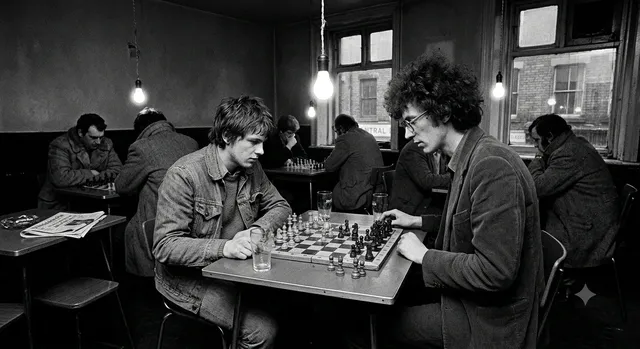
I remember with clarity a sense of trembling, walking down to town and setting foot in the Circling Pub on Bank Street. It was dark inside, old fashioned, and drained of customers except a few hardened drinkers scattered around the premises like ghosts from another world.
'Is there a chess club meets here?' I asked of the barman.
'Yes, they meet upstairs, but you're early. What can I get you?'
I was 19 then and a regular weekend piss head, as were nearly all council estaters at that time. I was tempted to say, 'A pint of bitter, please,' but thought the better of why I was there and muttered instead, 'Half a lemonade.'
I took my sober drink and sat down facing the bar. Isn't it strange how certain intentions, certain acts, which have not even the merest reckoning in the grand scheme of life fill us with fear? Anyone would have thought I was about to commit some horrendous deed of murder sat there. I was sweating, waiting for these 'chess players' to appear. I was consumed by the most appalling fear of what might happen, and I can honestly say that I felt a great urge to leave, visit some dive, and get pissed instead. That was when the Doctor sauntered in.
He was a tall, gangly sort of creature with a big bunch of wiry black hair on his head. That must be one of them, I thought. He ordered a drink and disappeared behind the bar and up some stairs. I was about to follow when more of these strange creatures appeared from the dark outside, and I decided it best to wait and observe such an overture of oddity.
'That's the lot you want, lad,' said the barman flinging his thumb over his shoulder towards the creatures creeping up the stairs.
'Thanks.'
I followed with terror, but with a strange feeling of fascination about how this council lad's life was about to change.
Prophetic? Yes, of course. We all know, even non-chess players, there's a time in one's life, which we know not of yet; but, strangely, do know our lives are going to be changed profoundly by our acts. Climbing those steps was one such rare occasion, and it was beautiful.
The room was small and lit dimly by two dangling, bare bulbs; the other bulbs didn't work. The décor was foisty, and it was cold too because the sweat dripping off me made me shiver. No one took off their coats and voices only whispered to one another.
I stood in this strange scene for a few minutes before a man, not much older than myself, said, 'My name's Dan. Is this your first time at the club?'
The ceremony of introduction was quickly over with the most efficient ease. Dan asked Steve to take care of me, and I'm sure he said aside to him, 'Just play the idiot once, Steve, and I'll get someone else to give him a game.'
Ade was right and Steve duly crushed me.
'I always win against the French Defence.' Steve wasn't noted for his modesty.
'The what?'
'The French Defence. Games have openings and you played the French Defence.'
I stared at the board and was mesmerised. I can only compare the moment to some sort of awakening, and I was hooked, addicted to the game of chess from that very first thrashing.
When the games were over and I was about to leave, the man with the black-wiry head of hair put his hand on my shoulder and said, 'Karl, isn't it? My name's Ralph. Aren't you having a pint?'
'A pint of bitter, thanks.' The man seemed genuine.
Prefer to listen? Watch the video reading below.
Reader Comments
Leave a Comment
We would love to hear your thoughts on this chapter.
About Karl Swainston
Karl Swainston is a writer and storyteller whose work is forged from a life lived across the North of England and far beyond. Growing up on a Leeds council estate in the 1960s, Karl's journey was anything but linear. By the age of thirty, he had already lived a dozen lives: from the rigors of grammar school to a degree in Latin, a stint as a fishmonger, a period of discovery living in Marseille, and a return to the hustle of London. Whether working as a postman, a builder, or competing as a county-level chess player, he was, above all, an avid reader—constantly documenting the world around him. This restless spirit continued into his professional life. Karl later taught in Bradford, where he ran a specialist unit for 244 of the most excluded students from across the region—young people whom even the local Pupil Referral Units could not accommodate. Working alongside his old friend Malcolm, Karl spent his days navigating the volatility of Bradford's most aggressive and dysfunctional teenagers. Throughout his life, Karl has been an avid runner and has always shared his home with a rotating cast of beloved dogs and cats—companions who have been constant witnesses to his work. As a writer, Karl's range is as expansive as his history. He works across a wide breadth of genres, including fiction and short stories, autobiography and memoir, biography, non-fiction, and metaphysical writing, as well as providing sharp commentary, opinion, analysis, and essays. Whether writing about his years managing the Harrogate Arms or offering insights from his current adopted home in South East India, where he lives in a simple village with his dog, Bambi, Karl's voice reflects the full, untidy, and deeply human breadth of life. He continues to draw on the rich, decades-long tapestry of his experiences to tell stories that matter, proving that no matter where you live, the human story remains the same.
Author Page