Tales From A Harrogate Caravan
Chapter 2 — The Catholic Primary School and the Slipper
← Karl Swainston / Tales From A Harrogate Caravan
St Mark's Roman Catholic Primary School: the dominion and bastion of corporal punishment? Not really; it was simply another school raised in stone by the Church to raise upright Christians for life in the city.
On the Brookfield Estate you also had a county primary school, Westfield, where a commonly bandied-about tale amongst youthful thieves was that a 'Blue Lady' wandered the corridors at night as a ghost and had once rubbed the throat of a common council thief across broken window glass. No one ever dared break into her abode. Oooh, no! God forbid! Even more so to us Catholics!
Higher up the estate stood St Mark's Catholic Church and its adjoining primary school. Religion dictated which school your parents sent you to, a rule that seemed immovable and non-negotiable.
On the streets, though, to the kids with dirty faces, cheap ponytails, coloured snake belts and scraped knees, all playing on the same red-brick estate, none of it mattered. Such was the wisdom of youth over religion.
I can't remember my first day at school. In those days, education began at five and the institutions kept hold of you until you were sixteen.
The headteacher, as I remember him, was Mr Mercer, a tall, gangly fellow with wiry grey hair. Years later I called at his house for him to countersign my passport, as you did then, and found a wizened old man complaining about being stung by a wasp. Time had shrunk the giant who had once seemed so fearsome.
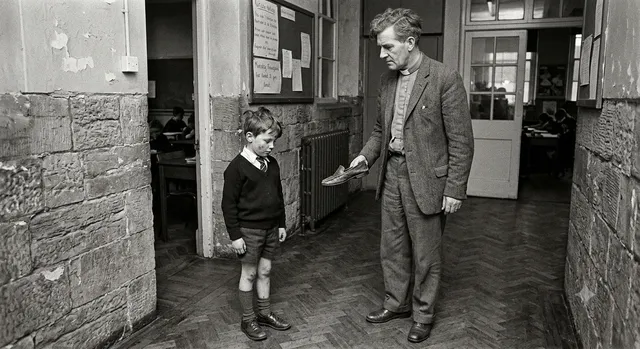
Mr Mercer's chosen form of behavioural correction was the slipper, and I can remember numerous occasions when it was belted against my backside. One particular occasion sticks foremost in my memory.
Sport—especially running, football and rounders—filled the junior school curriculum. At every opportunity there seemed to be some physical activity, and every pupil was expected to take part.
As I remember it, Mr Cartwright, the PE teacher, would regularly cram us into the back of his three-wheeler van and drive us to sports events. On one journey, as he accelerated up a hill, the rear door flew open and half a dozen children tumbled into the road. Fortunately no one was seriously hurt, and we were simply loaded back in again with the door properly secured. Such was child safeguarding in those days.
The golden prize for all this effort was Sportsman of the Year. Strange that I can't remember there ever being a Sportswoman of the Year, though perhaps I simply never noticed. Every boy wanted that trophy, and I was no different.
Whenever the opportunity arose, I threw myself into every event, convinced I was the best. When the annual prize-giving evening arrived alongside the school play, I was certain the award was mine.
I must have been six or seven because, by then, I'd memorised the names of every bird in Britain. I'd found a book and learnt them all, much to the teachers' amazement. But enough of that. There I sat cross-legged on the hall floor, waiting for the moment everyone had come for.
"And the prize for Sportsman of the Year goes to..."
I was practically on my feet before the name was announced.
"...Ian Dawson!"
There are moments in life when you're utterly confounded, and that was one of them. Looking back, I know Ian deserved it. He was the better footballer and the better all-round sportsman.
At the time, though, disappointment quickly turned to anger. Perhaps the teachers realised how crestfallen I looked because they immediately called me up to receive the Headteacher's Award for memorising the birds of Britain.
Mr Mercer presented me with The Mystery of Monster Mountain by Enid Blyton—or at least I think it was that book—when I believed I should have been collecting the sports trophy. I muttered something through clenched teeth and walked off the stage without waiting for a reply.
The gesture did not go unnoticed.
The following day, after some minor infringement that certainly didn't deserve the slipper, I was summoned to Mr Mercer's office and told how ungrateful I had been the previous evening. The slipper, I was informed, would correct such ingratitude, and it duly did.
Looking back, I had been an ungrateful child. The book never really stood a chance. When I got home, it was ceremonially burnt in the back field to a chorus of curses.
St Mark's School had the church right beside it, and every child was expected to attend Sunday Mass. There were three services—9 a.m., 11 a.m. and 6 p.m.—and a teacher would sit at the back recording which pupils attended. Woe betide anyone who missed, because Monday morning's first lesson for the absentees was often a ruler across the knuckles.
All in all, though, I remember school with considerable fondness, and most of the punishments were probably deserved. On one occasion another pupil and I were instructed to wheel a large television into another classroom.
Instead of doing as we were told, we turned it into a contest to see who could push harder. One of the wheels caught on a thick orange mat, the television toppled over, and the picture tube exploded with a deafening crash.
Everyone in the school knew about it.
Mr Cartwright certainly did. I can still remember him charging from his classroom, grabbing a rounders bat and giving us both six of the best.
Prefer to listen? Watch the video reading below.
Reader Comments
Leave a Comment
We would love to hear your thoughts on this chapter.

About Karl Swainston
Karl Swainston is a writer and storyteller whose work is forged from a life lived across the North of England and far beyond. Growing up on a Leeds council estate in the 1960s, Karl's journey was anything but linear. By the age of thirty, he had already lived a dozen lives: from the rigors of grammar school to a degree in Latin, a stint as a fishmonger, a period of discovery living in Marseille, and a return to the hustle of London. Whether working as a postman, a builder, or competing as a county-level chess player, he was, above all, an avid reader—constantly documenting the world around him. This restless spirit continued into his professional life. Karl later taught in Bradford, where he ran a specialist unit for 244 of the most excluded students from across the region—young people whom even the local Pupil Referral Units could not accommodate. Working alongside his old friend Malcolm, Karl spent his days navigating the volatility of Bradford's most aggressive and dysfunctional teenagers. Throughout his life, Karl has been an avid runner and has always shared his home with a rotating cast of beloved dogs and cats—companions who have been constant witnesses to his work. As a writer, Karl's range is as expansive as his history. He works across a wide breadth of genres, including fiction and short stories, autobiography and memoir, biography, non-fiction, and metaphysical writing, as well as providing sharp commentary, opinion, analysis, and essays. Whether writing about his years managing the Harrogate Arms or offering insights from his current adopted home in South East India, where he lives in a simple village with his dog, Bambi, Karl's voice reflects the full, untidy, and deeply human breadth of life. He continues to draw on the rich, decades-long tapestry of his experiences to tell stories that matter, proving that no matter where you live, the human story remains the same.
Author Page