Tales From A Harrogate Caravan
Chapter 59 — The Holiday Disaster
← Karl Swainston / Tales From A Harrogate Caravan
The next morning I awoke early, around the hour of five, and by seven, I was uncomfortably bored. I would try and go play golf, but would only hit the balls around the course without any enthusiasm, and I didn't enjoy it; I would go fishing with John, but didn't enjoy that either; I would go walking with the dogs, and that was the only release I felt, but that, too, was not really enjoyable.
In hindsight, what I did next was the worst of all choices, but at the time it seemed the best. I booked a holiday in Majorca for Jack, Rachel, Donald, and myself. Why was it bad? Because I should have endured that deep well of emptiness and accustomed myself to it, worked with the grief, and developed a strong foundation of discipline and not escaped and fled away from it.
The holiday was a disaster. We all hated it and couldn't wait to get back home. Nothing was the same without Anna. Anna had driven all the holidays and was the matriarch, the nucleus, the heart of every holiday, of all our holidays. And this one was bereft of that heart. The kids remained around the pool and had no inclination to be adventurous, which was understandable. I went for a run, after a run, after a run, and when I wasn't running, I'd hire a bike and cycle as far as I could, as though with each exertion, I was running away from something, but didn't realise it. I dropped to under 70kg.
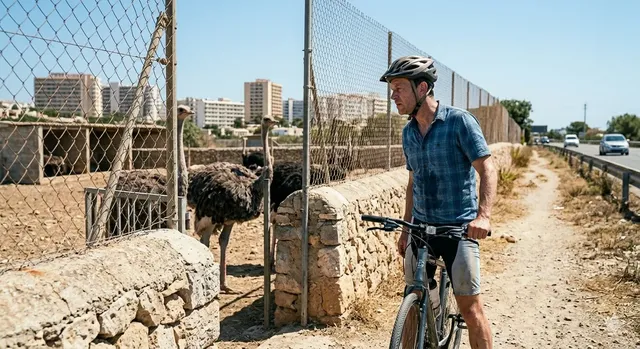
We were in Santa Ponsa, and I'd hired a bike in the heat of the afternoon. I started to cycle out of town and along the highway. I didn't know where I was going and didn't really care, as I was riding. I must have ridden for some while and was passing a waist-high stone wall with high wire above it when I suddenly slammed on the brakes and stopped and looked. I knew the place. I'd been there before. I delved into my memory, and I recalled some five or six years back when we took the kids to Magaluf. I was stood on the outskirts and was looking in on an ostrich garden. I remembered I used to go running past it.
I left the bike and walked into town by the same path I had run all those years ago. It was so strange wandering along the High Street where as a family, Anna, I and the kids frequented pubs, bars, played crazy golf, ordered ice cream, ordered breakfast and walked down to the beach. The moment wasn't unpleasant; it was poignant and filled with a great depth of emptiness at that time. I rode back to Santa Ponsa, and within a day we were all back home again.
***
The summer holidays were now afoot, and there was no work, and this made the days not only long but loathsome, too. I was incredibly lonely. I realised that during my time with Anna, we never really socialised outside the circle of the kids. We never had, or desired, any social partners for company; we had our own company, and we were happy with that. When Anna was gone, I would occasionally see Bennie or John, but that was only for a few hours, and the rest of the time was spent being idle again.
When you're severely bored at seven in the morning, it doesn't take long for distractions to be found. Since the time of Anna's illness, I don't really think I'd stopped drinking; it was, simply, that I wasn't aware of it. When you feel guilty, though, at ten in the morning, cracking open a can of lager, you know what you're doing is wrong. Outsiders and onlookers can pontificate and judge all they like, but the weird workings of my mind at that time didn't give a damn. I wouldn't get pissed and be falling all over; I somehow followed Walter's example from many years before and merely topped up and became a managing or functioning alcoholic.
There were a few more weeks left yet before work back at the vocational unit in September started, and I think I drank more in those few weeks than at any other time in my life. The more you drink, the more futile and dispossessed of will your mind and heart become. I felt incredible guilt, as I thought I should be helping the kids more, but whatever I tried, it seemed to pass off without much effect.
The summer of 2011 came and went, and the autumn arrived and with it work back at the unit. We'd only been back a few days, and Rita pulled me to one side and said she wanted to talk.
'How do you feel being back, Karl?'
'I don't really know. It's not the same without Anna here.'
'I feel the same, and we haven't the numbers of students we had in the past, and maybe it's time to pursue other avenues and maybe work here until Christmas and then call it a day?'
Rita was straight to the point, but her point was true too. We didn't have a large population of students any more, and besides, the students had suddenly become irksome to me, as they never had done before, and that is the knell in any profession, particularly when you're dealing with temper-tantrummed teenagers.
After a moment's reflection, I replied, 'Yea, I agree. What will you do?'
'Oh, I'll think of something. And you, what will you do, Karl?'
'I don't need to work, and maybe I'll take a few months out and think what to do then.'
Rita knew me and advised otherwise, 'It's not in your nature, Karl, to be idle, and I don't think it will do you any good. Look at you now, and even when you're working and have this distraction, you are still idle, and that's why you drink too much and are sad.'
It was September, early September, and Rita was right: I was 47 and I was sad. That night Rachel put me on Facebook.
**End of Part I**
**PART II**
Prefer to listen? Watch the video reading below.
Reader Comments
Leave a Comment
We would love to hear your thoughts on this chapter.
About Karl Swainston
Karl Swainston is a writer and storyteller whose work is forged from a life lived across the North of England and far beyond. Growing up on a Leeds council estate in the 1960s, Karl's journey was anything but linear. By the age of thirty, he had already lived a dozen lives: from the rigors of grammar school to a degree in Latin, a stint as a fishmonger, a period of discovery living in Marseille, and a return to the hustle of London. Whether working as a postman, a builder, or competing as a county-level chess player, he was, above all, an avid reader—constantly documenting the world around him. This restless spirit continued into his professional life. Karl later taught in Bradford, where he ran a specialist unit for 244 of the most excluded students from across the region—young people whom even the local Pupil Referral Units could not accommodate. Working alongside his old friend Malcolm, Karl spent his days navigating the volatility of Bradford's most aggressive and dysfunctional teenagers. Throughout his life, Karl has been an avid runner and has always shared his home with a rotating cast of beloved dogs and cats—companions who have been constant witnesses to his work. As a writer, Karl's range is as expansive as his history. He works across a wide breadth of genres, including fiction and short stories, autobiography and memoir, biography, non-fiction, and metaphysical writing, as well as providing sharp commentary, opinion, analysis, and essays. Whether writing about his years managing the Harrogate Arms or offering insights from his current adopted home in South East India, where he lives in a simple village with his dog, Bambi, Karl's voice reflects the full, untidy, and deeply human breadth of life. He continues to draw on the rich, decades-long tapestry of his experiences to tell stories that matter, proving that no matter where you live, the human story remains the same.
Author Page