Tales From A Harrogate Caravan
Chapter 1 — Facebook and the Dating Game
← Karl Swainston / Tales From A Harrogate Caravan
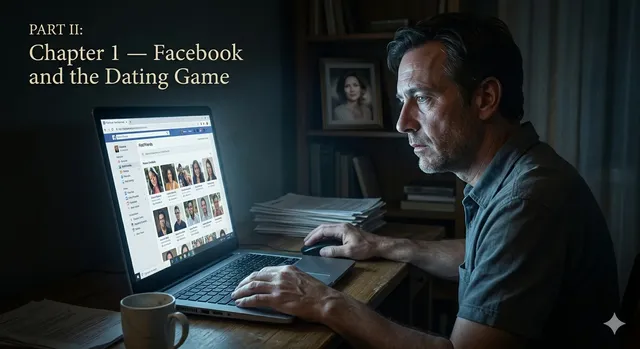
Before and even after Anna’s death, I’d never even thought about Facebook let alone joining it. It didn’t appeal to me, and still it doesn’t even now as the years have passed. I find the site inane, and the endless comments about what people have had for tea, or what songs they’re listening to, or where they’ve been for holidays is on the point of being annoying. The only benefit Facebook presents is that you can contact old friends and chat with present friends online; to me there is no other reason for the site.
During the beginning of September, Rachel created me an account because I was bored, and reluctantly, at first I began to contact a few old friends, but then, as with all new pursuits, I did the same with Facebook: I went completely overboard, and I added anyone and everything that ever appeared on that site. I’d see a post from a person and click they’d be added as a ‘friend’; I’d see a song from a person and click they’d be added; I’d see a picture of sausage and eggs and click they’d be added.
I don’t actually think I ever spoke to anyone on Facebook that first week, as I was too busy building up a veritable bank of people who I have never even spoken to even to this present day. Facebook occupied a man approaching fifty and that was all. It distracted me temporarily from the boredom of living.
Anna had been gone now for some six or seven weeks, and the house became very claustrophobically empty. I know that’s not a phrase, but that’s how the empty house was to me. For a time, Facebook relieved somewhat that pressure, but when the understanding came to realisation that the people I sometimes spoke to, figures of the past, I had nothing in common with; I fell to being bored with Facebook again and gradually lost interest even in that. I even began to find the site irritating and only went on there in extreme cases of boredom.
Facebook is a place of old friends because once you contact them, you soon realise why they are ‘old friends’. You may exchange a few words, but they quickly fizzle out, and then you cease to have any communication at all with them. Maybe that’s just me, but out of all the old friends I contacted, there isn’t one I speak to now. I suppose it’s because time has distanced the friendship or land distance being too far to reignite a friendship, but the result is you no longer seek, or want, the old friendship to continue; not in a bad way, I might add, but in a way in which there is absolutely no desire or enthusiasm to pursue it.
Old school friends I found the strangest. Everyone has friends when they’re at school, and then you don’t see these characters for twenty years or more. Suddenly, contact is made, and you assume that the persons back then – i.e. you and the old friend – are the same characters as you are now. That’s the first point. I know for a fact I am not the same person or character I was when I was in my early and mid-teens. The second point is that the other ‘friend’ almost certainly will not be the same person or character you went to school with. And yet, when either they or I made that initial contact, you deem them to be that same character. I know I did, and it took some considerable time to realise this.
When I did, I ceased to make contact anymore with past friends, as I felt I knew my local shopkeeper, Brian, more than I did some distant mate. Anyway, I’m pontificating again and that’s unpardonable for a registered bankrupt.
Prefer to listen? Watch the video reading below.
Reader Comments
Leave a Comment
We would love to hear your thoughts on this chapter.

About Karl Swainston
Karl Swainston is a writer and storyteller whose work is forged from a life lived across the North of England and far beyond. Growing up on a Leeds council estate in the 1960s, Karl's journey was anything but linear. By the age of thirty, he had already lived a dozen lives: from the rigors of grammar school to a degree in Latin, a stint as a fishmonger, a period of discovery living in Marseille, and a return to the hustle of London. Whether working as a postman, a builder, or competing as a county-level chess player, he was, above all, an avid reader—constantly documenting the world around him. This restless spirit continued into his professional life. Karl later taught in Bradford, where he ran a specialist unit for 244 of the most excluded students from across the region—young people whom even the local Pupil Referral Units could not accommodate. Working alongside his old friend Malcolm, Karl spent his days navigating the volatility of Bradford's most aggressive and dysfunctional teenagers. Throughout his life, Karl has been an avid runner and has always shared his home with a rotating cast of beloved dogs and cats—companions who have been constant witnesses to his work. As a writer, Karl's range is as expansive as his history. He works across a wide breadth of genres, including fiction and short stories, autobiography and memoir, biography, non-fiction, and metaphysical writing, as well as providing sharp commentary, opinion, analysis, and essays. Whether writing about his years managing the Harrogate Arms or offering insights from his current adopted home in South East India, where he lives in a simple village with his dog, Bambi, Karl's voice reflects the full, untidy, and deeply human breadth of life. He continues to draw on the rich, decades-long tapestry of his experiences to tell stories that matter, proving that no matter where you live, the human story remains the same.
Author Page