Tales From A Harrogate Caravan
Chapter 58 — Anna's Death
← Karl Swainston / Tales From A Harrogate Caravan
The next day Anna was barely conscious, and when she was, she would utter, 'I'm ready now. I'm ready now.'
When we replied, 'What are you ready for, Anna, tell us?'
She simply repeated, 'I'm ready now. Now, I'm ready.'
The next day Anna lost consciousness, and she never regained it. The doctor advised against giving her water to sip, as she might choke upon it. Instead, we periodically used swabs to moisten her lips, lips that were once so full and red, but were now limp, pale, and almost lifeless. I opened her mouth and tried to moisten the inside of it; her tongue was stuck to her cheek because of the lack of moisture.
A nurse had been assigned to stay the nights and allow Jack and me to get some sleep, and she stayed with Anna during the night.
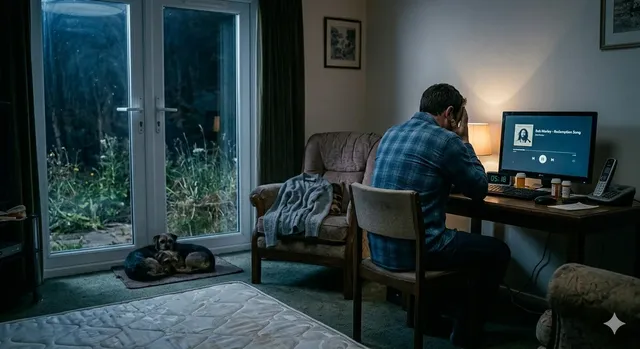
At five o'clock the next morning, the nurse started to ascend the stairs. The two little dogs we had began to bark against the intrusion when she opened the bedroom door.
'Karl, can you come down, please.'
Anna died around the hour of five in the morning. The nurse asked us to close her eyes. I tried and so did Jack, too, but they seemed to resist the effort. Eventually, Anna's eyes did close for the very last time.
I went next door and woke Rachel and Donald, and they came to their mam for the last time.
An hour later, the doctor arrived and confirmed Anna, my Anna, Rachel's mam, and Jack's, too, had indeed died.
Another hour passed and more people arrived, and then Anna was gone, and only the hospital bed remained.
I sat in the chair next to the computer and played the first song I could find: 'Redemption Song' by Bob Marley.
***
A week and a day or two passed before the funeral. The strangest part in that time was the unendurable silence and lack of company. During Anna's last days at home there would regularly be upwards of ten people visiting each day, and now, there were none. I suppose people think it's best to leave the family alone and to not pester them. I would do the same if roles were reversed, but company for me, at that time, was better than the excruciating emptiness during those first few days of losing Anna.
Before the funeral, the vicar turned up on this big Harley Davidson motorbike and announced he would be taking the funeral service. He was a voluble character, and I liked him. He asked what songs we would like playing, and Rachel wanted 'One Woman' by Bob Marley.
'And what about you, Karl? What song would you like, or what song do you think Anna would've liked?'
I was going to offer a song when a memory from a few months earlier arose to strike and arrest my attention. I remembered back; it was a Friday, and we'd had a barbecue with the neighbours next door, and Anna and I were both in the high spirits of drink, and she was sat on my lap, and we were each choosing a song off YouTube, and one particular song, which she had chosen, she'd said, 'I'd like this playing at my funeral if I ever get to die.' I didn't think anything of it at the time.
I couldn't remember the song, and I told the vicar, when I remembered it, I'd drop off the song before the funeral.
No matter how hard you sometimes try to recall a memory, the memory won't oblige, and I must have listened to hundreds of songs, but I couldn't find that one or even remember the words of the song, which would have helped. I was on the point of giving up and presenting another song, when almost completely out of the blue, whilst walking the dogs in the park, the word 'Carnival' came to me, and when I arrived home, I played 'The Carnival is Over' by the Carpenters.
The funeral passed over as funerals do, and there were many tears from the people who were there. Old Brian was in the first car with us, and Gilly and Michael, our neighbours, dropped him off home with his shopping when it was over.
Prefer to listen? Watch the video reading below.
Reader Comments
Leave a Comment
We would love to hear your thoughts on this chapter.
About Karl Swainston
Karl Swainston is a writer and storyteller whose work is forged from a life lived across the North of England and far beyond. Growing up on a Leeds council estate in the 1960s, Karl's journey was anything but linear. By the age of thirty, he had already lived a dozen lives: from the rigors of grammar school to a degree in Latin, a stint as a fishmonger, a period of discovery living in Marseille, and a return to the hustle of London. Whether working as a postman, a builder, or competing as a county-level chess player, he was, above all, an avid reader—constantly documenting the world around him. This restless spirit continued into his professional life. Karl later taught in Bradford, where he ran a specialist unit for 244 of the most excluded students from across the region—young people whom even the local Pupil Referral Units could not accommodate. Working alongside his old friend Malcolm, Karl spent his days navigating the volatility of Bradford's most aggressive and dysfunctional teenagers. Throughout his life, Karl has been an avid runner and has always shared his home with a rotating cast of beloved dogs and cats—companions who have been constant witnesses to his work. As a writer, Karl's range is as expansive as his history. He works across a wide breadth of genres, including fiction and short stories, autobiography and memoir, biography, non-fiction, and metaphysical writing, as well as providing sharp commentary, opinion, analysis, and essays. Whether writing about his years managing the Harrogate Arms or offering insights from his current adopted home in South East India, where he lives in a simple village with his dog, Bambi, Karl's voice reflects the full, untidy, and deeply human breadth of life. He continues to draw on the rich, decades-long tapestry of his experiences to tell stories that matter, proving that no matter where you live, the human story remains the same.
Author Page