Tales From A Harrogate Caravan
Chapter 6 — The Fat Badger and the Kiss
← Karl Swainston / Tales From A Harrogate Caravan
We made our way up Montpellier, past Betty’s Café, and on past the monument to our fallen war dead, and into a bar, where we ordered some tapas, and drank a beer and a wine.
Late afternoon had gone, and so had the early part of the evening, too, and I’d already decided I’d had a few too many drinks to drive, and that I would secure some room in a hotel for the night. It was just before eight, and a slight drizzle was falling.
‘Do you want to go for another drink? I can’t drive, and I’ll find a room in one of those hotels over there,’ pointing at the Crown and the White Hart Hotel.
‘I would like to, but my hair is a little wet, and besides, I’ve still got my work clothes on, and I would much prefer to meet another time if that’s okay?’
‘I don’t mind waiting until you go home and get changed, as that would give me time to get a room somewhere?’
‘Are you sure? I’ll be a good hour?’
‘You go and get yourself changed, and I’ll meet you in here, The Fat Badger.’
We were stood beside the roundabout there and next to a little side pass when Isla moved me back and availed herself of that ‘kiss’, which she’d intimated at from her last message online.
‘I’ll meet in just over an hour,’ and off she skipped to get changed.
I suppose I passed the ‘kiss test.’
I booked a room, rang John up and told him not to worry about the car. I then ran a bath in the Crown Hotel. It wasn’t a bath as such, because when I’d filled it, I simply floated in the water; it was that big.
The appointed time came, and I made my way across to the Fat Badger.
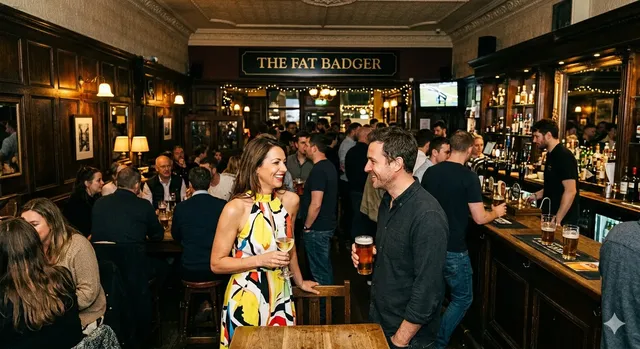
The Fat Badger is a strange mixture between a pub and a restaurant bar. Its décor is that of old oak, and its clientele are shades of various characters that it would be difficult to paint with one ilk of person. On that Friday night, as with most Friday nights, the place was packed, and after struggling to the bar and returning with a pint, I texted Isla and asked how long she’d be. A text came back almost instantly, saying, ‘Come and find me. I’m already here.’
I’d already looked around, but I hadn’t seen her, but then I did. She looked magnificent in a hugging halter dress: lemon, white and black, in the tones of Kandinsky, and with a figure of beauty. She didn’t look the same woman as the one I’d left an hour earlier.
‘You look stunning. The dress looks stunning.’
‘It’s the figure in the dress that makes the dress look stunning,’ she replied, glowing at both the compliment and at her wise reply.
‘I’m sorry, I didn’t see you when I came in, and I did look around.’
‘I saw you and decided to leave you for a while. Now you can get the lady a drink.’
‘What drink would the lady prefer?’
‘A fine Sauvignon Blanc, please.’
The night was splendid, and we drank until midnight before falling into the hotel room shortly afterwards.
Isla left early in the morning, and I left shortly afterwards and drove back to Leeds. In the car I thought what a great night, and I recalled that 'kiss', which Isla used as her gauge for dating, and I thought how it reminded me of a scene from David Lean's *Hobson's Choice*, where Maggie pulls Will, John Mills, into a back alley and says, 'Now you can kiss me, Will.'
When I arrived home, I searched for the clip on YouTube and sent Isla the scene, but without saying what the movie was.
Isla was distraught. Here was a woman receiving some sort of 'movie clip' from a man she barely knew, and she thought last night's antics had, by some mischief, found their way onto film. But within a short space of time, she was relieved, and she sent a text back saying how much she'd enjoyed the clip, and how she looked forward to when we were to meet next.
Prefer to listen? Watch the video reading below.
Reader Comments
Leave a Comment
We would love to hear your thoughts on this chapter.

About Karl Swainston
Karl Swainston is a writer and storyteller whose work is forged from a life lived across the North of England and far beyond. Growing up on a Leeds council estate in the 1960s, Karl's journey was anything but linear. By the age of thirty, he had already lived a dozen lives: from the rigors of grammar school to a degree in Latin, a stint as a fishmonger, a period of discovery living in Marseille, and a return to the hustle of London. Whether working as a postman, a builder, or competing as a county-level chess player, he was, above all, an avid reader—constantly documenting the world around him. This restless spirit continued into his professional life. Karl later taught in Bradford, where he ran a specialist unit for 244 of the most excluded students from across the region—young people whom even the local Pupil Referral Units could not accommodate. Working alongside his old friend Malcolm, Karl spent his days navigating the volatility of Bradford's most aggressive and dysfunctional teenagers. Throughout his life, Karl has been an avid runner and has always shared his home with a rotating cast of beloved dogs and cats—companions who have been constant witnesses to his work. As a writer, Karl's range is as expansive as his history. He works across a wide breadth of genres, including fiction and short stories, autobiography and memoir, biography, non-fiction, and metaphysical writing, as well as providing sharp commentary, opinion, analysis, and essays. Whether writing about his years managing the Harrogate Arms or offering insights from his current adopted home in South East India, where he lives in a simple village with his dog, Bambi, Karl's voice reflects the full, untidy, and deeply human breadth of life. He continues to draw on the rich, decades-long tapestry of his experiences to tell stories that matter, proving that no matter where you live, the human story remains the same.
Author Page