Tales From A Harrogate Caravan
Chapter 7 — Closing the Unit and the Gambia Trip
← Karl Swainston / Tales From A Harrogate Caravan
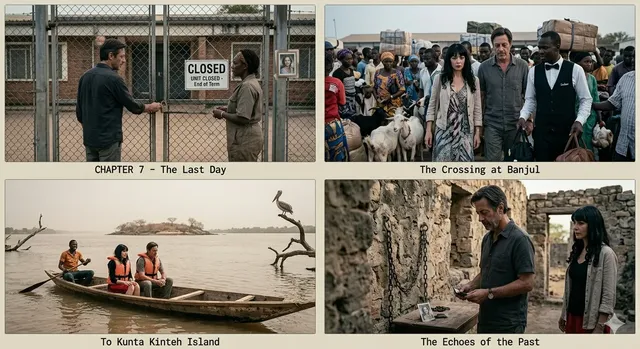
I did meet Isla again, and we shared some beautiful and great times together in the run-up to Christmas. Work at the unit was now winding down, and the last of the students were placed in other forms of alternative provision, and on the last day of that autumnal term, Rita and I closed the unit down. It wasn't a bad time, though, and both of us looked back on some tremendous years working with very difficult kids, and neither would Rita or I have changed those blessed years for any other. Time will move on, though, and Time was telling Rita and me to do the same.
Financially I was secure for the present time and wasn't in a rush to decide what to do next career-wise.
Isla was a hotel manager and had had to work most of the time over the festive period, but with the start of the New Year, hotels fall quiet, and she was afforded some much needed time off from work. It was then I decided to book a holiday for us somewhere in the sun, and within the week we were flying from Gatwick to Gambia, from winter to summer, from England to Africa.
I'd never travelled out of Europe, and I didn't much fancy the six hours of flight, but Isla was animated, and the time was noticeable. From the plane, we were taken by bus to Serrekunda and a beautiful hotel beside the Atlantic. It should have been perfect, but it wasn't. No matter how much you try and control your thoughts, memories, and emotions, you sometimes cannot. All the holidays I'd had for the last fifteen years or so were with Anna and the children, and the holiday with Isla then was somehow different. Isla noticed a change in my mood, and I took to running again along the beach to shake off the unwelcome melancholy, but it persisted. Circumstances, too, didn't provide remedy, as the hotel was secluded, and it wasn't advised to venture off 'out there,' as they advised against it. Add to that drinks in abundance, and the holiday somehow became glued down to daily habits.
I wanted to see Africa, and Isla did, too, and when Isa, a waiter, offered to be our guide on the first available free day he had, he took us on a tour. We left very early in the morning, sometime around the hour of five, which caused great annoyance to Isla, who customarily wouldn't surface until after ten. Isla was a woman with a temper, and it didn't improve when we arrived at Banjul Ferry Terminal to take the boat across the waters and on to James' Island, or as you probably are more familiar with, Kunta Kinteh Island, and the slavery trading post captured in the novel *Roots*.
***
The terminal was crowded with all manner of Africans in suits, Africans in shorts, Africans with goats at the side of them, and many of the goats had chickens with them, too. The boat was a veritable market of people, and when it sailed, you could hear her groan as she made her way across that mighty Gambia river.
The journey took a couple of hours, and it was freezing. Isla and I only had flimsy attire on, thinking the day would be hot, which it was, but forgetting the nights were also cold.
When we embarked at Barra, though, the sun had risen, and the warmth and then heat were mighty. We had to wait some considerable time for security to check all the passengers' documentation, and finally, after some time, Isa led us through some thoroughfare of concrete creations and through a market.
The market was a veritable hell. Everything was slammed together: the people, the small sheds, the wares, the animals having their heads cut off, and the muddy floor. Isla was pale and felt convulsive, as she could smell the stench, but I was senseless of it. It is amazing what we deem adversity to be, and making one's way through that market, that hell, made one feel completely blessed. The place and experience had a profound effect on me, and even now, when meeting with adversity, I recall that market and think lightly of present ills.
We finally made it out of the pit, and a taxi was waiting, which Isa had secured in advance. Not long into the journey, the car stopped, and a man with a gun appeared, and the window was drawn down. It was some sort of checkpoint, and Isa said it was customary to pay the guard 500 Dalasi, which sounds a lot, but is only a few quid. Isla, though, tempered highly already because of the boat ride with all the animals and her evident torture through the market, was having none of it, and she began to question the man with the gun as to why she should have to pay. Isla was by no means 'tight', and did possess enough intelligence and wisdom to understand most things, but I can never understand to this day why she wanted to argue with the man with the gun.
Finally, Isa had to intervene, and state that the taxi wasn't going anywhere until the money was paid. Isla paid the few quid, and the car was allowed to press on to Albadarr.
Albadarr was like any other village along the great Gambia, but when we entered the place, it felt indescribably eerie. Although there were many properties scattered around, there weren't many people, and you expected to see children playing, women and men working, but there were only a few, and they looked at you suspiciously and disappeared. We arrived at the jetty, and our guide, who was to take us by boat to the island, was waiting.
He was a very animated fellow and spoke perfect English, and he began to tell us that the other tourists, who were to make the journey with us, had cancelled at the last minute, and that he would only be taking Isla and me.
We put on our safety jackets and boarded the slender craft. Isa chatted with some locals, and decided to stay on land. The boat set off, and within minutes, we were whizzing through the Gambia to that historic island.
The first image which strikes you, and echoes the emptiness of the land we'd just left, was that the trees were all barren, leafless, and dead. Only a few pelicans clung to their twisted and dark branches. The island is no bigger than half a football pitch and shrinking more and more with each passing season, we were informed. During the height of the slavery trade, the island would house all the slaves before some galley was brought alongside, and the poor slaves were crammed into its hull, and off the Gambia they were sent and over the mighty Atlantic to be worked upon some cotton farm in the southern states of America.
The island still displayed the grim chambers of stone where the slaves were kept; it still maintained the living quarters of the guards, and as with the dead trees, even the ground seemed to resist the push of any new vegetation. It was both mesmerising and horrific, and you could almost hear the groans and cries of slaves in the timeless world of the past crying out in the present. I don't think they manufactured the place for the tourists to have this grim feel; I think it was entirely natural and seemed to have made its own deathly pallor over that island.
We returned back, and headed off to the ferry port. Strangely, the experience on the island had an effect on your senses and perceptions too of reality, as the market and boat somehow seemed different, and even Isla ceased to wince, and she looked upon the market, characters and animals on the boat differently.
Within days the holiday had ended, and so had Isla and I. I found the experience draining and melancholic. This was no fault of Isla's, but entirely mine, the schism of letting go of the past and embracing a future life. I knew then Anna was still deeply with me, and I had to come to terms with that, but the journey out of grief isn't easy, but you do finally emerge the stronger character for it.
Prefer to listen? Watch the video reading below.
Reader Comments
Leave a Comment
We would love to hear your thoughts on this chapter.

About Karl Swainston
Karl Swainston is a writer and storyteller whose work is forged from a life lived across the North of England and far beyond. Growing up on a Leeds council estate in the 1960s, Karl's journey was anything but linear. By the age of thirty, he had already lived a dozen lives: from the rigors of grammar school to a degree in Latin, a stint as a fishmonger, a period of discovery living in Marseille, and a return to the hustle of London. Whether working as a postman, a builder, or competing as a county-level chess player, he was, above all, an avid reader—constantly documenting the world around him. This restless spirit continued into his professional life. Karl later taught in Bradford, where he ran a specialist unit for 244 of the most excluded students from across the region—young people whom even the local Pupil Referral Units could not accommodate. Working alongside his old friend Malcolm, Karl spent his days navigating the volatility of Bradford's most aggressive and dysfunctional teenagers. Throughout his life, Karl has been an avid runner and has always shared his home with a rotating cast of beloved dogs and cats—companions who have been constant witnesses to his work. As a writer, Karl's range is as expansive as his history. He works across a wide breadth of genres, including fiction and short stories, autobiography and memoir, biography, non-fiction, and metaphysical writing, as well as providing sharp commentary, opinion, analysis, and essays. Whether writing about his years managing the Harrogate Arms or offering insights from his current adopted home in South East India, where he lives in a simple village with his dog, Bambi, Karl's voice reflects the full, untidy, and deeply human breadth of life. He continues to draw on the rich, decades-long tapestry of his experiences to tell stories that matter, proving that no matter where you live, the human story remains the same.
Author Page