Tales From A Harrogate Caravan
Chapter 5 — The Journey to Harrogate
← Karl Swainston / Tales From A Harrogate Caravan
The following day arrived, and I’d finished work at 1pm. I had to drive over and pick John up from the bungalow first. I’d given him some money to buy a used car, so he could go fishing, and he’d phoned earlier that day and said he only had to pick the car up in Wakefield.
‘How far is it?’
‘Not far, just on the edge of Wakefield.’
‘It betta be, as I can’t be late, John.’
Of course, with John, lateness is a definite occurrence, and we must have spent nearly an hour scouring some estate in Wakefield looking for this old Volvo.
‘It’s here,’ he finally shouted as we drove up some dilapidated drive. I passed John the money, and out of the car he went and hobbled over to some greasy bloke with half his hairy belly hanging out of his pants. They exchanged a few words, and John climbed into the white Volvo and began driving away. I followed the car all the way back to Leeds.
By the time we returned to Leeds, I was late and seriously thought about calling off the date, and even more so when I hit the trail of traffic crawling out of Leeds. If it had been any other day than Friday, I would have called it off, but it was Friday, and Fate, once again, was playing its hand.
Luckily, this Isla woman, who I was to meet, was also an inveterate latecomer like John, and she texted to ask if I could meet half an hour later.
I’d been to Harrogate a few times before, in my youth and in my childhood, when we’d cycle through the place. In both states of age, I didn’t really notice much about the place. On entering the spa town on that sunny autumnal day, though, I did notice what a splendid place it really was and how it attracted thousands of visitors each year. I could never understand Betty’s though, and I know many will castigate me for castigating it, but I cannot for the life of me see the purpose of queuing for over half an hour to have a cup of tea? Okay, there’s the décor and other pretentious tea sippers, but what the hell, I could never wait to have a cup of tea.
Betty’s is rested at the top of Montpellier Hill, a place I still haven’t paid a parking ticket for, and as I drove down it, I really did marvel at how picturesque the place was. At the bottom, there’s a small roundabout, and then there’s Valley Drive, home of Isla, whom I was shortly to meet.
Suddenly, a thought struck me: I didn’t have an image in the forefront of memory of what Isla actually looked like. In those months I don’t think I was actually in a reality as we know it, but in some sort of semi-surreal world, somewhat like a soul drifting through life but not being part of it. The dependency upon alcohol merely intensified this damaged image of reality.
***
I parked up, and then the phone rang. It was John. I forgot about Isla.
‘Karl?’ – I always knew something was wrong when John started with this address – ‘bit of a problem here.’ And as was customary of John, he let fall a silence to have its impact.
‘What’s wrong? It’s the car, isn’t it? What’s wrong with it?’
‘The engine mounting is knackered.’
I was out of the car by this time and striding up and down Valley Drive.
‘What do you mean “the engine mounting is knackered”? That car has cost us £500. Didn’t you have a look beneath the bonnet before you bought it?’ I shouted.
‘No.’
‘What the hell, John, why not?’
‘I knew you were late and wanted to get off, and I thought it’d be alright.’
‘Oh, John,’ I groaned. ‘We’ve paid out £500 for a car, and you didn’t even bother to check under the bonnet? What the hell.’
Across the road there was a woman in a red skirt waving her arms. In my exchange with John, I’d completely forgotten the reason I was there. I cut the conversation short with John and so began another avenue of life.
Isla wasn’t Scottish at all, and I don’t know how that notion ever entered my head. I suppose I was chatting with another Isla, and it was this one I thought I was supposed to meet.
I looked across the Drive at her, and she shouted, 'It’s Karl, isn’t it? I won’t be a minute, I’ve just to nip in the flat and get something,’ and into an elegant Victorian set of flats the woman disappeared.
I waited upon the pavement for a couple of minutes or so, thinking more about the car than I did about the woman I was to date. I didn’t quite catch a look of her; when I did, she’d vanished, but when she emerged again, I did take in her charm and good looks.
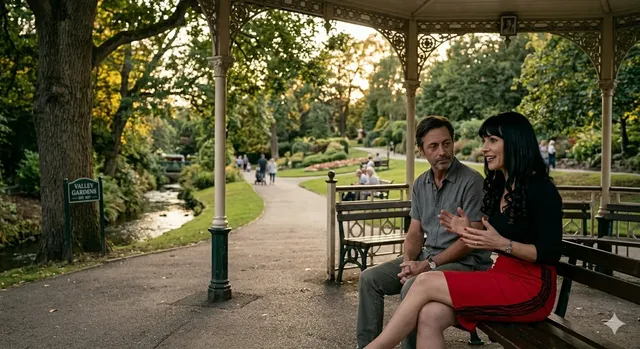
Isla stood around five and a half feet, and had intense black hair, which emerged straight at the crown, but as it fell down, it wavered into ringlets of curls as it covered her shoulders. She wore a neat, tight, red skirt with strands of black following her shape, which showed her figure to full advantage. As we walked down the Drive and through the entrance into Valley Gardens, Isla chatted with utmost confidence; one could immediately discern a woman with much wit and mischief in her character.
Valley Gardens is a wonderful creation of Victorian design. Two winding paths lead you into the centre, and running alongside one there is a small, but beautiful stream. Summer still lingered that day in the Gardens, and the leaves and plants still kept much of their foliage. Autumn was there, too, and I remember sitting inside a pagoda, listening to this woman chat animatedly at the side of me and looking out onto those Gardens. It was wonderful.
Isla had a chirpy character, and I suppose her Sunderland accent accentuated the skipping of the words she sang. We sat and chatted for an hour or so, or at least she chatted, and I listened, because, as I learned afterwards, one doesn’t get much of a part when Isla is on the stage.
Prefer to listen? Watch the video reading below.
Reader Comments
Leave a Comment
We would love to hear your thoughts on this chapter.

About Karl Swainston
Karl Swainston is a writer and storyteller whose work is forged from a life lived across the North of England and far beyond. Growing up on a Leeds council estate in the 1960s, Karl's journey was anything but linear. By the age of thirty, he had already lived a dozen lives: from the rigors of grammar school to a degree in Latin, a stint as a fishmonger, a period of discovery living in Marseille, and a return to the hustle of London. Whether working as a postman, a builder, or competing as a county-level chess player, he was, above all, an avid reader—constantly documenting the world around him. This restless spirit continued into his professional life. Karl later taught in Bradford, where he ran a specialist unit for 244 of the most excluded students from across the region—young people whom even the local Pupil Referral Units could not accommodate. Working alongside his old friend Malcolm, Karl spent his days navigating the volatility of Bradford's most aggressive and dysfunctional teenagers. Throughout his life, Karl has been an avid runner and has always shared his home with a rotating cast of beloved dogs and cats—companions who have been constant witnesses to his work. As a writer, Karl's range is as expansive as his history. He works across a wide breadth of genres, including fiction and short stories, autobiography and memoir, biography, non-fiction, and metaphysical writing, as well as providing sharp commentary, opinion, analysis, and essays. Whether writing about his years managing the Harrogate Arms or offering insights from his current adopted home in South East India, where he lives in a simple village with his dog, Bambi, Karl's voice reflects the full, untidy, and deeply human breadth of life. He continues to draw on the rich, decades-long tapestry of his experiences to tell stories that matter, proving that no matter where you live, the human story remains the same.
Author Page