Tales From A Harrogate Caravan
Chapter 41 — The Death of Pubs
← Karl Swainston / Tales From A Harrogate Caravan
With the advent of the internet, chess, and indeed life for that matter changed.
Take the common pub. There was literally one on every road across the country. In Hunslet and Belle Isle alone there were over twenty pubs and clubs within the radius of a couple of miles. In East End Park, there were even more drinking dens.
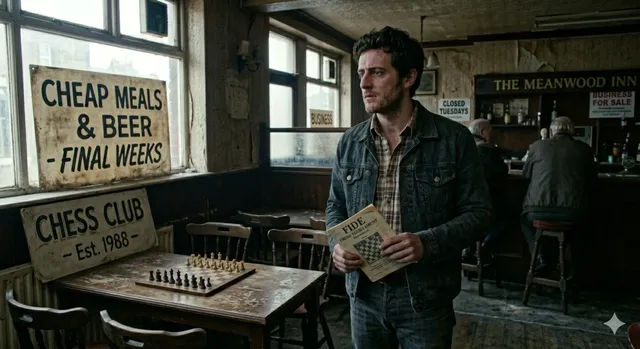
Now, there are only six, and by next year there will no doubt be only three, as the early warning signs are already outside the pubs advertising cheap meals and cheap beer. Healthy pubs don't need to drop their prices, but weak and dying ones, in one last desperate act, do. I know about the death of a pub, and I will relate a tale about one later.
I don't regret pubs disappearing, as it is all part of change. It's the poignancy of the pub I miss, the nostalgia. More often than not, now, when I walk into a pub from the daylight and into the dinginess inside, I feel a sort of depressed revulsion and turn around, leaving to seek lighter abodes.
Chess revolved around pubs and clubs for us lot back then. There would always be a pub somewhere frequented day or night, and we played in some dire and wretched haunts. I can't remember the name of the worst, somewhere in the bottom side of Meanwood. It was a club, if you could call it that.
But when the pubs started to disappear, so did the chess players – though that wasn't the only reason. It didn't happen quickly, but it happened with inevitability. The days of being in our twenties, or even early thirties, were soon gone. Back then none of us worked, or if you did, it was either on the side, or on a building site where it didn't matter if you were covering the scaffold with stale draughts of beer each morning and puking over the side.
I've already related how I 'believed' I could be the first grandmaster who took up chess after the age of 16. I did, I really believed in my fancy I could do that. I don't know if anyone has achieved this feat yet, but I doubt it. Grandmasters learn the game early in life, and their brain, I believe, forms differently too. It evolves and learns to adapt to the puzzles the game gives to it constantly.
Unlike a late teenager, whose brain has probably neared its completion, the young mass of pink matter accommodates the demands pressed upon it. Back then, I didn't understand this, and it took at least ten years to fully comprehend it. I was a dreamer back then and probably still am, and any brain, even mine, can still dream.
When I did realise I was never even going to be a FIDE Master, or a 200 grade, for that matter, there was only the inertia of chess, and the camaraderie that went with it. Towards the later years of my twenties, I turned up for chess as a social event only and began to pursue another dream.
Prefer to listen? Watch the video reading below.
Reader Comments
Leave a Comment
We would love to hear your thoughts on this chapter.

About Karl Swainston
Karl Swainston is a writer and storyteller whose work is forged from a life lived across the North of England and far beyond. Growing up on a Leeds council estate in the 1960s, Karl's journey was anything but linear. By the age of thirty, he had already lived a dozen lives: from the rigors of grammar school to a degree in Latin, a stint as a fishmonger, a period of discovery living in Marseille, and a return to the hustle of London. Whether working as a postman, a builder, or competing as a county-level chess player, he was, above all, an avid reader—constantly documenting the world around him. This restless spirit continued into his professional life. Karl later taught in Bradford, where he ran a specialist unit for 244 of the most excluded students from across the region—young people whom even the local Pupil Referral Units could not accommodate. Working alongside his old friend Malcolm, Karl spent his days navigating the volatility of Bradford's most aggressive and dysfunctional teenagers. Throughout his life, Karl has been an avid runner and has always shared his home with a rotating cast of beloved dogs and cats—companions who have been constant witnesses to his work. As a writer, Karl's range is as expansive as his history. He works across a wide breadth of genres, including fiction and short stories, autobiography and memoir, biography, non-fiction, and metaphysical writing, as well as providing sharp commentary, opinion, analysis, and essays. Whether writing about his years managing the Harrogate Arms or offering insights from his current adopted home in South East India, where he lives in a simple village with his dog, Bambi, Karl's voice reflects the full, untidy, and deeply human breadth of life. He continues to draw on the rich, decades-long tapestry of his experiences to tell stories that matter, proving that no matter where you live, the human story remains the same.
Author Page