Tales From A Harrogate Caravan
Chapter 42 — Buying a House and Getting a Dog
← Karl Swainston / Tales From A Harrogate Caravan
Although I had steady employment with the teaching agency, the crippling debts of the past meant financially life was still tough for us. In order to supplement income, I took on a couple of private tuitions, but with each passing week another student would be added until I was soon teaching seven days a week. I still rode a bike back then and would easily clock up over 100 miles a week. Anna was looking after Jack and Rachel, and all the money that was gained from private teaching she'd place in a tin beside the dresser.
I reckoned she'd have been happy at 955, but there was always one point which niggled her, and that was the house was our Mick's, as he had bought it from the council, and we paid rent to him. Anna wanted her own home and quite rightly too, and she'd constantly pester me to think about it. I suppose, back then, I was still wary of a family life and commitment, even though I now had a family, but I can remember there was always some anxiety within me when having to think about the issue of buying a house and being saddled with a mortgage.
Maybe it's the same with most people buying their first home? I don't know, but now, with experience of property, I wouldn't have any anxious thoughts.
At around that time Anna had been given the chance of a grey whippet, which her niece couldn't care for. I have had dogs and cats ever since I can remember: Lucky, Kim, Lassie, Rebel, and Colonel, and too many cats with strange sounding names. After I'd taken Rebel to the vets for the last time, and I watched that wearied, old dog of eighteen years look behind himself at me with those gummy eyes and a look of love, I'd sworn not to have another dog. And I didn't, but when Anna brought the whippet back with her one afternoon, that was it. Smokey was added to the list of all the other dogs and cats who have resided at 955.
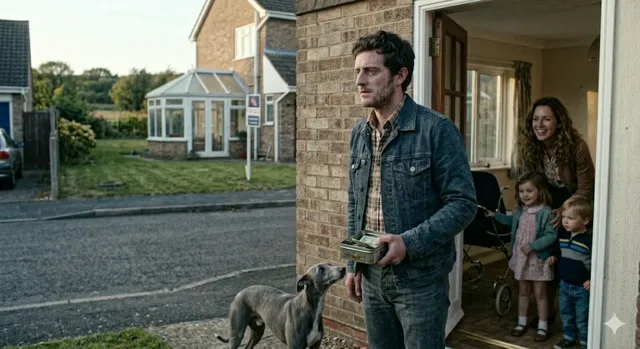
I was returning home from a walk in the woods with Smokey one Thursday evening, and I'd noticed at the side of the fields leading to the woods a house for sale. I decided to 'have a look', as there'd be no harm in that. I did, and the house was a detached house with a conservatory and a big yard with copious garden for both kids and the dog. I liked it, and I knew Anna wasn't going to relent on her pestering of me for buying a house, and I thought best get this one then.
'There's a house for sale by the park down there,' I casually muttered upon returning with Smokey.
'Rachel, get my coat; we're off to see the house. You can have some breakfast when we get back. Don't take your jacket off.'
I took Anna, Rachel, and Jack in the pram round to the property, and Anna wanted it so much so that the following day an appointment was booked with an agent, and within the afternoon, a deposit had been borrowed, and we'd – or Anna – had made an offer on the property. A short time afterwards, we'd secured a mortgage, and we moved out of 955 and into the new home.
John, the bricklayer, took up the mantle of 955 as its newest tenant. Within the week, a window had been put through, but that's another story.
The house and new home was fantastic, but for one problem: the mice. Living next to a field meant every mouse in those fields knew where you lived, and I suspect those that had done a runner from 955 because of the cat had turned up on this doorstep. They were everywhere, and within a day or two, they had even broken into the sofa and into the two armchairs and taken up cosy residence there. We knew this because each time you sat down, some mouse would scurry out of it.
Anna didn't want to kill the mice with traps, and with Jack crawling around the floor, she wouldn't entertain poison. Nothing worked, though, and I suspect the mice increased their vermin population with Jack dropping biscuit crumbs everywhere. No, there was no choice in the matter: we had to have a cat. Anna was reluctant to have a cat since Rachel had asthma, but the house was fairly big and airy, and she decided to give it a go. 'If the cat gets to Rachel, it'll have to go back,' she concluded.
Prefer to listen? Watch the video reading below.
Reader Comments
Leave a Comment
We would love to hear your thoughts on this chapter.

About Karl Swainston
Karl Swainston is a writer and storyteller whose work is forged from a life lived across the North of England and far beyond. Growing up on a Leeds council estate in the 1960s, Karl's journey was anything but linear. By the age of thirty, he had already lived a dozen lives: from the rigors of grammar school to a degree in Latin, a stint as a fishmonger, a period of discovery living in Marseille, and a return to the hustle of London. Whether working as a postman, a builder, or competing as a county-level chess player, he was, above all, an avid reader—constantly documenting the world around him. This restless spirit continued into his professional life. Karl later taught in Bradford, where he ran a specialist unit for 244 of the most excluded students from across the region—young people whom even the local Pupil Referral Units could not accommodate. Working alongside his old friend Malcolm, Karl spent his days navigating the volatility of Bradford's most aggressive and dysfunctional teenagers. Throughout his life, Karl has been an avid runner and has always shared his home with a rotating cast of beloved dogs and cats—companions who have been constant witnesses to his work. As a writer, Karl's range is as expansive as his history. He works across a wide breadth of genres, including fiction and short stories, autobiography and memoir, biography, non-fiction, and metaphysical writing, as well as providing sharp commentary, opinion, analysis, and essays. Whether writing about his years managing the Harrogate Arms or offering insights from his current adopted home in South East India, where he lives in a simple village with his dog, Bambi, Karl's voice reflects the full, untidy, and deeply human breadth of life. He continues to draw on the rich, decades-long tapestry of his experiences to tell stories that matter, proving that no matter where you live, the human story remains the same.
Author Page