Tales From A Harrogate Caravan
Chapter 40 — First Teaching Job
← Karl Swainston / Tales From A Harrogate Caravan
There was no work in education to be had when I'd finished the course, as it was summer, and the only option left for work was back with John bricklaying. I'd run up a pack of debts whilst at University, and these meant there was never really any spare cash to spend, but we got by. The building work lasted into the first part of September, but then it began again to fizzle out to not even a full week. I hadn't applied for any teaching posts, as I didn't really fancy teaching and much preferred working in construction. But times were hard, and Anna would, quite rightfully, eternally complain at me for doing a year on the course and then not applying for teaching jobs.
What Anna didn't know is that I would have jacked the PGCE in early into the course, and the only reason I didn't was imagining the creatures smirking and thinking they had won. I was terribly stubborn, and this, I know, is a weakness of mine.
Whilst Anna complained about my reluctance to teach, Fortune intervened on her behalf. When I returned home from work one night towards the end of September, Anna was waiting.
'That Samantha woman from the University has rung up and asked if you want a part-time maternity cover job for a teacher in a school in Leeds. She said it's a tough school, but you'll manage. I've already told her you'll have it. You start on Monday morning, so you'd better dig out some trousers and tell John you'll only be able to work two days with him.' And that was it. I took my first teaching post.
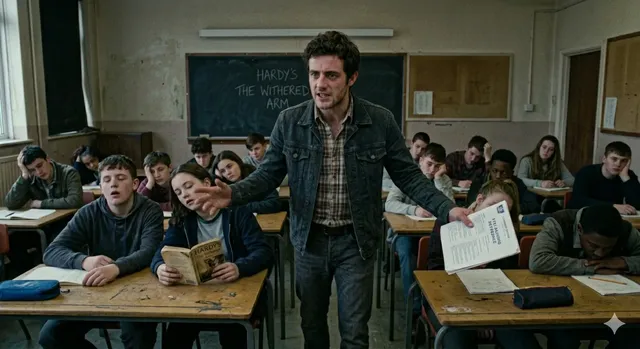
The school was Shelley High School, and it wasn't a tough school where the kids are all gangsters; no, it was 'tough' in another way. Most of the students just wouldn't wake up. It was like teaching in a zombie land. I tried every trick in the book with Hardy's 'The Withered Arm', to get them interested, but each attempt was met with some type of groan. Since that time I've had many years of motivating and energising students successfully, but, I do believe, were you to give me that class again now, knowing what I do, I don't think I could energise and enthuse them even now.
When I was 24, I had a job as an activity organiser for Leeds Mind, a drop-in centre, where most of the clients were sedated on one form of medication or another, and I had more success with them than I did with that class of September.
I was there just over a couple of months, and the resident teacher was due to return. I still hadn't made any applications for teaching posts, hoping instead that John would have found some good building work, but he didn't, and on the Thursday I finished at the school, Anna met me in town, and in her bag were all my teaching documents and references etc., and she marched me round to Select Education, a teaching supply agency, and had me registered. Damn the woman. But I loved her.
On the Friday, the phone rang, and it was the agency.
'Is Karl there please? We've a post in Bradford, Karl, if you're interested? It's teaching Drama, as the teacher has gone off on long-leave sickness. There's a good chance you'll be there until the other side of Christmas. Do you want it?'
'Yes, I'll take it.'
'Make sure you establish yourself from the start.' And the woman put the phone down.
'Establish myself? What does the woman mean "establish myself"?'
'Doesn't matter,' Anna intervened. 'You've a full-time job now.'
At 8.30am on the Monday morning, I realised what the woman meant when 9WMT came crashing through that Drama Hall door.
I looked at the Faculty Head with incredulity, and he casually walked over and said, 'The last two drama teachers didn't even last a day or two. You'll be alright, though; give it your best shot. Good luck,' and off he went to teach P.E.
Just see it out until the end of the day, Karl, and don't bother coming back tomorrow, as there'll be other opportunities in other schools, I thought. But before I could get through to tomorrow, I had to get to the end of the day today and that meant stratagems and boundless energy to get the group turned around.
By the end of the lesson, I had the boys pulling off some heist and grappling with the police or killing off fellow gangsters, and the girls fighting on a Jerry Springer show – sexist, I know, but you have to understand it was survival in that room for me.
By the end of the day, the Faculty Head appeared and said, 'You've done well, Karl. We'll see you tomorrow.'
Tomorrow came and then the next day and the next, and by Friday, I loved the challenge, and within a few weeks, I had the students in line and learning.
Prefer to listen? Watch the video reading below.
Reader Comments
Leave a Comment
We would love to hear your thoughts on this chapter.
About Karl Swainston
Karl Swainston is a writer and storyteller whose work is forged from a life lived across the North of England and far beyond. Growing up on a Leeds council estate in the 1960s, Karl's journey was anything but linear. By the age of thirty, he had already lived a dozen lives: from the rigors of grammar school to a degree in Latin, a stint as a fishmonger, a period of discovery living in Marseille, and a return to the hustle of London. Whether working as a postman, a builder, or competing as a county-level chess player, he was, above all, an avid reader—constantly documenting the world around him. This restless spirit continued into his professional life. Karl later taught in Bradford, where he ran a specialist unit for 244 of the most excluded students from across the region—young people whom even the local Pupil Referral Units could not accommodate. Working alongside his old friend Malcolm, Karl spent his days navigating the volatility of Bradford's most aggressive and dysfunctional teenagers. Throughout his life, Karl has been an avid runner and has always shared his home with a rotating cast of beloved dogs and cats—companions who have been constant witnesses to his work. As a writer, Karl's range is as expansive as his history. He works across a wide breadth of genres, including fiction and short stories, autobiography and memoir, biography, non-fiction, and metaphysical writing, as well as providing sharp commentary, opinion, analysis, and essays. Whether writing about his years managing the Harrogate Arms or offering insights from his current adopted home in South East India, where he lives in a simple village with his dog, Bambi, Karl's voice reflects the full, untidy, and deeply human breadth of life. He continues to draw on the rich, decades-long tapestry of his experiences to tell stories that matter, proving that no matter where you live, the human story remains the same.
Author Page