Tales From A Harrogate Caravan
Chapter 57 — The Dandelions
← Karl Swainston / Tales From A Harrogate Caravan
In the space of a week Anna had deteriorated so much. At the start of the week, she could take some food, medication, and water, but by the end of the week, only little sips of water and some medication.
At that time, I would be busy and attentive to every need of Anna and of Rachel and Jack, too, and of all the people who came to see Anna during those last days, and I tried to be the efficient, diligent, and caring husband and father. The reality was, though, I was an emotional and mental wreck. It wasn't easy, and that was why I drank to get through the day. When grief, torment, and lack of hope, fuelled by alcohol, take a grip of one's heart and mind, strange events begin to assume life, and the most bizarre thoughts gain a sense of reality.
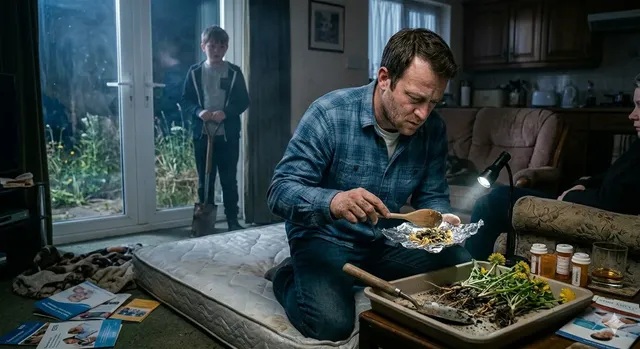
I was sat on the conservatory steps listlessly looking on when I noticed the yellow top of a dandelion had forced its way through the hardest of concrete, and it was now living its life to the full under the big, blue sky of July above. When you drink with regularity and without much cessation, reality becomes distorted, and I suppose that's fertile ground for extraordinary thoughts of desperation to seed and grow. How does a dandelion force itself through the concrete, I thought, and if it can do that to secure life, maybe the roots which bury themselves deep in the earth can do the same for Anna?
I can see the total stupidity of it now when looking back, but at that time, it took a deep hold of me, and I started to dig up these little plants, cut off the deepest part of the root, crush them, and feed them to Anna. When the doctor attended one night, just before it was getting dark, I asked – nay told him the idea – and I can remember him being very uncomfortable sat there next to a man expounding such a notion and in such a desperate, mad way that all he could do was reply, 'Maybe.' But he knew it wasn't to be done and merely shook his head upon leaving at a man maddened by torment and dispossessed of his reason by drink and madness.
I do think now that it was some state of madness I was in at that time. It must have been, as why else would I have convinced Jack to go and get a torch and bring a spade, so that we could go search for dandelions in the moonlight of the night by the woods? But I did. I deeply regret it now; now that I see the reality, but at the time, I couldn't, and I saw only reality in impassioned imagination.
Prefer to listen? Watch the video reading below.
Reader Comments
Leave a Comment
We would love to hear your thoughts on this chapter.

About Karl Swainston
Karl Swainston is a writer and storyteller whose work is forged from a life lived across the North of England and far beyond. Growing up on a Leeds council estate in the 1960s, Karl's journey was anything but linear. By the age of thirty, he had already lived a dozen lives: from the rigors of grammar school to a degree in Latin, a stint as a fishmonger, a period of discovery living in Marseille, and a return to the hustle of London. Whether working as a postman, a builder, or competing as a county-level chess player, he was, above all, an avid reader—constantly documenting the world around him. This restless spirit continued into his professional life. Karl later taught in Bradford, where he ran a specialist unit for 244 of the most excluded students from across the region—young people whom even the local Pupil Referral Units could not accommodate. Working alongside his old friend Malcolm, Karl spent his days navigating the volatility of Bradford's most aggressive and dysfunctional teenagers. Throughout his life, Karl has been an avid runner and has always shared his home with a rotating cast of beloved dogs and cats—companions who have been constant witnesses to his work. As a writer, Karl's range is as expansive as his history. He works across a wide breadth of genres, including fiction and short stories, autobiography and memoir, biography, non-fiction, and metaphysical writing, as well as providing sharp commentary, opinion, analysis, and essays. Whether writing about his years managing the Harrogate Arms or offering insights from his current adopted home in South East India, where he lives in a simple village with his dog, Bambi, Karl's voice reflects the full, untidy, and deeply human breadth of life. He continues to draw on the rich, decades-long tapestry of his experiences to tell stories that matter, proving that no matter where you live, the human story remains the same.
Author Page