Tales From A Harrogate Caravan
Chapter 56 — The Cancer Ward
← Karl Swainston / Tales From A Harrogate Caravan
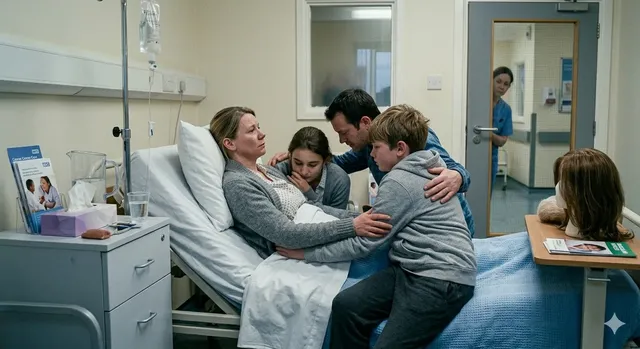
The next day, they moved Anna to the Oncology Ward, which is a fancy name for the Cancer Ward. When you move along the corridor, Death views out at you from all the frightened faces of those resting in their beds.
When we arrived at Anna's bedside, she was choosing which wig she'd wear when her hair fell out with the chemo treatment. She only had one dose of chemo, and she didn't get to wear the blonde wig we chose.
She was in good spirits and still believed the best. When Rita and her sister visited, she was convinced a couple of doses of chemo would sort out the problem.
The next day, she phoned, and her mood had changed palpably.
'Karl, can you come down to the hospital now, as the doctor wants to speak to you.' I knew then, she knew.
'I don't want you to bring the kids, though. I don't want them to know.'
A mother didn't want her kids to know she was dying. Yes, that word.
O, how I struggled to both not tell the kids and to tell them, and in the end, it was Rita and my mam who said, 'They have to know, Karl. They have to know.'
I took the kids to the Cancer Ward.
We went into the room Anna was in, and she didn't look at us but stared out of the window. Rachel was confused and Jack more so. A Macmillan nurse ushered us out and into a small family room; Rachel on one side of me and Jack on the other; both children still unaware of what was about to shatter their tiny little lives.
They uttered the most devastating words in the softest of tones: 'Karl, Rachel, Jack, your wife and mum is going to die.'
I can still feel that pull from either child to the side of me: that tug of pain, of torment, of disbelief, of deepest dread. Then the tears, and then the collapse of their arms as grief takes over, and they both fall into a private state of suffering.
The words were finished, and we were led back to the room where Anna was. She was waiting. Jack ran to her, and Rachel went to the other side of the bed. They all hugged, and it was heart wrenching, as Anna softly said repeatedly, 'Don't cry. Shhush-shhush, don't cry.'
A little while later, the same Macmillan nurse came in and asked Anna where she would like to die. I said, 'At home,' and Anna began to cry.
We waited an hour or so for the hospital to fill out all the necessary documents and prescribed medication, and then we left the Cancer Ward for the last time.
***
Donald had prepared a single bed in the living room because the hospital bed hadn't arrived yet, and I'd pulled down a spare mattress, which I'd placed at the side of the bed, so that I could sleep downstairs.
Anna's bed was near the patio doors, and as I chatted with her, I noticed Jack alone outside. I made some excuse to leave and made my way outside. He was stood there with his head down between two bushes of purple lilac, and he was crying. I tried to give him comfort, but to a thirteen-year-old lad, when you haven't any hope to give, it's a futile try, but I did the best I could and drew him slowly back into the house to talk with his mam.
The next day Anna wanted to bathe, but she was too frail to walk up the steps, and I had to piggyback her. I can remember recalling at the time how I used to carry twelve bricks in a hod and sometimes three concrete blocks on my shoulders all day long, and now, on those steps taking Anna's frail body up, I barely felt I was bearing half the weight.
Rachel had run the bath, and she undressed her mam and bathed her. When she'd finished, I took Anna in my arms and carried her back down the steps again and into the sitting room.
Anna was still talkative, and there were a great many visitors, but the time spent with them and the medication and morphine she was on made her constantly tired, and she would want to sleep.
When she was awake, I tried a great many times, and so did Rachel and Jack too, to ask, 'Is there anything you want, Anna? Do you want to talk about anything?'
But Anna never did. She simply looked at you, and that was it.
One time, when it was deep into the night and dark, too, I suddenly woke up and looked up from the mattress I was sleeping on, and Anna was, with her head tilted to one side, looking down at me in the gloom. When I returned the look, she simply stared for a while, drew her head away, and said nothing.
There was only one time Anna ever spoke about death, and it was when I was sat on the edge of the bed. The kids had gone to Scarborough for the day for a break, and Anna touched my shoulder and said, 'I know I'm going to die, Karl,' and then looked away again.
Prefer to listen? Watch the video reading below.
Reader Comments
Leave a Comment
We would love to hear your thoughts on this chapter.
About Karl Swainston
Karl Swainston is a writer and storyteller whose work is forged from a life lived across the North of England and far beyond. Growing up on a Leeds council estate in the 1960s, Karl's journey was anything but linear. By the age of thirty, he had already lived a dozen lives: from the rigors of grammar school to a degree in Latin, a stint as a fishmonger, a period of discovery living in Marseille, and a return to the hustle of London. Whether working as a postman, a builder, or competing as a county-level chess player, he was, above all, an avid reader—constantly documenting the world around him. This restless spirit continued into his professional life. Karl later taught in Bradford, where he ran a specialist unit for 244 of the most excluded students from across the region—young people whom even the local Pupil Referral Units could not accommodate. Working alongside his old friend Malcolm, Karl spent his days navigating the volatility of Bradford's most aggressive and dysfunctional teenagers. Throughout his life, Karl has been an avid runner and has always shared his home with a rotating cast of beloved dogs and cats—companions who have been constant witnesses to his work. As a writer, Karl's range is as expansive as his history. He works across a wide breadth of genres, including fiction and short stories, autobiography and memoir, biography, non-fiction, and metaphysical writing, as well as providing sharp commentary, opinion, analysis, and essays. Whether writing about his years managing the Harrogate Arms or offering insights from his current adopted home in South East India, where he lives in a simple village with his dog, Bambi, Karl's voice reflects the full, untidy, and deeply human breadth of life. He continues to draw on the rich, decades-long tapestry of his experiences to tell stories that matter, proving that no matter where you live, the human story remains the same.
Author Page