Tales From A Harrogate Caravan
Chapter 7 — The Black Moment
← Karl Swainston / Tales From A Harrogate Caravan
I was walking with the dogs early this morning through a rhubarb field in what they call the 'rhubarb triangle' around Rothwell. The furrowed ground was strewn with dead, black stalks of rhubarb, all wizened and flattened by the cold, and looking like the very image of death. I could never understand why the farmer had neglected to harvest his crop. Maybe the market it was meant for wasn't worth the labour, or perhaps he shot the local gossip and was doing life. I don't know. But the image of 'blackness' compelled me to recall a part of my life when the pieces on the chess board all went black.
I was not much older than 19 or 20; I was doing well at chess, and I lived in complete contentment in the hope that I would, one day soon, become a Grandmaster. All that consumed me was an addiction to play chess. Every penny I earned from window cleaning went to the cost of playing in tournaments. There was only one problem: I wasn't yet strong enough to win an Open tournament, even a small event. I can recall making the decision to give up all other recreations and devote entirely my whole being to becoming a Grandmaster. I stopped socialising, drinking, shagging, and even reading, and like a monk rose with the dawn and went to bed with the night studying chess. My grade began to rise quickly, but there was a price.
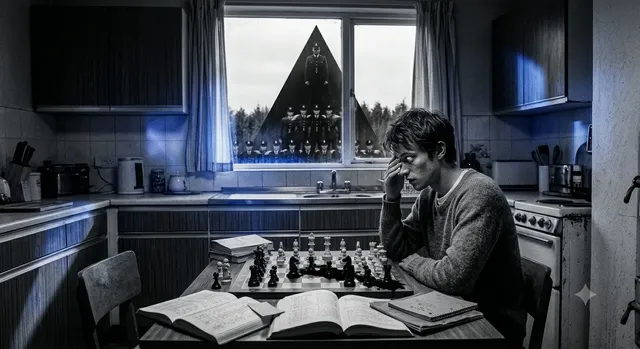
Slamming your brain with a puzzle throughout the duration of almost every second, every minute, every hour, every day, every week, every month, and nearly every year – but it didn't reach a year; I never did get to put that test to my brain for a year. I never knew anything was wrong until that day, in the kitchen with the oven door open, belting out fire and the pieces turning colour before my very eyes. I stood up from the board but then sat down again, almost immediately, and tried to focus, but the same event occurred.
Still, I didn't really think there was much wrong and simply put it down to needing glasses, which I'd worn as a kid.
That night, though, something else happened more sinister. I remember feeling exhausted and felt a cold coming on, and I went to bed early. I must have fallen almost instantaneously into a deep sleep because I tried to recall on the next day the events leading up to what happened. I awoke in the dead of night. Nothing was stirring, and it was cold. I tried to fall back asleep, but I couldn't do so, and I lay there instead staring at the curtains as they moved with the night's breeze.
‘No, not there. Ssshh! Shhuss! Over there. Be quiet.’
The voices were coming from downstairs in the living room; they travelled up along the staircase to my bedroom door, which was half open.
‘No, Shussh, don't move. Listen.’
I knew I wasn't dreaming and was completely awake, and the whispers didn't terrify me but unnerved me, as I had enough reason to know if there was anyone down there, the dogs would have them.
I went down the stairs, though, cautiously. In the room, the noises and whispers had ceased, and there was only Colonel, the greyhound, on the sofa, his bed, asleep.
I turned around and headed off back to bed, thinking how strange: I definitely knew it wasn't a dream, but I was now convinced it was.
I climbed back into bed and pulled the thick duvet, which Donald had nicked from Woolworths and sold to me for a couple of quid, back over my head and tried to go back to sleep. Through the little chink, which I'd left open to breathe fresh air, I could discern a flickering blue light and some muffled noises.
They must be coming from outside, I thought, and the blue light must be the police. Something must be happening; and buzzed with curiosity, I leapt out of bed to the window and drew back the curtains.
The first thing that hit me was a triangle, black and as big as a house. At the bottom were a long line of policemen; on the next row, sitting on their shoulders, there was another line of policemen; on their shoulders, another line until there was only one policeman eye to eye, looking at me from the top of the pyramid. It was then I noticed they were all hideous creatures moving towards me.
I knew it was in my mind, and that was probably the reason I did not scream out. But I also knew I was completely awake and stood at the window, too. A hot sweat in horror is when you can act, but a cold sweat in terror is when you cannot. With the latter, you're numb, and the heat of horror earlier now evaporates, and you feel the cold on your flesh. I was cold.
I walked back to the bed, climbed in like someone ready to die, and fell asleep again with my head under the blankets.
In the morning, strange things inside my head were happening and in my body too. I knew I'd pushed my mind to extraordinary feats of mental endurance in the endeavour to study the art of chess, and that there was nothing at all wrong with my social life or physical life, too, as I still ran every day, to cause such a catastrophe of the mind. No, here was something completely different happening. One day, you’re fine and dandy, and the next you're an introvert and scared. Can it be that the exercise of thoughts can bring about mental change and physical inertia? Can it be that forcing your brain to dance their little electrical impulses all day long can force them to shut down, just as the muscles and bones on an exhausted runner would do?
I don't remember much else, except this unendurable torment of life, a tremendous sense of not wanting to be 'here'; an exit and a quick way out. If the Devil would have led me by the hand to some bridge and said, ‘There you are, Karl,’ I would have leapt with joy to end that horror I felt in my mind.
The Devil didn't come though, and the madness didn't stay either and slowly disappeared over a matter of weeks when I began to run again to forget the torment of the mind.
Something did snap in my skull then; I know that now. After that, I did carry on playing chess, but I took things easy from then on and let my old recreations of debauchery run back into my arms and life.
Prefer to listen? Watch the video reading below.
Reader Comments
Leave a Comment
We would love to hear your thoughts on this chapter.

About Karl Swainston
Karl Swainston is a writer and storyteller whose work is forged from a life lived across the North of England and far beyond. Growing up on a Leeds council estate in the 1960s, Karl's journey was anything but linear. By the age of thirty, he had already lived a dozen lives: from the rigors of grammar school to a degree in Latin, a stint as a fishmonger, a period of discovery living in Marseille, and a return to the hustle of London. Whether working as a postman, a builder, or competing as a county-level chess player, he was, above all, an avid reader—constantly documenting the world around him. This restless spirit continued into his professional life. Karl later taught in Bradford, where he ran a specialist unit for 244 of the most excluded students from across the region—young people whom even the local Pupil Referral Units could not accommodate. Working alongside his old friend Malcolm, Karl spent his days navigating the volatility of Bradford's most aggressive and dysfunctional teenagers. Throughout his life, Karl has been an avid runner and has always shared his home with a rotating cast of beloved dogs and cats—companions who have been constant witnesses to his work. As a writer, Karl's range is as expansive as his history. He works across a wide breadth of genres, including fiction and short stories, autobiography and memoir, biography, non-fiction, and metaphysical writing, as well as providing sharp commentary, opinion, analysis, and essays. Whether writing about his years managing the Harrogate Arms or offering insights from his current adopted home in South East India, where he lives in a simple village with his dog, Bambi, Karl's voice reflects the full, untidy, and deeply human breadth of life. He continues to draw on the rich, decades-long tapestry of his experiences to tell stories that matter, proving that no matter where you live, the human story remains the same.
Author Page