Tales From A Harrogate Caravan
Chapter 6 — The Harris Tweed Jacket
← Karl Swainston / Tales From A Harrogate Caravan
It was during this time I was given a Harris Tweed jacket of the most expensive kind. John, a fellow chess player and bricklayer, had been given the jacket by this receptionist on a site in London, and since the jacket didn't fit him, he passed it down to me. You have to remember that in the early years of the 1980s, when still in your teens, there wasn't the glut of cheap clothes that there is today. A set of jeans would set you back a good tenner, and that was a quarter of your wage gone for a teenager on a wage of no more than £40 a week. A jacket was a more expensive and luxurious item, and a decent one would mean you have to put money aside for a couple of weeks.
I was no dandy, and whatever cash I readily had was just as readily lost. I was a scruffy pillock as the saying went. I would buy a pair of shoes or trainers, and wear them until they actually did fall apart. My attire consisted solely of a couple of shirts, one pair of jeans, and a pair of mucky trainers, which I'd treat to the washing machine every second week. The old jacket I had was threadbare and only in desperate weather conditions was it donned.
At this time Brent Bewildered was lodging at 955, and he was a veritable dandy and would regularly secure some fine items of clip from somewhere. They wouldn't stay fine, though, as the living conditions in 955 and cheap make of the clip meant that the life span was short. I remember returning home one summer from a day's graft concreting. It was a Friday, and as I was walking up the broken path, there was Brent all clipped up in this brilliant black suit. At least it looked brilliant from a distance, but when you got closer, the jacket had a sort of worn sheen on it, which gave it a cheaper look.
'Off out, Brent?'
'Yea, off to pull all the women in the town. Do you like the suit?'
'Looks good. Where d'ye get it?'
'My mate gave it to me. Anyway, can't stay, the women are waiting,' and off he sauntered past me.
I watched him walk down that path, and all the way down his back, from the back of his neck to the foot of his trousers there was a veritable carpet of dog hair, which he was no doubt unaware of, and which clung to the cheap, synthetic suit. I don't think he scored that night.
The Harris Tweed that John gave me was anything but cheap. No dog hairs from the sofa of 955 clung to that jacket. Harris Tweeds were just on the brink of coming into fashion in Leeds, and most were of the cheap, imitation kind, but my jacket was thick and lined with great skill by the seamstress who made it. You could see the quality in the clip; feel the opulence, and how proud I was to wear it.
I'd go up to mates with their cheap, imitation Harris Tweeds and rub their thin cloth between my fingers, fling my head to one side, purse my bottom lip, and say, 'Nice jacket.'
They'd reply with some paltry brand, and then they'd return the act and place the thick lapels of my jacket between their fingers and say, 'Yea, what's yours, Karl?'
I'd slowly reveal the inner lining with the name tag and say with the greatest of pride, 'Harris Tweed. Harris Tweed is this, pal.'
Wherever I went the jacket went, and we were inseparable, and when the horse racing came round at York, the jacket went too. The only problem was the jacket was the only fashionable item of clothing in my clip, and the shirt, jeans, socks and trainers didn't quite match, so that I still looked working class, but I didn't care, the jacket was all that mattered.
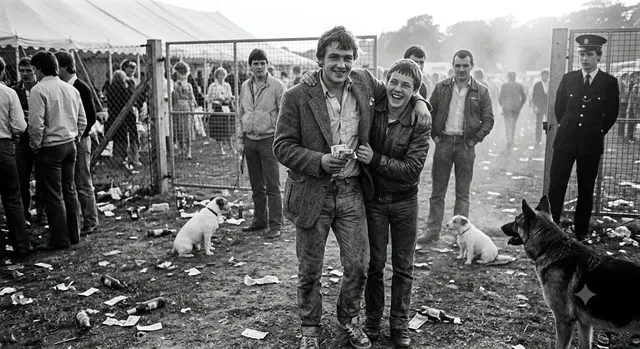
The summer and sun were terrific when we arrived at York races. To those who don't know York, there are two parts on either side of the track: the 'posh' part with all the grand architectural stands and on the other, the family, or cheap side, where all the kids ran around screaming and all the drunks did too.
As working class youngsters, we never really had much money, and it was always the poorest part of the course for us.
The day's meeting was a massive affair, and there were thousands of people there. The 'posh' part was packed with punters. Because of the huge crowds, the officials had erected huge champagne tents at the side of the 'poor' part, but sectioned off, and all manner of fine ladies and gentlemen strode with assumed elegance and breeding across the course, past security, and into the marquee to sip champagne.
We hadn't yet paid to get in, and I exclaimed to Danny Boy, 'Come on, Donald, let's have a bit of fun.'
Danny Boy was a year or two younger than me, and he didn't wear a Harris Tweed like me, but donned a cheap brown leather jacket, but that didn't matter, I had a Harris Tweed, and that would gain us entry.
I waited for an opportunity to arrive at the security gate without being seen walking up to it, as the jeans I was wearing would have given the game away.
With my best upper class voice, I declared, 'Come along, Benson,' as I gestured to Danny Boy in my trail, whilst saying to the young security guard, 'An exquisite day for the races, don't you think? Come along, Benson, be quick now,' and in both of us went. No questions, no nothing. We couldn't believe it and thought we'd simply get turned back, but the reality was we were in with the toffs, and more importantly: the champagne. I turned round to Danny Boy to gesture the nearest table of champagne, but he was already there and starting his first guzzle. When we'd taken our fill of what was available and were beginning to attract down-the-nose looks from the toffs, we decided it was time to leave, and we slipped to an idle part of the marquee and nipped under the flap and into our customary cheap part of the course complete with bellies filled with champagne. The Harris had done the deed as it were.
Betting is a dangerous game at the best of times, but when accompanied by drink, it can be lethal, and this day was no different. The champagne had gone straight to Danny Boy's head and mine, too, and add to that more alcoholic beverages and you get the scene. Our Mick and Sammy were with us, and they weren't nearly half as drunk. Danny Boy was the first to be relieved of his money by daft betting, and I was shortly after. Only two races had gone, and we were both skint. Our Mick had a little win, and he lent us a tenner for the next race. Donald studied the form and duly chose the horse, which was a 20/1 shot, but that didn't ring any alarm bells, as drunkenness and an indefatigable gambling addiction is completely deaf to those.
'Bang it all on, Karl, and if it loses, I'll go and find our Kev and scratch some money out of him.'
I don't think Kev had even gone to the races that day. Off I went, in anything but a straight line, in search of the best price. There must have been fifty of these betting stands, and I wasn't really attentive to their position but only the price on the boards. I found the best price and duly placed the bet at 20/1, a tenner, and made my way back to Donald and the others to finish off another drink and wait for the race to start.
The race started, and when you've put everything on the horse, your last dollar, as they say, the emotions are the keenest, and it was no different for Danny Boy and me when our horse burst through to the front in the final furlong and snatched the race by a neck! We were rich; we were intoxicated, and we were Lords. What a joy!
But joys, as you know, don't last and can just as quickly be extinguished.
'Give us the ticket, Karl, and I'll run and get the money. Which bookies did you place it with?' cried Danny Boy.
I was fumbling in my jeans and Harris Tweed for the ticket and thinking, 'I can't remember which bookies.'
That didn't matter, though, because the search for the ticket was becoming desperate.
'Check your Harris again,' Donald shouted.
I checked the Harris, but the ticket had definitely gone and was lost.
'You stupid fucking bastard,' and other such expletives were delivered without ceremony.
I don't know how I'd lost the ticket. Does any common drunk know how they lose things? I started to look around on the floor, but there were a million spent and lost tickets strewn across the turf and the search would be pointless.
'Let's go to the stand where you put the bet on, and we'll sort it from there,' Donald urged. And all four of us set off; me and Danny Boy staggering in front and our Mick and Terry walking behind us, muttering something about 'idiots'.
We must have walked up and down every single bookies on that course ten times and it was hopeless, as I couldn't remember where I'd put on the bet. We were winners, but were now losers. We all sat dejected on the grass. But desperation does have creative powers, and I think the drink had started to abate a bit when I thought of an idea.
'All the bookies keep ledgers, and they have to record every bet they take. Benny told me this, and he's a bookie's clerk. If we can find out which bookies' stand I put the bet on, we can look at the ledger!' I exclaimed and jumped up.
'But you can't even fucking remember which stand you put the bet on, you idiot, so sit the fuck back down,' slammed Sammy.
I sat back down, but I was not to be undone when I saw this steward walking into one of the offices there. I thought for a minute and then said, 'Wait a minute, wait a minute,' and set off for the office.
I returned shortly afterwards and proudly declared, 'Sorted. The old official is going to walk along the bookies and check all the ledgers for me.'
'Brilliant!' Danny Boy cried, and he began jumping in the air, as though he'd had another winner.
The old official did as he promised, and off he set with us in tow to check all the ledgers. He had to break off twice to see to other duties, but he returned each time and resumed his investigation of the ledgers. Finally, he found the bookies and the errant bet. I can honestly say, even to this day, how I ventured up to the furthest end of the course I do not know. I could have sworn I never went up there, but I did, and the old official was now discussing the bet with the bookie and the lost ticket. He returned to us and informed us that we would be getting paid, but only half an hour after the last race, as someone else could produce the ticket, and those were the rules. We were a bit disappointed, but at least we had the money now, and we waited.
We duly collected the winnings and set off for the bus back home. The time was around six, and the first bus was packed and simply drove past. We headed for the pub across the road and returned forty minutes later for the next bus. That bus was packed and simply drove past; back to the pub we went.
This was repeated until well after ten o'clock, when, finally, completely pissed, we hauled ourselves on the last bus. I was ready for falling asleep, but Danny Boy was at the back of the bus in full voice belting out Frank Sinatra's 'Strangers in the Night' to the groans of all the other passengers.
'Yeh, don't like it then, eh?' he slurred with passion and mischief and added, 'Let's see if you like this then,' and without shame dropped his pants and waved his tackle around whilst laughing uproariously.
Prefer to listen? Watch the video reading below.
Reader Comments
Leave a Comment
We would love to hear your thoughts on this chapter.
About Karl Swainston
Karl Swainston is a writer and storyteller whose work is forged from a life lived across the North of England and far beyond. Growing up on a Leeds council estate in the 1960s, Karl's journey was anything but linear. By the age of thirty, he had already lived a dozen lives: from the rigors of grammar school to a degree in Latin, a stint as a fishmonger, a period of discovery living in Marseille, and a return to the hustle of London. Whether working as a postman, a builder, or competing as a county-level chess player, he was, above all, an avid reader—constantly documenting the world around him. This restless spirit continued into his professional life. Karl later taught in Bradford, where he ran a specialist unit for 244 of the most excluded students from across the region—young people whom even the local Pupil Referral Units could not accommodate. Working alongside his old friend Malcolm, Karl spent his days navigating the volatility of Bradford's most aggressive and dysfunctional teenagers. Throughout his life, Karl has been an avid runner and has always shared his home with a rotating cast of beloved dogs and cats—companions who have been constant witnesses to his work. As a writer, Karl's range is as expansive as his history. He works across a wide breadth of genres, including fiction and short stories, autobiography and memoir, biography, non-fiction, and metaphysical writing, as well as providing sharp commentary, opinion, analysis, and essays. Whether writing about his years managing the Harrogate Arms or offering insights from his current adopted home in South East India, where he lives in a simple village with his dog, Bambi, Karl's voice reflects the full, untidy, and deeply human breadth of life. He continues to draw on the rich, decades-long tapestry of his experiences to tell stories that matter, proving that no matter where you live, the human story remains the same.
Author Page