Tales From A Harrogate Caravan
Chapter 8 — King Lear in the Drizzle
← Karl Swainston / Tales From A Harrogate Caravan
After my 'black moment', as I've said, I took the illness and fracture of my mind away with running and debauchery. But there was one other incident, which had no bearing upon my recovery, but it did have an utmost impact on my life, and I wish to relate it now.
In my self-remedy of recovery, I would wander for hours with the dogs in the fields and regularly venture down by the canal, river, and across the two bridges to Temple Newsam park and grounds.
Temple Newsam had an amphitheatre, and strolling past it with my greyhound and the two Alsatians running at will by my side and terrorising all the posh dogs, but only in looks, and not sinking their teeth into the poodles' necks, as all three were well behaved, I noticed a sign: ‘Tonight! King Lear by William Shakespeare: 7pm.’
I can't remember the name of the amateur dramatic company who put on the play, but I can remember the rest of the day.
At that time of 'blackness', I was a strong reader of literature, which the Doctor had initiated, and for every word in a book I didn't understand, I'd underline the word and then practice it stupidly in a sentence at the first available opportunity. I know it was pretentious crap, but all children learn new words and get them wrong and are corrected; and, remember, I was a tolerant fellow for one so young: I had a desire to learn, and that fucked off everything else.
I always resisted reading Shakespeare until that day, both at Grammar School, where I couldn't stand it, and when the Doctor first ordered, ‘Read him.’ I couldn't and didn't, for I felt 'intellectually' unprepared, and was afraid I wouldn't understand it.
I took the dogs back home and didn't think at all about returning in the evening, as the day was beautiful, and it was summer, and I'd intended to undertake a long run instead. However, my ‘blackness’ was still there and with it inertia; I didn't make the run but merely sat in 955 staring at the walls.
King Lear was ripe for me. I had to get out of the house, and I took the one well-behaved dog I had to the amphitheatre, our Lassie. It took us a good forty minutes to walk to Temple Newsam from Belle Isle, over fields, canal and river. Once past the Stourton Power Station, the heavens, as they say, opened, and the rain fell.
We were nearer Temple Newsam than home, and I decided to press on, especially with home and the 'blackness' being my only companion.
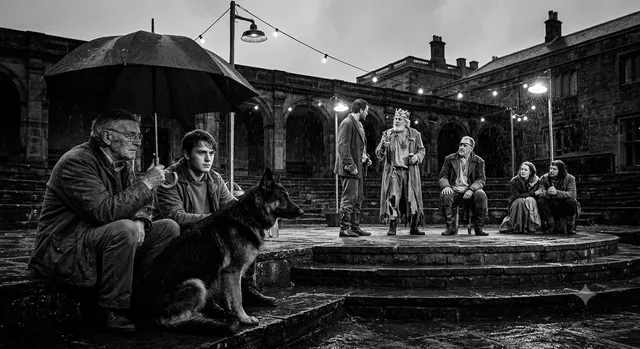
When we arrived at Temple Newsam, Lassie and I were wet through, and there was only an old bloke with a big umbrella sat in the open amphitheatre. I know the black umbrella was big because I and my dog sat under it that summer night.
The amateur dramatic crew were huddled beneath the arch at Temple Newsam stables, no doubt thinking what the fuck to do. They waited. No one else except the old man, my dog and I came to see their play.
‘I'm sorry, but we're going to have to call the show off because of the weather,’ one of the thespians said to us.
‘I've walked a mile to get here,’ complained the old man, who was in his seventies; and I'm sure must be dead now, and this is a tribute to him; God bless him.
I added, ‘I've walked five miles to get here over the fields and we're wet through,’ pointing to the dog to add necessary weight to the argument, ‘and I've never seen or read a Shakespeare play.’
‘Good point, lad,’ the old man shouted to me. ‘Here, get thysen under my umbrella here and bring the dog too. She looks shivering.’
I duly did, and Lassie accompanied me under that old man's umbrella.
Another fellow made his way towards us from the arch; we identified him later as Edmund from the play. ‘Okay, we're going to put it on and call it a rehearsal. Do you both mind waiting a bit while we get a few beers from the offie?’
It happened in those days, such honesty. Gloucester and his company got their beers from some local off licence, probably in Halton Moor, which I'll tell you about later, and they began their performance of King Lear in the drizzle of Temple Newsam amphitheatre.
I could lie, and I could say, ‘There was a storm,’ but I'd be lying. It simply pissed it down and it became dark, but the lights of the amphitheatre still shone, and I still feel emotional even now watching that amazing play performed by a set of drunken thespians.
The thespians weren't drunk at the beginning, and neither were they legless at the end. Don't get me wrong, they weren't slurring or falling over the stone, but they were enjoying Shakespeare and singing in words in the metre and rhythm of a language I'd never heard: iambic pentameter: dee dum, dee dum, dee dum, dee dum laced with cider, wine, and lager. Brilliant! Enchanting and totally mesmeric it was. I loved it and so did the old man too. And when King Lear looked upon Cordelia on the floor, dead – and pissed as well, I think – the effect was heart wrenching for me. I was still waiting for Cordelia to wake up in the play, but instead the actor finished her performance, and she went for another can of beer.
I've seen almost fifty plays of Shakespeare since, and I can honestly say that performance of King Lear was astounding, and the best I've ever seen. I wasn't drunk, but had that 'blackness' in me, and the play happened when my nerves were supremely alive to the theme of the play, the poetry of the play, the universality of the play, and, of course, the song of metre in the play, which those amateur thespians performed with brilliance. I shall never forget it.
The following day, the sun was guaranteed to shine, and I went again with Lassie to watch King Lear. The old man was there, too, but without his umbrella. He'd been waiting for us. We sat and waited. The auditorium was packed full this time. The biggest pile of shite I've ever watched! I left well before the end, just after the old man left. Instead of music and poetry, there was Realism; where there should have been pain, there was nervousness, and the words had lost completely their 'warble' as the old man told me afterwards. Shit. Crap.
‘Ham acting,’ the critics call it: the bastards. I love it, and it is, to me, how Shakespeare should be acted and spoken. When I worked down London as a hod carrier, I'd go to the Barbican mid-week, wait for ten minutes or so into a Shakespeare play, and pay £5 for a cancellation, all in the hope of hearing 'ham acting.' I never did, and I would walk out after twenty minutes if I didn't recapture that first beauty I'd heard of Shakespeare by those drunken actors on a drizzly night in Leeds, sat there with an old man and my dog.
Prefer to listen? Watch the video reading below.
Reader Comments
Leave a Comment
We would love to hear your thoughts on this chapter.
About Karl Swainston
Karl Swainston is a writer and storyteller whose work is forged from a life lived across the North of England and far beyond. Growing up on a Leeds council estate in the 1960s, Karl's journey was anything but linear. By the age of thirty, he had already lived a dozen lives: from the rigors of grammar school to a degree in Latin, a stint as a fishmonger, a period of discovery living in Marseille, and a return to the hustle of London. Whether working as a postman, a builder, or competing as a county-level chess player, he was, above all, an avid reader—constantly documenting the world around him. This restless spirit continued into his professional life. Karl later taught in Bradford, where he ran a specialist unit for 244 of the most excluded students from across the region—young people whom even the local Pupil Referral Units could not accommodate. Working alongside his old friend Malcolm, Karl spent his days navigating the volatility of Bradford's most aggressive and dysfunctional teenagers. Throughout his life, Karl has been an avid runner and has always shared his home with a rotating cast of beloved dogs and cats—companions who have been constant witnesses to his work. As a writer, Karl's range is as expansive as his history. He works across a wide breadth of genres, including fiction and short stories, autobiography and memoir, biography, non-fiction, and metaphysical writing, as well as providing sharp commentary, opinion, analysis, and essays. Whether writing about his years managing the Harrogate Arms or offering insights from his current adopted home in South East India, where he lives in a simple village with his dog, Bambi, Karl's voice reflects the full, untidy, and deeply human breadth of life. He continues to draw on the rich, decades-long tapestry of his experiences to tell stories that matter, proving that no matter where you live, the human story remains the same.
Author Page