Tales From A Harrogate Caravan
Chapter 9 — Dortmund and the Duncan
← Karl Swainston / Tales From A Harrogate Caravan
There are certain days, inexplicable days, when everything seems to sit right with life. I can remember returning from the Dortmund Chess Festival, which is a town in Germany and is twinned with Leeds in the Republic of Yorkshire.
Bernie, a chess colleague, and I had just spent a free two week break there as representatives of Leeds Chess Club. We got to play in tournaments free of charge, and all the beer and food was free too: a recipe for unlicensed debauchery, which is probably why I can't recall my time there. But I do remember arriving back in Leeds City Centre with Bernie one weekday morning, and since the pubs were not yet open, we headed off for the market and bought a couple of cheap coffees and indulged in the artistic sport of flaneurism.
We sat there and amplified the characteristics of the people passing and expanded in the imagination their attributes to the point of the grotesque. We were still under the influence of alcohol from the boat across the channel, and, I suppose, to an outsider, we were nothing more than two giggling creatures taking the piss out of people going about their everyday existences.
Leeds Market is a bastion of working class commercialism. From all four corners of Leeds, folk would make their way daily to this ornate building with its fruit, fish, clothes, and almost any other item made upon God's planet. It was hard not to discern the common triteness in these people with their drab clothes and hunched gaits as they meandered their way through the endless aisles.
When the hour of eleven hammered upon the ancient clock clinging on the market wall, Bernie and I abandoned the coffee stall and headed for the nearest pub to continue the day.
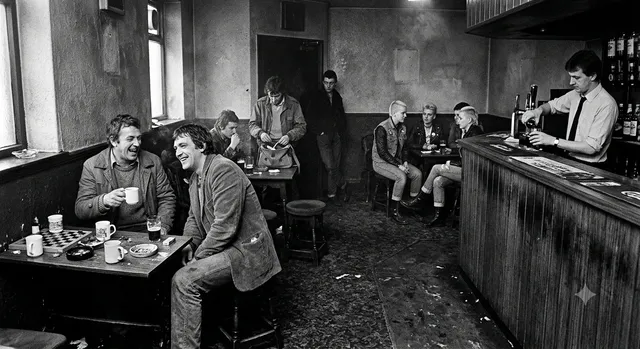
We must have frequented most of the pubs in town that day, and towards the latter part of the afternoon, we found ourselves in the Duncan, a pub of scurrilous reputation. The walls had that eternal brown look from years of tobacco smoke, and the carpet on the floor had that sticky feeling. The façade of the pub faced north and afforded little natural light, and what light did appear seemed somehow stolen and unnatural.
Throughout the day, the doors would constantly open and close as some thief brought through their newly purloined possessions to sell. They'd open the door and with shifty eyes cast around a quick reconnaissance of the establishment to check nothing legal was around, and only then would they sneak in and make their way to a table, which held a small band of their accomplices.
Not only did the Duncan house the criminal misfits of Leeds' lower classes, but it was also the haunt of a local collection of Leeds lesbians. They had their separate area in the Duncan and looked down upon the thieves dealing their wares. They always looked the same, and had that aggressive manner in both their gait and their attire and not to mention the skinhead bleached haircuts, too.
I never knew why they chose that wretched pub to gather. They were dauntless creatures and could have frequented any pub without fright, but they chose to meet in one of the worst. Why? I think it must have been a measure of the times. In the illiberal Eighties, perhaps they saw their sexual orientation as something not appropriate for a decent public house and felt more in harmony with the decrepitude of the Duncan like us.
'Hello, Karl,' said one of the lesbians, as she approached the bar.
I knew the woman through her sister, Liz, and often exchanged hellos.
'Hello, Kath? How's Liz doing?'
'Okay. She's at home. She's just fallen out with her boyfriend. Why don't you ask her out?'
'I might take a taxi round there. Is she still living in the same house?'
'Yes. If it was yesterday, you could have phoned, as she hadn't been cut off then, but not today. I'm off anyway.'
And so began the first of my three long relationships. I was twenty-two.
***
Liz was a single mother of two kids. Throughout my time with Liz, I constantly worked away in London, and when back in Leeds, I still lived at 255. During this time, Liz had many houses she lived in, and with each passing year, came another abode. Liz was a person who always saw the goodness in life and managed to smile at every adversity life could hurl at her.
In our twenties, our lives were abandoned and desperate, and there was very little normality. None of us kept a secure job, and therefore couldn't commit to any meaningful relationship such as house, job etc. We both lived for the day, and when that day finished, we lived for the next day. And that was how it was. We enjoyed life, though, and were happy together, but there was never anything lasting in the relationship, and towards the ending years of my twenties, I'd enrolled upon an access course for mature students wishing to go on to university.
It was impossible to live the life of the past, and the eventual fractures of life and relationship became ever wider, until, in the end, they ceased altogether, and Liz and I moved on to our thirties and new paths.
One day, several years later, Bernie rang me and said, 'Liz is dead, Karl.' She'd died of a brain haemorrhage, and I can remember that the poor girl used to complain of fierce headaches, but at the time, I thought nothing of it. I look back to our time in the Eighties, and still see Liz, her jet black curls, the redness of her lips, and that laughing smile, which always made me happy.
Reader Comments
Leave a Comment
We would love to hear your thoughts on this chapter.
About Karl Swainston
Karl Swainston is a writer and storyteller whose work is forged from a life lived across the North of England and far beyond. Growing up on a Leeds council estate in the 1960s, Karl's journey was anything but linear. By the age of thirty, he had already lived a dozen lives: from the rigors of grammar school to a degree in Latin, a stint as a fishmonger, a period of discovery living in Marseille, and a return to the hustle of London. Whether working as a postman, a builder, or competing as a county-level chess player, he was, above all, an avid reader—constantly documenting the world around him. This restless spirit continued into his professional life. Karl later taught in Bradford, where he ran a specialist unit for 244 of the most excluded students from across the region—young people whom even the local Pupil Referral Units could not accommodate. Working alongside his old friend Malcolm, Karl spent his days navigating the volatility of Bradford's most aggressive and dysfunctional teenagers. Throughout his life, Karl has been an avid runner and has always shared his home with a rotating cast of beloved dogs and cats—companions who have been constant witnesses to his work. As a writer, Karl's range is as expansive as his history. He works across a wide breadth of genres, including fiction and short stories, autobiography and memoir, biography, non-fiction, and metaphysical writing, as well as providing sharp commentary, opinion, analysis, and essays. Whether writing about his years managing the Harrogate Arms or offering insights from his current adopted home in South East India, where he lives in a simple village with his dog, Bambi, Karl's voice reflects the full, untidy, and deeply human breadth of life. He continues to draw on the rich, decades-long tapestry of his experiences to tell stories that matter, proving that no matter where you live, the human story remains the same.
Author Page