Tales From A Harrogate Caravan
Chapter 27 — Hunger and the Mackerel
← Karl Swainston / Tales From A Harrogate Caravan
University life was, on the whole, quite pleasant and even enjoyable. But poverty followed you around every day, month, and every year of study. Penury has a distinctive side-kick called hunger, and when you've exhausted everything the bank will lend you, taken every penny of every type of loan the university had to give, and emptied almost every pocket of charitable help from friends, there's only one baneful condition left: you go hungry for a day or two.
Let me rephrase that: you don't exactly have nothing to eat for a day or two, but you do go desperately close to it. Through my own fault and earlier cavalier and abandoned husbandry with money, I have endured a fair few of these detested days. One such day will never leave the confines of my memory and involves Brent Bewildered, a mackerel, a tomato, a slice of brown toast, and a certain piece of porcelain.
While my brother was still living at 955, and I was only paying board there, life was just about affordable, but after his kidney transplant, Mick had been out making up for lost youth, and in a short period of time had not only settled into a relationship with a girl, but he'd moved in with her as well.
It fell on me to pay the rent, which I hadn't accounted for at the start of year when I received my first grant and lost nearly half of it on the 2nd favourite at Doncaster.
Mick had been gone for only a few months or so when money, after paying the rent, became extremely scarce and almost non-existent. I did secure work at every opportunity, but there were still a couple of dogs at 955, and I didn't think it was fair to leave them in the house, not only all day whilst I was at university, but most of the night, too, on account of working in some bar. Like all non-realists I decided to sling it out, and within four weeks or so, I was desperately skint, and I didn't even have enough to buy food for the dogs, let alone myself. Enter Brent Bewildered, brother of Mark.
'Rent me a room, Karl, and I'll give you £25 a week.'
The deal was done, and Brent moved that day into 955. Not only would the money be handy, but I'd probably have license to get a night job of some sort, as Brent could help and look after the dogs. Job done.
I don't think I ever once remember Brent staying in 955 for an evening; he always had somewhere to go. He was a likeable lad, but there was something confusing about him, and people would often shake their heads when he departed. One Friday, he was all clipped up to go and meet some woman he'd met earlier in the week. He had a magnificent head of blonde hair and sported reasonably good looks. He showed off his dandy attire and asked for assurance that he looked the part, which he did, all splendid in black.
But the black cloth, which gave him his dandy look, was made of the thinnest and cheapest of materials, and when he left us in the summer sunshine at the gate of 955, saying, 'Wish me luck,' and spinning round to hop away for the bus, there was a veritable carpet of dog and cat hair clinging to the back of the poor sod.
The £25 a week Brent brought into 955 did help a little, but Brent's priorities in paying board were never at the forefront of his bewildered brain. Many a time he missed payment, and that only made matters worse. Only a fool, as I learnt, would rely on Brent for prompt payment.
'Are you getting paid today, Brent?'
'Yea.'
'What time are you back? Remember, you owe me fifty quid now, and I need it. I've had to miss two days at university to work for this agency order picking, and I can't stand it anymore.'
'Don't worry, Karl. I'll have the money tonight,' and off he went to work, selling cheap wares from door to door.
Brent did return that night, but without the fifty quid. 'Boss said we can't get paid until Friday, and I'll have to pay you then, Karl.'
'For fuck's sake, Brent. I was depending on that.'
'I can't do anything about it,' he said, throwing his cheap, black jacket over the back of the settee to collect a further coat of dog hair.
I'd stopped listening by then and was calculating what to do for the best. I knew the dogs had been fed, and had a couple of tins for tomorrow, but all I had left was a smoked mackerel, a tomato with a green leaf on the top of it, and a hardened slice of brown bread. I had intended to have these for tea after work the next day.
The night was past eleven, and I left Brent sitting with the dogs downstairs, watching some crap on television.
I rose very early the next morning, took the dogs out for their accustomed walk, and set off on foot to cover the three miles or so to work, as I didn't have the bus fare.
Those who have had the misfortune to order pick on the minimum wage for an agency will know the stomach of endurance needed to get through it. The work is soul-destroying, and it destroys any life in the brain and completely reduces you to an automaton. Compounding this pernicious employment was the fact that I was starving, having to walk miles around this endless factory picking orders. As you struggled through the day, you could feel yourself flagging, and then it happens in your brain: obsession.
After midday, watching all the desperado pickers eating their cheap meals and sandwiches – actually glaring at them – I became fixated with an image: a beautiful, golden mackerel, glistening with oil, utterly desirable; and on her body a meticulously cut red tomato, the green leaf on the top; and, finally, the single slice of brown bread sitting in complete harmony at their side, adding to the intense hallucination of hunger. I thought of Christ and the feeding of the five thousand with 'my mackerel' but no Christ was going to get his hands on this one.
As the day wore on, the image metamorphosed from obsession to possession, and when the day ended in the late afternoon, I was off to make it back the three miles to my 'heaven' waiting, no longer tired, but like one demented.
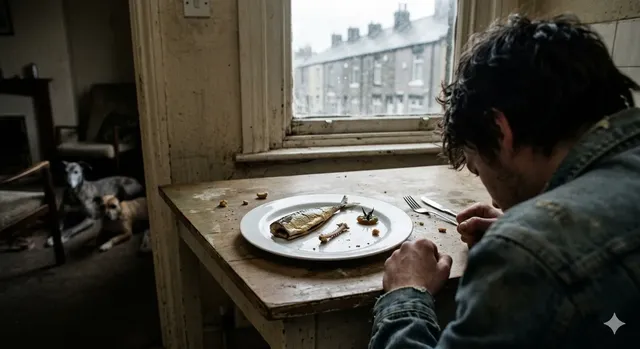
On the white porcelain plate, lying there on the kitchen table, was the skin of a mackerel, the green part of a tomato, and a couple of brown crumbs scattered around the whiteness of the plate.
Brent defied death that day. He didn't turn up that night either. On the following day, when he did finally appear, totally oblivious of his crime, anger in me had gone, but the memory hadn't.
'Get yer bags, Brent. You can find somewhere else to live,' I said without looking up. I suddenly remembered he owed me the fifty quid. 'Where's my rent?'
'I'll have to give it to you tomorrow.'
'Don't bother. Keep it, Brent. Now, off you go.'
Brent left the following day. We're still friends, but there are things in life you cannot tolerate, and for me, that day, was the horror of that image of mackerel skin, the green top of a tomato, and brown crumbs on a white plate.
Prefer to listen? Watch the video reading below.
Reader Comments
Leave a Comment
We would love to hear your thoughts on this chapter.

About Karl Swainston
Karl Swainston is a writer and storyteller whose work is forged from a life lived across the North of England and far beyond. Growing up on a Leeds council estate in the 1960s, Karl's journey was anything but linear. By the age of thirty, he had already lived a dozen lives: from the rigors of grammar school to a degree in Latin, a stint as a fishmonger, a period of discovery living in Marseille, and a return to the hustle of London. Whether working as a postman, a builder, or competing as a county-level chess player, he was, above all, an avid reader—constantly documenting the world around him. This restless spirit continued into his professional life. Karl later taught in Bradford, where he ran a specialist unit for 244 of the most excluded students from across the region—young people whom even the local Pupil Referral Units could not accommodate. Working alongside his old friend Malcolm, Karl spent his days navigating the volatility of Bradford's most aggressive and dysfunctional teenagers. Throughout his life, Karl has been an avid runner and has always shared his home with a rotating cast of beloved dogs and cats—companions who have been constant witnesses to his work. As a writer, Karl's range is as expansive as his history. He works across a wide breadth of genres, including fiction and short stories, autobiography and memoir, biography, non-fiction, and metaphysical writing, as well as providing sharp commentary, opinion, analysis, and essays. Whether writing about his years managing the Harrogate Arms or offering insights from his current adopted home in South East India, where he lives in a simple village with his dog, Bambi, Karl's voice reflects the full, untidy, and deeply human breadth of life. He continues to draw on the rich, decades-long tapestry of his experiences to tell stories that matter, proving that no matter where you live, the human story remains the same.
Author Page