Tales From A Harrogate Caravan
Chapter 26 — Walter and the Ancient Mariner
← Karl Swainston / Tales From A Harrogate Caravan
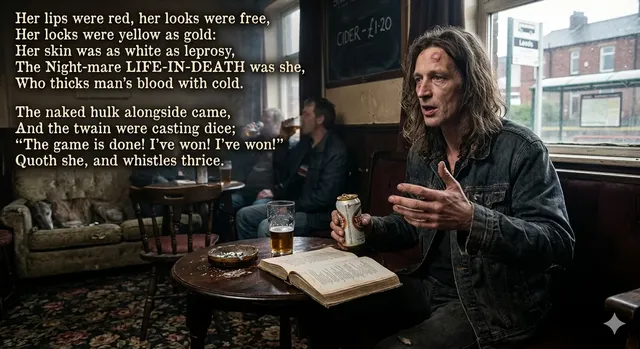
Walter, now there’s a colourful chess character from the past. Walter resembled some spent porn star from the Seventies. He was lean, tall, had long hair, and that sauntering gait which exuded confidence and a ‘couldn’t give a fuck’ attitude. He always carried around with him some new bruise on his head from the latest altercation he’d emerged from some pub with.
Years of alcoholic hammering had given his voice a kind of permanent slur, but he still possessed a quite remarkable memory, and I remember one night in a pub somewhere in Leeds hearing for the first time Coleridge’s 'Rime of the Ancient Mariner', which Walter could quote in its entirety. He’d picked it up in one of England’s prisons, and the beautiful piece never left the fellow.
His favourite two stanzas, the ones he always met me with, were:
‘Her lips were red, her looks were free, Her locks were yellow as gold: Her skin was as white as leprosy, The Night-mare LIFE-IN-DEATH was she, Who thicks man’s blood with cold. The naked hulk alongside came, And the twain were casting dice; The game is done! I’ve won! I’ve won!’ Quoth she, and whistles thrice.
Walter had the remarkable ability, or disability, whichever you deem it to be, to never achieve complete sobriety in a single day. The moment the fellow rose from whichever sofa he’d fallen asleep on, he would crack open a can of cider and simply top up the alcoholic engine he ticked along on. Throughout the rest of the day and into the night, too, Walter would simply keep the liquor pouring in, but without going over the top, never stopping either, and I never saw the man keel over; he simply went to sleep and woke the next day to create an image of the previous day, and year too.
Walter spent many a night on the sofa at 255, but eventually, due to alcoholic incontinence, the sofa took on a kind of musty urinal smell, and even Colonel, the greyhound, who made his bed there on a night, refused to sleep on it in the end, and he took to sleeping on the new chair we’d recently been given. In the end, the sofa was unceremoniously carted off to the back garden, given its final resting place, and burnt.
After that, I made excuses to Walter, and upon the orders of my brother, afforded every strategy to avoid Walter coming back to the house after a day and night on the cider and leaking urine all over the new, if not second-hand, settee.
The last time I saw Walter was on the night I met Anna, my future wife. We’d been drinking together in the Three Legs pub in the centre of town. Walter had gone to the toilet, and, for some reason, never came back. I don’t know where the fellow had gone, perhaps he’d returned and thought I’d gone; I don’t know. But I know I’ve never seen the man since to this day.
Reader Comments
Leave a Comment
We would love to hear your thoughts on this chapter.

About Karl Swainston
Karl Swainston is a writer and storyteller whose work is forged from a life lived across the North of England and far beyond. Growing up on a Leeds council estate in the 1960s, Karl's journey was anything but linear. By the age of thirty, he had already lived a dozen lives: from the rigors of grammar school to a degree in Latin, a stint as a fishmonger, a period of discovery living in Marseille, and a return to the hustle of London. Whether working as a postman, a builder, or competing as a county-level chess player, he was, above all, an avid reader—constantly documenting the world around him. This restless spirit continued into his professional life. Karl later taught in Bradford, where he ran a specialist unit for 244 of the most excluded students from across the region—young people whom even the local Pupil Referral Units could not accommodate. Working alongside his old friend Malcolm, Karl spent his days navigating the volatility of Bradford's most aggressive and dysfunctional teenagers. Throughout his life, Karl has been an avid runner and has always shared his home with a rotating cast of beloved dogs and cats—companions who have been constant witnesses to his work. As a writer, Karl's range is as expansive as his history. He works across a wide breadth of genres, including fiction and short stories, autobiography and memoir, biography, non-fiction, and metaphysical writing, as well as providing sharp commentary, opinion, analysis, and essays. Whether writing about his years managing the Harrogate Arms or offering insights from his current adopted home in South East India, where he lives in a simple village with his dog, Bambi, Karl's voice reflects the full, untidy, and deeply human breadth of life. He continues to draw on the rich, decades-long tapestry of his experiences to tell stories that matter, proving that no matter where you live, the human story remains the same.
Author Page