Tales From A Harrogate Caravan
Chapter 28 — Why the Inner Circle Was Born
← Karl Swainston / Tales From A Harrogate Caravan
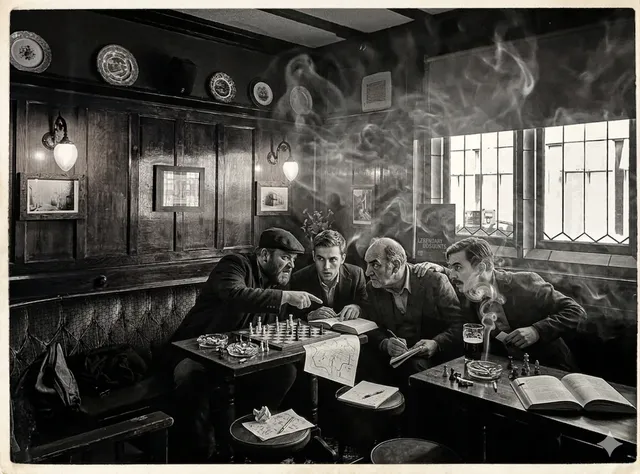
The Inner Circle Chess Club. I can't remember which character gave the team its name, but I do remember why it was born. In the old Leeds Chess Club, everything was given to nepotism and nothing to skill. Players who clearly didn't possess the ability or the experience to play in the first team were placed there at the expense of players who did possess the ability and the experience.
In the Yorkshire Chess Association League, which was played on Saturday afternoons, every cat, rat, and boil wanted to play in the first team, which was in the YCA First Division (‘The Woodhouse Cup’), as then you got to play the best players. If you weren't picked for this team: the horror of horrors, you were compelled to play in the lower divisions and that meant some weak player who would waste the whole of your Saturday.
We, working class upstarts, were rising talents, and although our grades were low – because you had to wait a year for them upgrading – we knew we were better than the pieces of shit playing above us. The favouritism which kept us locked out on Saturday persisted even to Wednesday nights and the LCA Evening League, and that, as they say, broke the camel's back.
‘I've had it with this bunch of bastards,’ complained JD.
‘Season's finished now, but what about setting up our own club in September?’
Stuart added, ‘Okay, we'll have to start in the lower divisions for a season or two, but we're already having to play in them now.’
All this for the game of chess you may think? But, you have to understand: chess was our lives; we lived for the game. All week you would study and stretch your pink brain to the point of bursting in order to beat the better player, and when you did, you were in heaven that Saturday night and great fun was to be had. But if you were beaten, or worse still, if you beat yourself with a blunder, oh, the misery, the depression, and invariably you wouldn't even make it to the Victoria, but would offer some pathetic excuse and piss off home, almost suicidal, particularly when you were left with only Cilla Black and Blind Date to gawp at.
All chess players then were single and completely dysfunctional marriage material to the opposite sex. Don't get me wrong: they could get a shag, but they couldn't form normal relationships, or marriage for that matter, on account they were anything but normal. This abnormality continued even into decrepit old age, and I can remember some old man, on a chair next to me, leaning on me because he'd had a stroke, but refusing to finish his game.
In the end the ambulance men wouldn't wait, and began to tug him away from the board, and I'm sure to this day I saw a tear in that man's eye. I couldn’t be certain because just then at the other end of the tournament hall, a chair, unable to bear the weight of Jeff Hucknell’s thirty stones, gave way completely and crashed to the floor with Jeff pulling half the table and pieces with him.
I wonder whatever happened to Jeff? I remember getting pissed with him and the Doctor in Scarborough and waltzing together in a hotel bar.
Prefer to listen? Watch the video reading below.
Reader Comments
Leave a Comment
We would love to hear your thoughts on this chapter.
About Karl Swainston
Karl Swainston is a writer and storyteller whose work is forged from a life lived across the North of England and far beyond. Growing up on a Leeds council estate in the 1960s, Karl's journey was anything but linear. By the age of thirty, he had already lived a dozen lives: from the rigors of grammar school to a degree in Latin, a stint as a fishmonger, a period of discovery living in Marseille, and a return to the hustle of London. Whether working as a postman, a builder, or competing as a county-level chess player, he was, above all, an avid reader—constantly documenting the world around him. This restless spirit continued into his professional life. Karl later taught in Bradford, where he ran a specialist unit for 244 of the most excluded students from across the region—young people whom even the local Pupil Referral Units could not accommodate. Working alongside his old friend Malcolm, Karl spent his days navigating the volatility of Bradford's most aggressive and dysfunctional teenagers. Throughout his life, Karl has been an avid runner and has always shared his home with a rotating cast of beloved dogs and cats—companions who have been constant witnesses to his work. As a writer, Karl's range is as expansive as his history. He works across a wide breadth of genres, including fiction and short stories, autobiography and memoir, biography, non-fiction, and metaphysical writing, as well as providing sharp commentary, opinion, analysis, and essays. Whether writing about his years managing the Harrogate Arms or offering insights from his current adopted home in South East India, where he lives in a simple village with his dog, Bambi, Karl's voice reflects the full, untidy, and deeply human breadth of life. He continues to draw on the rich, decades-long tapestry of his experiences to tell stories that matter, proving that no matter where you live, the human story remains the same.
Author Page