Resonance
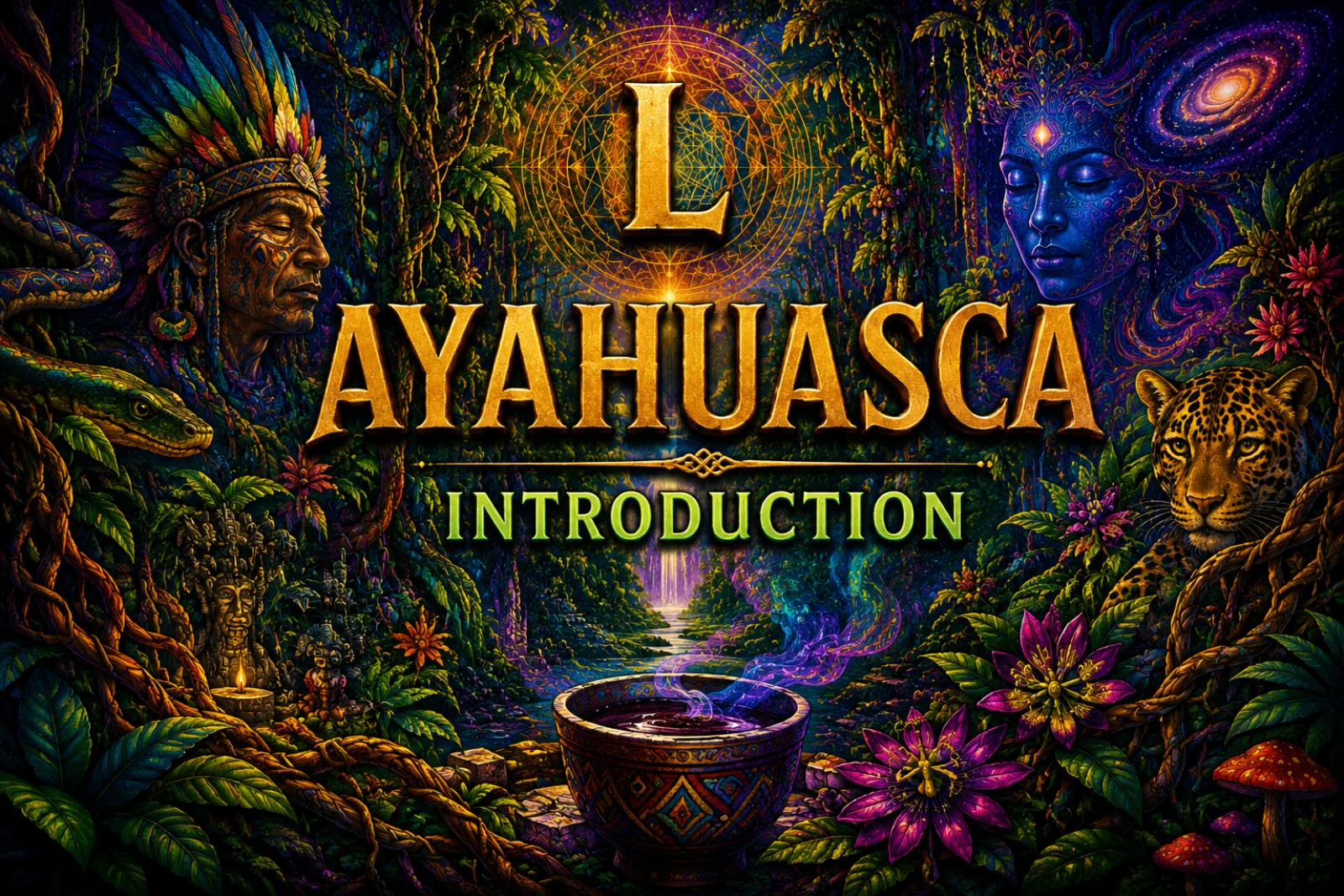
L — Ayahuasca – Introduction
Ayahuasca: Four syllables, that's all: aya-hu-as-ca. But contained in this almost magical combination of Amazonian ayahuasca vine, or vine of the soul, and a psychedelic – a term considered shortly – plant called chakruna there is a loosening and opening of the pineal gland, a release of DMT, and a pathway through to the deepest seat of your consciousness and soul is revealed; a place where can be found the most profound forms of time, space, matter, and being; where, the past, the present, and the future become fused to the single state of oneness that is everything in the Universe.
Before looking into the properties of ayahuasca, it is first necessary to contextualise the practice of drinking the tea in terms of the disparate cultures predominating European and South American histories.
Unlike European socio-cultural history, where Christianity has largely shaped the development of society from the time of Christ, through the middle ages, and significantly less to the present day, the Amazonian journey has been driven by indigenous culture and tradition, and in particular that of the shaman.
Shamans possess the ability to see beyond the present reality and can uncover both the benevolent and malignant forces of energy at work in the world around us. In the Amazonian basin, Ayahuasceros are the shamans, and through their states of vision, they help people to deal with the maladies of everyday life such as illness, depression, and even the worst forms of malady such as cancer. The shamans, the Ayahuasceros, can connect with the energies vibrating from a person, and having the ability to do this, they can alter, shift, help to change the force of that energy from the negative and malignant to a positive and healthy frequency of energy abundant in the Universe.
New research is uncovering many different healing properties of drinking ayahuasca tea. They have found that tea can help diabetic patients to produce insulin cells. When the body feels the borracheira, – the borracheira is a spiritual state whereby visions of the good and the bad energies and histories inside yourself are revealed as if they were the very meaning of God – and is energised with the profound positive energy, then even the tiniest cells within our being respond and embrace life and give renewed life to their cell structures and this, in turn, leads the diabetic to a state of self-recovery. One of the active ingredients in ayahuasca is an alkaloid called harmine or telepathine and is only one of a few alkaloids found in over a 100, 000 species of plants. Harmine has the ability to control glycaemic levels and drinking ayahuasca tea can help the diabetic to a healthier more sustained level of body and mind. And it is not only the chemical properties of ayahuasca that help alleviate physical illness, but ayahuasca tea can also help address dependants on drugs and those suffering post-traumatic stress disorders.
Prefer to listen? Watch the video reading below.
Reader Comments
Leave a Comment
We would love to hear your thoughts on this chapter.

About Karl Swainston
Karl Swainston is a writer and storyteller whose work is forged from a life lived across the North of England and far beyond. Growing up on a Leeds council estate in the 1960s, Karl's journey was anything but linear. By the age of thirty, he had already lived a dozen lives: from the rigors of grammar school to a degree in Latin, a stint as a fishmonger, a period of discovery living in Marseille, and a return to the hustle of London. Whether working as a postman, a builder, or competing as a county-level chess player, he was, above all, an avid reader—constantly documenting the world around him. This restless spirit continued into his professional life. Karl later taught in Bradford, where he ran a specialist unit for 244 of the most excluded students from across the region—young people whom even the local Pupil Referral Units could not accommodate. Working alongside his old friend Malcolm, Karl spent his days navigating the volatility of Bradford's most aggressive and dysfunctional teenagers. Throughout his life, Karl has been an avid runner and has always shared his home with a rotating cast of beloved dogs and cats—companions who have been constant witnesses to his work. As a writer, Karl's range is as expansive as his history. He works across a wide breadth of genres, including fiction and short stories, autobiography and memoir, biography, non-fiction, and metaphysical writing, as well as providing sharp commentary, opinion, analysis, and essays. Whether writing about his years managing the Harrogate Arms or offering insights from his current adopted home in South East India, where he lives in a simple village with his dog, Bambi, Karl's voice reflects the full, untidy, and deeply human breadth of life. He continues to draw on the rich, decades-long tapestry of his experiences to tell stories that matter, proving that no matter where you live, the human story remains the same.
Author Page