Resonance
XLIX — The Pineal Gland – Stimulation and Diet
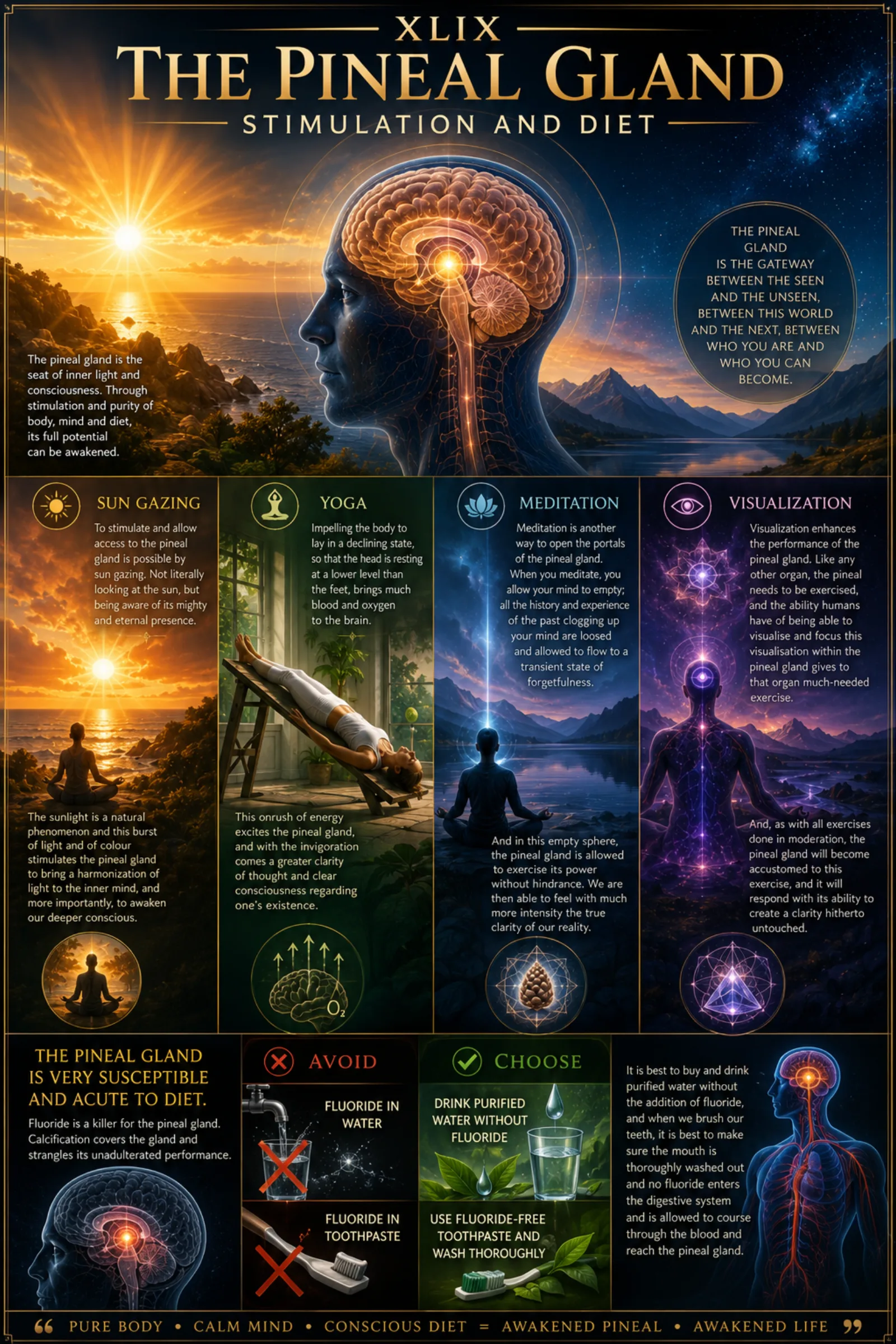
In order to stimulate and allow access to the pineal gland is possible by sun gazing. Not literally looking at the sun, but being aware of its mighty and eternal presence. The sunlight is a natural phenomenon and this burst of light and of colour stimulates the pineal gland to bring a harmonization of light to the inner mind, and more importantly, to awaken our deeper conscious.
In yoga, impelling the body to lay in a declining state, so that the head is resting at a lower level than the feet, brings much blood and oxygen to the brain. This onrush of energy excites the pineal gland, and with the invigoration comes a greater clarity of thought and clear consciousness regarding one's existence.
Meditation is another way to open the portals of the pineal gland. When you meditate, you allow your mind to empty; all the history and experience of the past clogging up your mind are loosed and allowed to flow to a transient state of forgetfulness, and in this empty sphere, the pineal gland is allowed to exercise its power without hindrance. We are then able to feel with much more intensity the true clarity of our reality.
Visualization enhances the performance of the pineal gland. Like any other organ, the pineal needs to be exercised, and the ability humans have of being able to visualise and focus this visualisation within the pineal gland gives to that organ much-needed exercise. And, as with all exercises done in moderation, the pineal gland will become accustomed to this exercise, and it will respond with its ability to create a clarity hitherto untouched.
The Pineal gland is very susceptible and acute to diet. Fluoride is a killer for the pineal gland. Calcification covers the gland and strangles its unadulterated performance. Fluoride is in the water and in our toothpaste, and it is best to buy and drink purified water without the addition of fluoride, and when we brush our teeth, it is best to make sure the mouth is thoroughly washed out and no fluoride enters the digestive system and is allowed to course through the blood and reach the pineal gland.
Reader Comments
Leave a Comment
We would love to hear your thoughts on this chapter.
About Karl Swainston
Karl Swainston is a writer and storyteller whose work is forged from a life lived across the North of England and far beyond. Growing up on a Leeds council estate in the 1960s, Karl's journey was anything but linear. By the age of thirty, he had already lived a dozen lives: from the rigors of grammar school to a degree in Latin, a stint as a fishmonger, a period of discovery living in Marseille, and a return to the hustle of London. Whether working as a postman, a builder, or competing as a county-level chess player, he was, above all, an avid reader—constantly documenting the world around him. This restless spirit continued into his professional life. Karl later taught in Bradford, where he ran a specialist unit for 244 of the most excluded students from across the region—young people whom even the local Pupil Referral Units could not accommodate. Working alongside his old friend Malcolm, Karl spent his days navigating the volatility of Bradford's most aggressive and dysfunctional teenagers. Throughout his life, Karl has been an avid runner and has always shared his home with a rotating cast of beloved dogs and cats—companions who have been constant witnesses to his work. As a writer, Karl's range is as expansive as his history. He works across a wide breadth of genres, including fiction and short stories, autobiography and memoir, biography, non-fiction, and metaphysical writing, as well as providing sharp commentary, opinion, analysis, and essays. Whether writing about his years managing the Harrogate Arms or offering insights from his current adopted home in South East India, where he lives in a simple village with his dog, Bambi, Karl's voice reflects the full, untidy, and deeply human breadth of life. He continues to draw on the rich, decades-long tapestry of his experiences to tell stories that matter, proving that no matter where you live, the human story remains the same.
Author Page