Resonance
LI — Ayahuasca – Research and Western Perspective
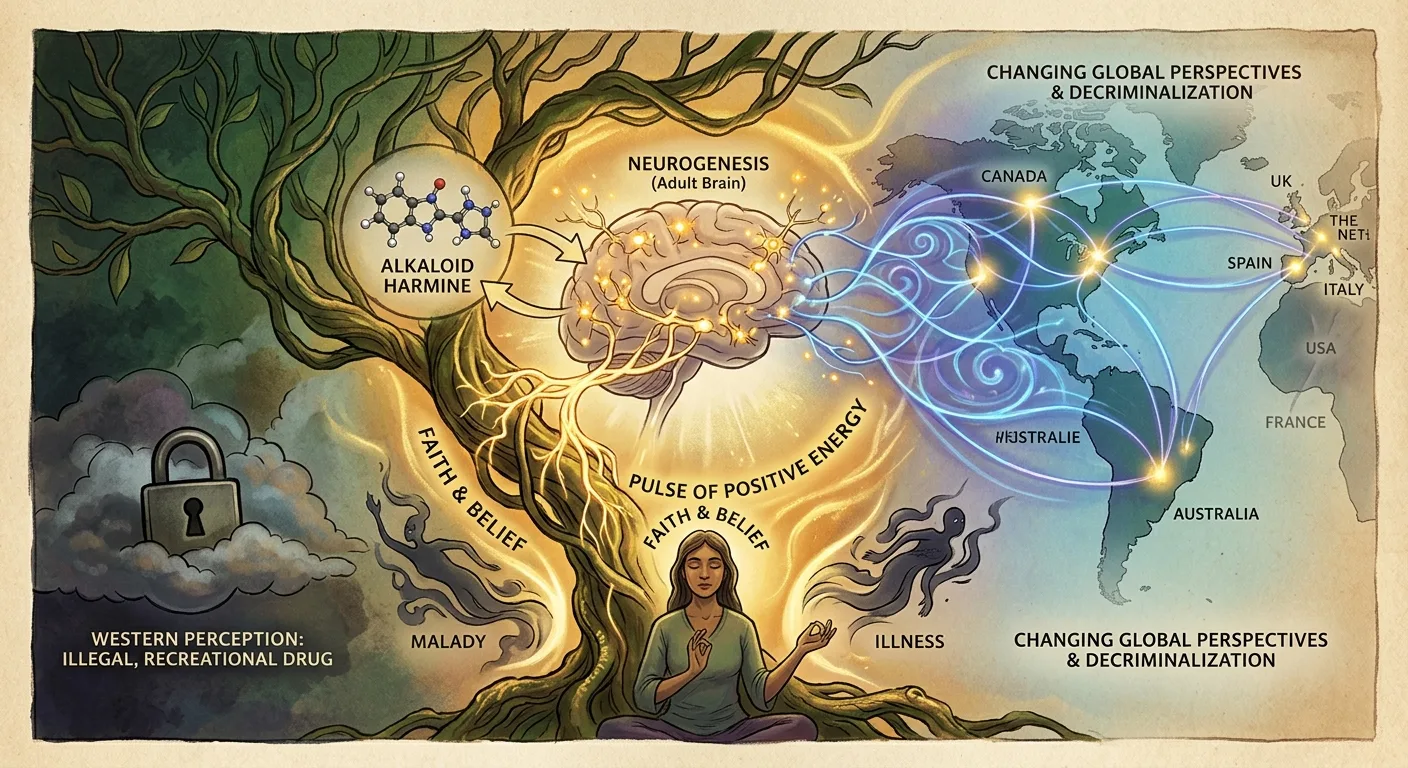
In 2016 at the Interdisciplinary Conference on Psychedelics Research 2016 in Amsterdam research undertaken by Dr Jordi Riba showed how drinking ayahuasca tea helped to produce new cells in the adult brain in a process called neurogenesis. They found that alkaloid harmine, once again, aided the self-healing process. The impact of these findings could have a massive impact on those suffering neurodegenerative disorders such as Alzheimer's and dementias of other natures. Previously, it was thought that no new neurons could be produced in the human adult brain. Ayahuasca has helped to change that scientific dogma.
For Europeans, it often hard to have credence in the ability of faith healing, and it is only when all other measures have been spent to remove or alleviate a malady, that they turn to faith as a last, desperate act of remedy. However, this does not have to be so, as the act of faith, the act of believing with your whole being, can maintain a healthy and spirited mind and body, and with that any unwanted callers of malady are quickly shunned and banished to their natural abode of the negative: for a healthy, strong, and believing mind, full of the energy of the positive will not allow coexistence with the negative and its accompanying maladies of illness, and just like healthy people it shuns all that around them which is unhealthy to maintain their own state of bliss and happiness. Drinking ayahuasca helps to bring on, nurture and maintain a strong pulse of positive energy around you.
In the west, however, ayahuasca is seen as a 'recreational psychedelic drug,' which has unsavoury and negative connotations with both something illegal and with the sinister world of drugs. Ayahuasca is anything but recreational: it certainly isn't addictive like most drugs, and it is practised with all the ceremony of faith with which any religious ritual is practised. As regards the term psychedelic, this label is also erroneous and evokes images of punters in a pot-filled room, 'off their head.' Brazil, in the 1980's conducted numerous researches into the tea, and the results determined that it was not a recreational drug, but was a means of spiritual awakening and, therefore, beneficial.
Ayahuasca does alter the state of one's consciousness in the mind, but it also has the ability to flow and connect every matter and atom of your physical being with the rest of Universe, it is as much somatic as it is psychological, and it is more: it is both philosophical and religious, and the experience and practice of drinking ayahuasca brings together all the forces of energy flowing out of your mind, body, and soul, and all the forces of energy flowing into your mind, body, and soul.
This western perspective and credence of ayahuasca has seen the tea banned in many parts of the world, but that is changing, and countries like Spain and Canada, and Australia and Italy and The Netherlands have relaxed their stance against the tea, and with time, other countries like the UK, the USA, and France will follow suit.
Prefer to listen? Watch the video reading below.
Reader Comments
Leave a Comment
We would love to hear your thoughts on this chapter.
About Karl Swainston
Karl Swainston is a writer and storyteller whose work is forged from a life lived across the North of England and far beyond. Growing up on a Leeds council estate in the 1960s, Karl's journey was anything but linear. By the age of thirty, he had already lived a dozen lives: from the rigors of grammar school to a degree in Latin, a stint as a fishmonger, a period of discovery living in Marseille, and a return to the hustle of London. Whether working as a postman, a builder, or competing as a county-level chess player, he was, above all, an avid reader—constantly documenting the world around him. This restless spirit continued into his professional life. Karl later taught in Bradford, where he ran a specialist unit for 244 of the most excluded students from across the region—young people whom even the local Pupil Referral Units could not accommodate. Working alongside his old friend Malcolm, Karl spent his days navigating the volatility of Bradford's most aggressive and dysfunctional teenagers. Throughout his life, Karl has been an avid runner and has always shared his home with a rotating cast of beloved dogs and cats—companions who have been constant witnesses to his work. As a writer, Karl's range is as expansive as his history. He works across a wide breadth of genres, including fiction and short stories, autobiography and memoir, biography, non-fiction, and metaphysical writing, as well as providing sharp commentary, opinion, analysis, and essays. Whether writing about his years managing the Harrogate Arms or offering insights from his current adopted home in South East India, where he lives in a simple village with his dog, Bambi, Karl's voice reflects the full, untidy, and deeply human breadth of life. He continues to draw on the rich, decades-long tapestry of his experiences to tell stories that matter, proving that no matter where you live, the human story remains the same.
Author Page