Resonance
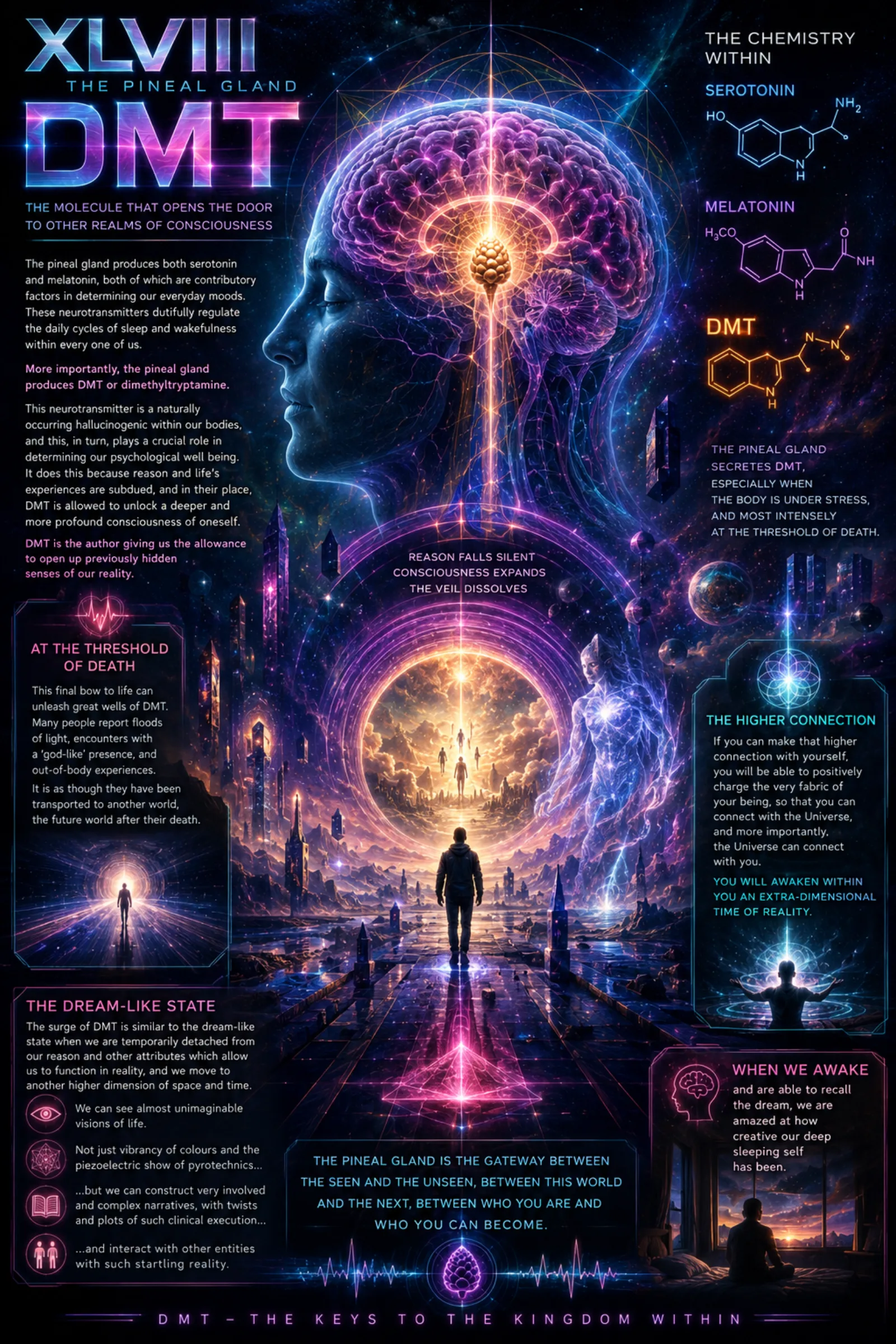
XLVIII — The Pineal Gland – DMT
The pineal gland produces both serotonin and melatonin, both of which are contributory factors in determining our everyday moods. These neurotransmitters dutifully regulate the daily cycles of sleep and wakefulness within every one of us. More importantly, the pineal gland produces DMT or dimethyltryptamine. This neurotransmitter is a naturally occurring hallucinogenic within our bodies, and this, in turn, plays a crucial role in determining our psychological well being. It does this because reason and life's experiences are subdued, and in their place, DMT is allowed to unlock a deeper and more profound consciousness of oneself. DMT is the author giving us the allowance to open up previously hidden senses of our reality.
The pineal gland secretes DMT, and this is especially so when the body is under stress. We can take many prophylactic measures to guard against stress, but perhaps the greatest stress which our mortal bodies must endure is the very stress of death. This final bow to life can unleash great wells of DMT, and this why many people balanced upon the point of life and death see great floods of light coming towards them, or as they believe, they are moving towards. This surge of DMT can separate the body from the consciousness, and often the person will have an out-of-body experience. People on the point of death can also experience a 'god-like' presence surrounding their beings. It is as though they have been transported to another world, the future world after their death. There are untold accounts and narratives of this experience, and it is not strange how most of them recount the experience as beyond the very description of beautiful and blissful.
If you can make that higher connection with yourself, you will be able to positively charge the very fabric of your being, so that you can connect with the Universe, and more importantly, the Universe can connect with you. You will awaken within you an extra-dimensional time of reality.
The pineal gland and the surge of DMT which is given to us are similar to the dream-like state when we are temporarily detached from our reason and other attributes which allow us to function in reality, and we move to another higher dimension of space and time, and we can see almost unimaginable visions of life. But it is not just the vibrancy of colours and the piezoelectric show of pyrotechnics that we can see; we are also able to construct very involved and complex narratives, narratives with twists and plots of such clinical execution that when we awake; and we are able to have interaction with other entities with such startling reality, are able to recall the dream, we are amazed at how creative our deep sleeping self has been.
Prefer to listen? Watch the video reading below.
Reader Comments
Leave a Comment
We would love to hear your thoughts on this chapter.
About Karl Swainston
Karl Swainston is a writer and storyteller whose work is forged from a life lived across the North of England and far beyond. Growing up on a Leeds council estate in the 1960s, Karl's journey was anything but linear. By the age of thirty, he had already lived a dozen lives: from the rigors of grammar school to a degree in Latin, a stint as a fishmonger, a period of discovery living in Marseille, and a return to the hustle of London. Whether working as a postman, a builder, or competing as a county-level chess player, he was, above all, an avid reader—constantly documenting the world around him. This restless spirit continued into his professional life. Karl later taught in Bradford, where he ran a specialist unit for 244 of the most excluded students from across the region—young people whom even the local Pupil Referral Units could not accommodate. Working alongside his old friend Malcolm, Karl spent his days navigating the volatility of Bradford's most aggressive and dysfunctional teenagers. Throughout his life, Karl has been an avid runner and has always shared his home with a rotating cast of beloved dogs and cats—companions who have been constant witnesses to his work. As a writer, Karl's range is as expansive as his history. He works across a wide breadth of genres, including fiction and short stories, autobiography and memoir, biography, non-fiction, and metaphysical writing, as well as providing sharp commentary, opinion, analysis, and essays. Whether writing about his years managing the Harrogate Arms or offering insights from his current adopted home in South East India, where he lives in a simple village with his dog, Bambi, Karl's voice reflects the full, untidy, and deeply human breadth of life. He continues to draw on the rich, decades-long tapestry of his experiences to tell stories that matter, proving that no matter where you live, the human story remains the same.
Author Page