Resonance
XLVII — The Pineal Gland – Crystals and Light
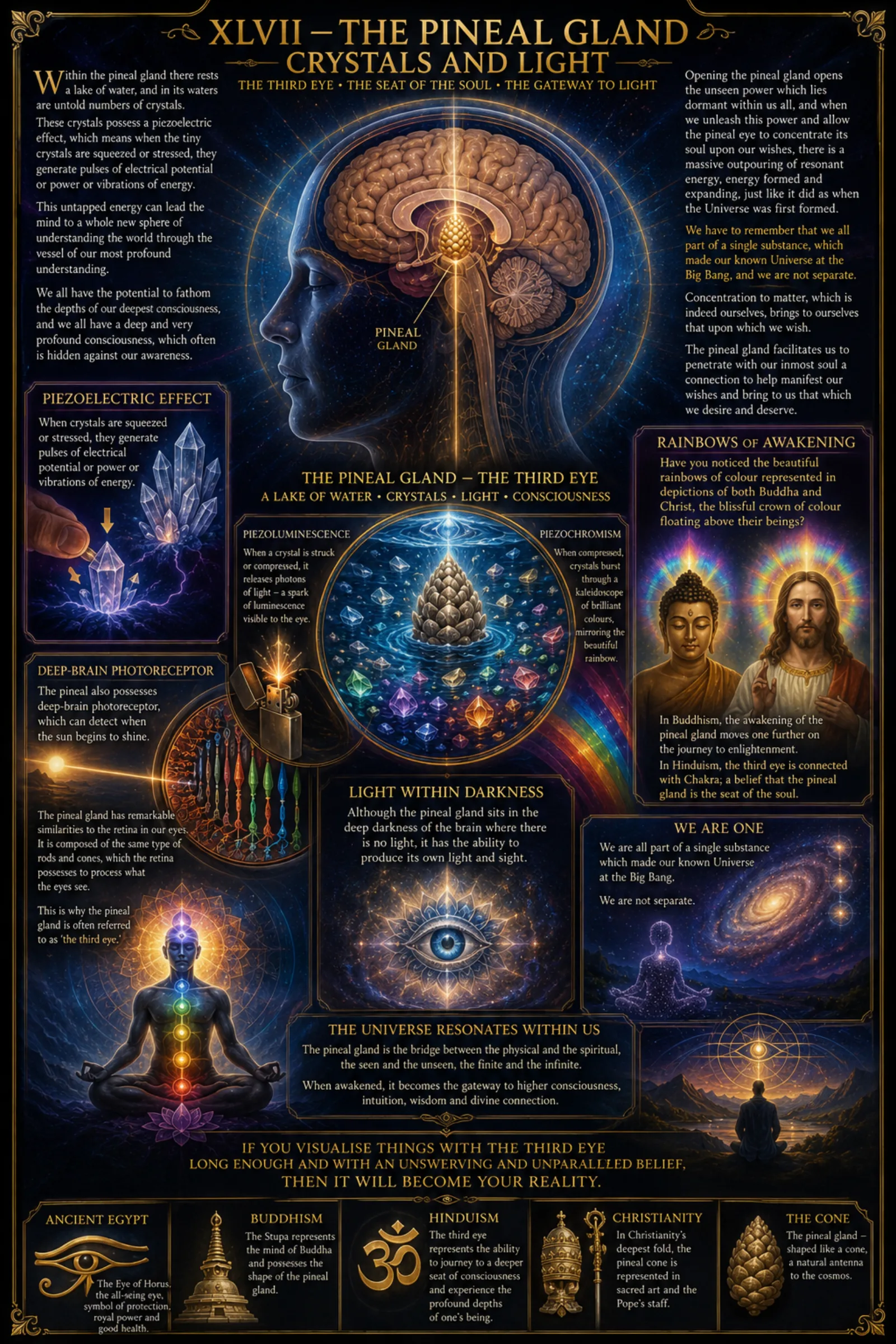
Within the pineal gland there rests a lake of water, and in its waters are untold numbers of crystals. These crystals possess a piezoelectric effect, which means when the tiny crystals are squeezed or stressed, they generate pulses of electrical potential or power or vibrations of energy. This untapped energy can lead the mind to a whole new sphere of understanding the world through the vessel of our most profound understanding. We all have the potential to fathom the depths of our deepest consciousness, and we all have a deep and very profound consciousness, which often is hidden against our awareness. Opening the pineal gland opens the unseen power which lies dormant within us all, and when we unleash this power and allow the pineal eye to concentrate its soul upon our wishes, there is a massive outpouring of resonant energy, energy formed and expanding, just like it did as when the Universe was first formed. We have to remember that we all part of a single substance, which made our known Universe at the Big Bang, and we are not separate. Concentration to matter, which is indeed ourselves, brings to ourselves that upon which we wish. The pineal gland facilitates us to penetrate with our inmost soul a connection to help manifest our wishes and bring to us that which we desire and deserve.
Have you noticed the beautiful rainbows of colour represented in depictions of both Buddha and Christ, the blissful crown of colour floating above their beings? In Buddhism, the awakening of the pineal gland moves one further on the journey to enlightenment. In Hinduism, the third eye is connected with Chakra; a belief that the pineal gland is the seat of the soul.
Accompanying this generation of power, the pineal gland has the ability to produce piezoluminescence, as when a crystal in a common cigarette lighter is struck and compressed, and the crystalline spark of wonderful luminescence is created for our eyes to see. Photons, the most fundamental particles of light, the most visible portion of the electromagnetic spectrum are released.
Furthermore, the pineal lake of water and its fantastic crystals possess the ability of piezochromism, or the skill of the compressed crystals to change and burst through a kaleidoscope of brilliant colours, mirroring the phenomenon of the beautiful rainbow. The pineal also possesses deep-brain photoreceptor, which can detect when the sun begins to shine. The pineal gland has remarkable similarities to the retina in our eyes. It is composed of the same type of rods and cones, which the retina possesses to process what the eyes see. This is why the pineal gland is often referred to as 'the third eye.' Although the pineal gland sits in the deep darkness of the brain where there is no light, it has the ability to produce its own light and sight.
If you visualise things with the third eye long enough and with an unswerving and unparalleled belief, then it will become your reality.
Prefer to listen? Watch the video reading below.
Reader Comments
Leave a Comment
We would love to hear your thoughts on this chapter.

About Karl Swainston
Karl Swainston is a writer and storyteller whose work is forged from a life lived across the North of England and far beyond. Growing up on a Leeds council estate in the 1960s, Karl's journey was anything but linear. By the age of thirty, he had already lived a dozen lives: from the rigors of grammar school to a degree in Latin, a stint as a fishmonger, a period of discovery living in Marseille, and a return to the hustle of London. Whether working as a postman, a builder, or competing as a county-level chess player, he was, above all, an avid reader—constantly documenting the world around him. This restless spirit continued into his professional life. Karl later taught in Bradford, where he ran a specialist unit for 244 of the most excluded students from across the region—young people whom even the local Pupil Referral Units could not accommodate. Working alongside his old friend Malcolm, Karl spent his days navigating the volatility of Bradford's most aggressive and dysfunctional teenagers. Throughout his life, Karl has been an avid runner and has always shared his home with a rotating cast of beloved dogs and cats—companions who have been constant witnesses to his work. As a writer, Karl's range is as expansive as his history. He works across a wide breadth of genres, including fiction and short stories, autobiography and memoir, biography, non-fiction, and metaphysical writing, as well as providing sharp commentary, opinion, analysis, and essays. Whether writing about his years managing the Harrogate Arms or offering insights from his current adopted home in South East India, where he lives in a simple village with his dog, Bambi, Karl's voice reflects the full, untidy, and deeply human breadth of life. He continues to draw on the rich, decades-long tapestry of his experiences to tell stories that matter, proving that no matter where you live, the human story remains the same.
Author Page