Resonance
XLVI — The Pineal Gland
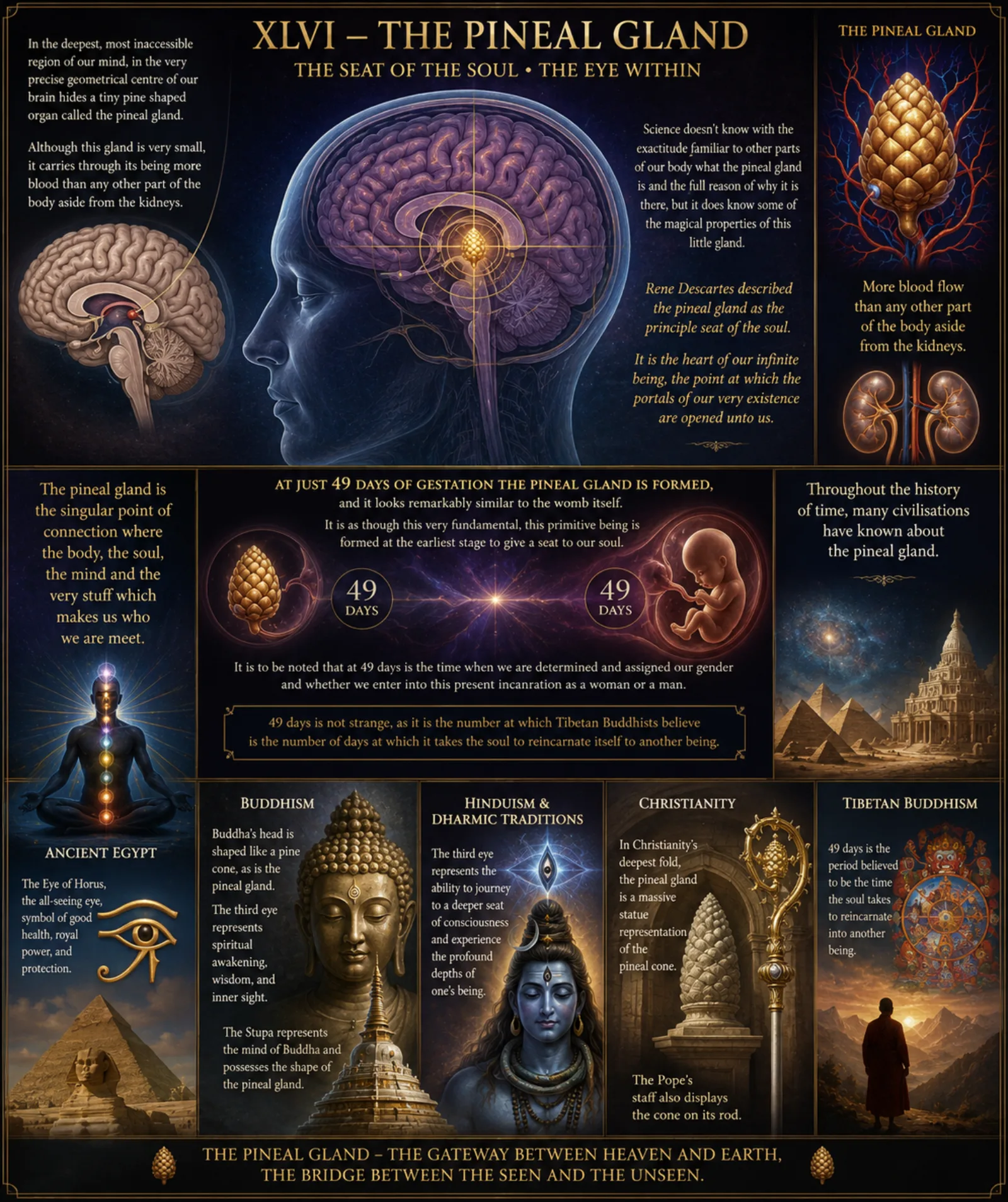
In the deepest, most inaccessible region of our mind, in the very precise geometrical centre of our brain hides a tiny pine shaped organ called the pineal gland. Although this gland is very small, it carries through its being more blood than any other part of the body aside from the kidneys. Science doesn't know with the exactitude familiar to other parts of our body what the pineal gland is and the full reason of why it is there, but it does know some of the magical properties of this little gland.
Rene Descartes described the pineal gland as the principle seat of the soul. It is the heart of our infinite being, the point at which the portals of our very existence are opened unto us.
It remarkable that at just 49 days of gestation the pineal gland is formed, and it looks remarkably similar to the womb itself. It is as though this very fundamental, this primitive being is formed at the earliest stage to give a seat to our soul. It is to be noted that at 49 days is the time when we are determined and assigned our gender and whether we enter into this present incarnation as a woman or a man. 49 days is not strange, as it is the number at which Tibetan Buddhists believe is the number of days at which it takes the soul to reincarnate itself to another being.
The pineal gland is the singular point of connection where the body, the soul, the mind and the very stuff which makes us who we are meet.
Throughout the history of time, many civilisations have known about the pineal gland. The ancient Egyptians represented it as The Eye of Horus, the all-seeing eye, and was the symbol of good health, royal power, and most importantly of protection. In Buddhism, not only are representations of Buddha's head shaped like a pine cone, as is the pineal gland but statues, too, exhibit Buddha's third eye penetrating out and seeing the world outside from the deepest seat within. Buddhists take this to be both the spiritual awakening of knowledge and of its more profound virtue, wisdom. The Stupa represents the mind of Buddha and possesses the shape of the pineal gland, also. In Hinduism and Dharmic traditions, the third eye represents the ability to journey to a deeper seat of consciousness and experience the profound depths of one's being. In Christianity's deepest fold, the pineal gland is a massive statue representation of the pineal cone, and the Pope's staff also displays the cone on its rod.
Prefer to listen? Watch the video reading below.
Reader Comments
Leave a Comment
We would love to hear your thoughts on this chapter.
About Karl Swainston
Karl Swainston is a writer and storyteller whose work is forged from a life lived across the North of England and far beyond. Growing up on a Leeds council estate in the 1960s, Karl's journey was anything but linear. By the age of thirty, he had already lived a dozen lives: from the rigors of grammar school to a degree in Latin, a stint as a fishmonger, a period of discovery living in Marseille, and a return to the hustle of London. Whether working as a postman, a builder, or competing as a county-level chess player, he was, above all, an avid reader—constantly documenting the world around him. This restless spirit continued into his professional life. Karl later taught in Bradford, where he ran a specialist unit for 244 of the most excluded students from across the region—young people whom even the local Pupil Referral Units could not accommodate. Working alongside his old friend Malcolm, Karl spent his days navigating the volatility of Bradford's most aggressive and dysfunctional teenagers. Throughout his life, Karl has been an avid runner and has always shared his home with a rotating cast of beloved dogs and cats—companions who have been constant witnesses to his work. As a writer, Karl's range is as expansive as his history. He works across a wide breadth of genres, including fiction and short stories, autobiography and memoir, biography, non-fiction, and metaphysical writing, as well as providing sharp commentary, opinion, analysis, and essays. Whether writing about his years managing the Harrogate Arms or offering insights from his current adopted home in South East India, where he lives in a simple village with his dog, Bambi, Karl's voice reflects the full, untidy, and deeply human breadth of life. He continues to draw on the rich, decades-long tapestry of his experiences to tell stories that matter, proving that no matter where you live, the human story remains the same.
Author Page