Resonance
XXIII — The Redundancy Story
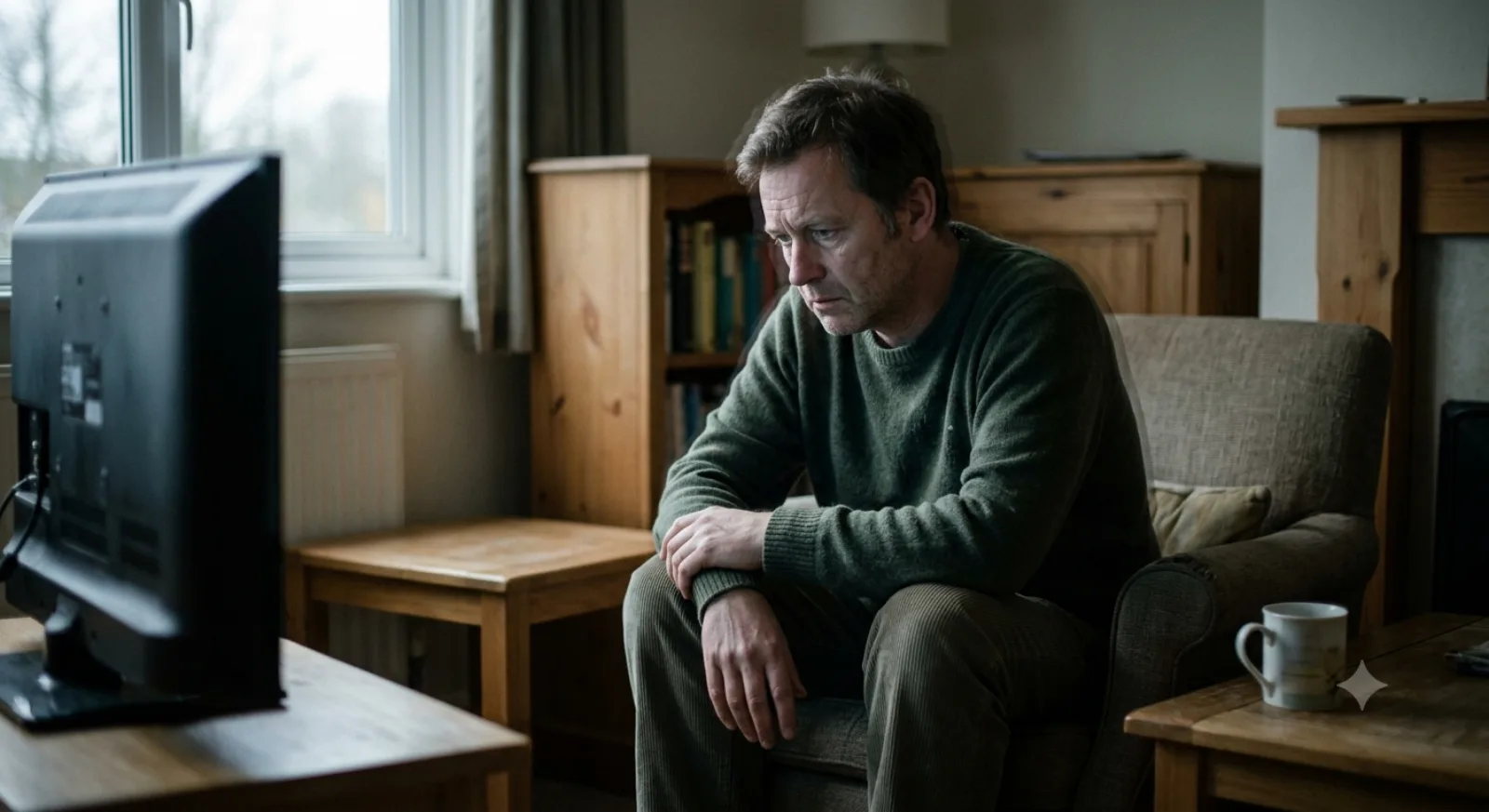
Over the weekend the man declined to go fishing as was his usual recreation on the weekend; he declined to go out with his wife and friends on Saturday evening. But his wife still went out, declaring, 'I'm not staying in on a Saturday night with £3000 in the bank.' On Sunday, the man sat in his house full of despondency, watching the television aimlessly.
All of this was learned afterwards.
On Monday, a car pulled up alongside the road I was walking. It was my friend with his wife and children in the back of the car. He had a smile on his face as big a saucer. He related how his father-in-law had asked a company boss about vacancies in the business the previous day, and he was told there was a job there advertised, which fitted perfectly all the skills of his son-in-law. An interview was set up for the following morning, and he got the job, and it paid more than his old job had done. The wife in the back of the car had the last say, 'I told him not to worry, and that he'd get another job, which he has, and he's missed one hell of a weekend dragging himself around the house.'
Now let us look at the event in detail.
Stress was caused by the sound of, 'You've lost your job.' The pressure, or vibrational pulse, entered the ears and travelled through the whole entirety of his being. This happened in a split second, and always, it could not be resisted, as we have no control over the external circumstance of losing one's job. As each stressful vibration hit his sense, it generated thoughts, and the body had the general inclination first to snatch at the thought of fear and think the worst, so that survival mechanisms of flight or fight may kick in if needed. At this animalistic level, such as being met by a pride of lions on an African plain, maybe life-saving, but on another level, such as losing one's job, it isn't. The problem is that 'thought' and the 'thought of fear' is still present at the first words of uttering, 'You've lost your job,' The vibrational stress has reverberated only a couple of pulses, but fear has intensified the 'strain' - how the body, mind, and whole being becomes deformed from what it was without fear to what it is with fear – the tiniest particles are energised by fear, and, as they do so, they each, in turn, vibrate against other particles, so that in the end the man loses all sight and feeling of the reality around him, and sinks into his own world of despondency, encapsulating within him now not just a few particles of fear, but a whole being affected by fear. The very energy of his body changed, and the outward show was apparent to all.
Prefer to listen? Watch the video reading below.
Reader Comments
Leave a Comment
We would love to hear your thoughts on this chapter.
About Karl Swainston
Karl Swainston is a writer and storyteller whose work is forged from a life lived across the North of England and far beyond. Growing up on a Leeds council estate in the 1960s, Karl's journey was anything but linear. By the age of thirty, he had already lived a dozen lives: from the rigors of grammar school to a degree in Latin, a stint as a fishmonger, a period of discovery living in Marseille, and a return to the hustle of London. Whether working as a postman, a builder, or competing as a county-level chess player, he was, above all, an avid reader—constantly documenting the world around him. This restless spirit continued into his professional life. Karl later taught in Bradford, where he ran a specialist unit for 244 of the most excluded students from across the region—young people whom even the local Pupil Referral Units could not accommodate. Working alongside his old friend Malcolm, Karl spent his days navigating the volatility of Bradford's most aggressive and dysfunctional teenagers. Throughout his life, Karl has been an avid runner and has always shared his home with a rotating cast of beloved dogs and cats—companions who have been constant witnesses to his work. As a writer, Karl's range is as expansive as his history. He works across a wide breadth of genres, including fiction and short stories, autobiography and memoir, biography, non-fiction, and metaphysical writing, as well as providing sharp commentary, opinion, analysis, and essays. Whether writing about his years managing the Harrogate Arms or offering insights from his current adopted home in South East India, where he lives in a simple village with his dog, Bambi, Karl's voice reflects the full, untidy, and deeply human breadth of life. He continues to draw on the rich, decades-long tapestry of his experiences to tell stories that matter, proving that no matter where you live, the human story remains the same.
Author Page