Resonance
XXIV — The Wife's Wisdom
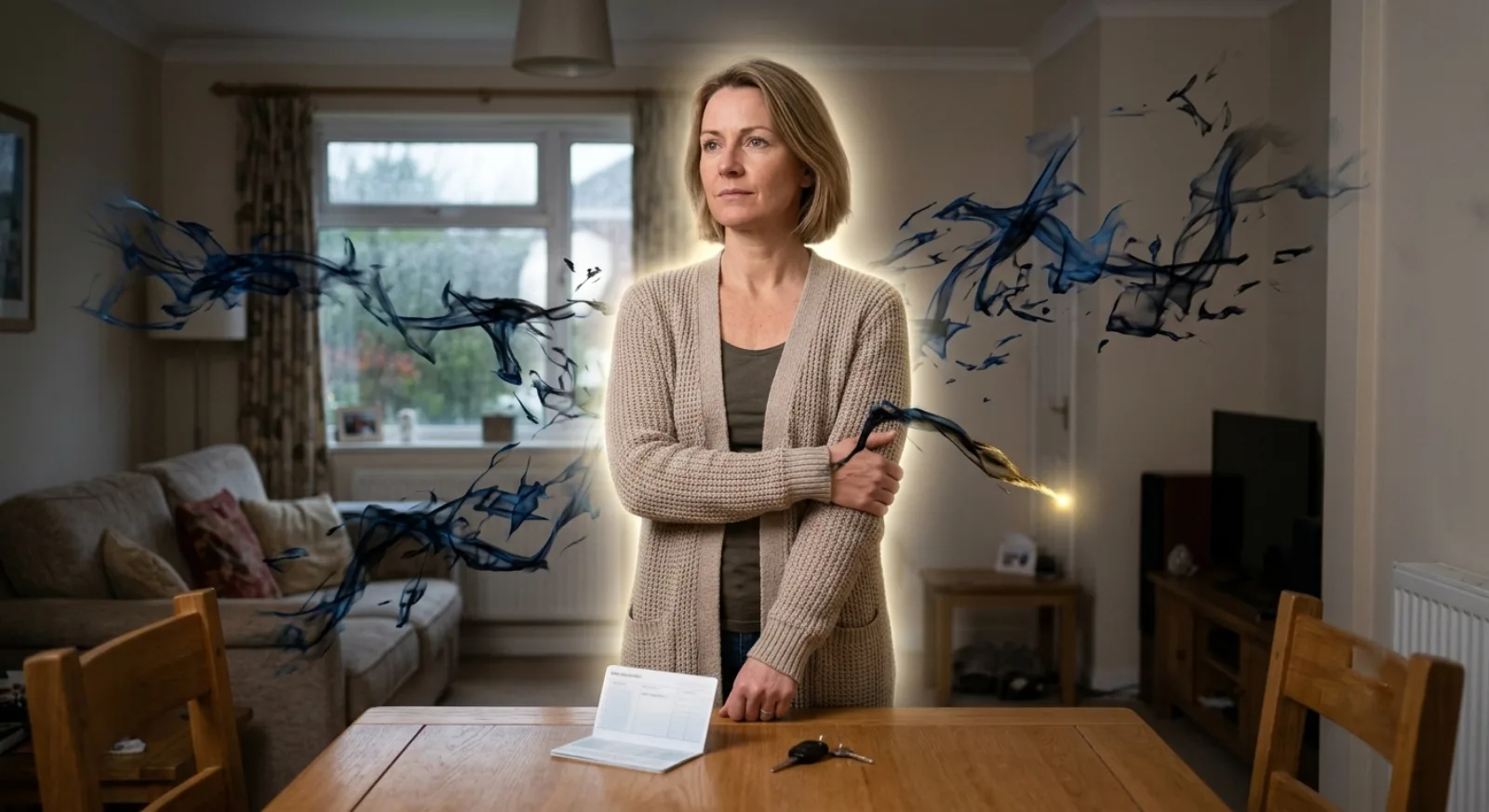
Now, with the wife, the very same process of 'stress' is delivered, and she, too, cannot resist this intrusion and penetration striking upon her energy of being. Like her husband, she too has the inclination to snatch at fear, but rather than let it travel through to the heart and open more avenues and energies of fear to fester, she says, 'No.' She realises in the very first instance, maybe unwittingly, that it isn't a 'fight or flight' attack, but mere 'stress' brought about as a consequence of everyday living in the modern world. Her subconscious being realises that 'stress' is but a mere vibrational energy arriving to apply pressure upon her being. She did not allow the 'strain' in vibration to make any effect, any deformation in mind and body, and before it gained hold of all the avenues and pulses of her being, she had banished the lot of them, and in their place beat only the tiniest particles of strong and vibrant energy, the energy which said, 'I'm not staying in on a Saturday night with £3000 in the bank.'
She was like the trampoline's membrane facing the stress, and although she bent but a little because of the external pressure of him being made redundant (stress), she didn't admit to the strain breaking her, and merely sent the vibration back, 'to the bog from whence it came,' as the Aesop fable saying goes.
Shakespeare wrote:
'When remedies are past, the griefs are ended By seeing the worst, which late on hopes depended. To mourn a mischief that is past and gone Is the next way to draw new mischief on.'
There was no 'remedy' for the lost job. The job was doomed, gone, and could not be saved. The man had to realise that 'this' was the past, and mourning the loss of it will only bring new miseries and new mischiefs on.
Our negative emotions are often the authors of our own ailments and diseases. Our thoughts are the creators of our behaviour, and our behavioural patterns compound similar patterns and vibrations of the negative, which they draw from the Universal well of life, and the result is that we bring on voluntary suffering; we are the volunteer victims of our own ill health. They may be hard to digest, and to most, it is impenetrable to both their understanding of life and their empiricism of life; they will not allow such a thought as they are committing the crime against themselves.
When you feel a negative emotion, a contrast in your vibration is created, and this is not a harmonious emotion or vibration, as it is not your soul and is alien, because your soul is positive and beautiful creation in this life. This harsh dissonance brings on, within the fleeting passing of a second, disharmony, and you can feel this disharmony.
Prefer to listen? Watch the video reading below.
Reader Comments
Leave a Comment
We would love to hear your thoughts on this chapter.
About Karl Swainston
Karl Swainston is a writer and storyteller whose work is forged from a life lived across the North of England and far beyond. Growing up on a Leeds council estate in the 1960s, Karl's journey was anything but linear. By the age of thirty, he had already lived a dozen lives: from the rigors of grammar school to a degree in Latin, a stint as a fishmonger, a period of discovery living in Marseille, and a return to the hustle of London. Whether working as a postman, a builder, or competing as a county-level chess player, he was, above all, an avid reader—constantly documenting the world around him. This restless spirit continued into his professional life. Karl later taught in Bradford, where he ran a specialist unit for 244 of the most excluded students from across the region—young people whom even the local Pupil Referral Units could not accommodate. Working alongside his old friend Malcolm, Karl spent his days navigating the volatility of Bradford's most aggressive and dysfunctional teenagers. Throughout his life, Karl has been an avid runner and has always shared his home with a rotating cast of beloved dogs and cats—companions who have been constant witnesses to his work. As a writer, Karl's range is as expansive as his history. He works across a wide breadth of genres, including fiction and short stories, autobiography and memoir, biography, non-fiction, and metaphysical writing, as well as providing sharp commentary, opinion, analysis, and essays. Whether writing about his years managing the Harrogate Arms or offering insights from his current adopted home in South East India, where he lives in a simple village with his dog, Bambi, Karl's voice reflects the full, untidy, and deeply human breadth of life. He continues to draw on the rich, decades-long tapestry of his experiences to tell stories that matter, proving that no matter where you live, the human story remains the same.
Author Page